Best Prenatal Vitamins: A Label-by-Label Guide
Table of Contents
- What nutrient numbers should you check on the best prenatal vitamins?
- What should the best prenatal vitamins contain?
- How should you take prenatal vitamins with meals and medications?
- Who should skip a standard prenatal or get an individual plan?
- How do four of the best prenatal vitamins compare?
- Which prenatal fits your routine, and who should pass?
- What should you ask your OB before choosing a prenatal?
- How can you tell whether your prenatal routine is working?
- Where can you read more about individual prenatal nutrients?
- FAQs
In this fictional example, Elise Navarro, a 38-year-old civil engineer, turns two prenatal bottles sideways on her kitchen counter while a yellow tape measure holds her appointment notes flat. “Why does one say three capsules and the other say two?” she asks her partner, who has been comparing the price on the front rather than the serving on the back. Her pharmacist has suggested bringing the labels to her preconception visit, so Elise writes three questions beside them: which folate form, how much iron, and where does DHA come from? That is a more useful way to shop for the best prenatal vitamins than hunting for “the strongest prenatal.”
Quick answer: The best prenatal vitamins depend on your nutrient plan: Pure Encapsulations® offers two-capsule dosing; Metagenics® includes choline and DHA; Thorne® supplies higher iron; Xymogen® combines two folate forms. Confirm the choice with your OB, start before conception when possible, and take the full label serving without stacking prenatal formulas.
Clinical review pending — Holistic Health Partners
What nutrient numbers should you check on the best prenatal vitamins?
Start with five lines on the Supplement Facts panel: folate, iron, choline, DHA, and the number of capsules in one serving. The best prenatal vitamins are the ones whose numbers fit your diet and your OB’s plan, so compare each label against these pregnancy reference points.
| What to check | Useful starting point | What it means for your choice |
|---|---|---|
| Folate | 600 mcg dietary folate equivalents (DFE) daily during pregnancy | Read the form and units. DFE is not the same measurement as mcg of folic acid. |
| Folic acid before conception | ACOG advises a prenatal with at least 400 mcg, starting at least one month before pregnancy | If your prenatal uses methylfolate instead, discuss your folic-acid plan with your OB. |
| Iron | 27 mg daily during pregnancy | This is a total-intake reference, not an instruction to add 27 mg to your prenatal. |
| Choline | 450 mg daily during pregnancy | Count food plus supplements; a prenatal may contribute only part of this amount. |
| DHA and seafood | Check DHA on the label; ACOG recommends 8–12 ounces of lower-mercury seafood weekly | A multivitamin capsule is not automatically an omega-3 supplement. |
Sources: NIH ODS folate guidance, NIH ODS choline guidance, and ACOG’s pregnancy nutrition guidance. These are nutrition references, not endorsements of the products below.
What should the best prenatal vitamins contain?
The best prenatal vitamins support the increased nutrient needs of pregnancy while leaving room for food and an individualized care plan. Folate, iron, iodine, vitamin D, choline, and DHA deserve separate attention because a bottle can be generous in one and contain little or none of another.
Folate supports normal cell division and DNA production. Iron helps make hemoglobin, which carries oxygen; iodine supports normal thyroid hormone production, and vitamin D supports calcium use and bone health. Choline contributes to cell membranes and normal brain development, while DHA is an omega-3 fat involved in brain and eye structure. A prenatal does not replace protein, fiber, or a varied diet.
Folate: why do the units and forms matter?
“1,000 mcg DFE” does not mean “1,000 mcg folic acid.” DFE stands for dietary folate equivalents, a label unit that accounts for differences in folate availability. Look for both the DFE amount and the ingredient in parentheses: folic acid, L-5-methyltetrahydrofolate, or another specified form.
NIH ODS recommends 400 mcg of folic acid daily for people who could become pregnant, in addition to food folate. That recommendation specifically names folic acid, including for those with an MTHFR C677T variant. A higher methylfolate number should not be treated as permission to disregard it; have your OB review the complete plan before switching forms or adding another supplement.
A randomized trial in 60 pregnant participants compared 0.6 mg daily of folic acid with 5-MTHF over 16 weeks. Red-blood-cell and serum folate did not differ significantly between groups after 16 weeks. That helps explain why many of the best prenatal vitamins use methylfolate, but it does not establish that one branded prenatal is better or that the forms are interchangeable for every clinical goal.
Iron: should the biggest number win?
No. The pregnancy reference intake is 27 mg of iron daily, but the right supplemental amount depends on food intake, blood tests, tolerability, and your clinician’s instructions. When you compare the best prenatal vitamins, more iron can mean more stomach discomfort or constipation, not necessarily a better fit. An iron-containing prenatal and a separate iron product should be reviewed together.
Choline and DHA: what can a multivitamin leave out?
Check these lines even when the front says “complete.” Choline is bulky, and DHA is an oil, so even the best prenatal vitamins in capsule-only form may leave you relying on food or a separately planned product. Eggs, meat, fish, dairy, and soy foods can contribute choline; the goal is the whole day’s intake, not forcing every nutrient into one bottle.
Human choline research is promising but not a reason to self-prescribe a high dose. A small controlled-feeding trial found faster infant information processing with total choline intakes of 930 versus 480 mg daily during the third trimester. A larger randomized trial did not find improvements in the infant cognitive measures it tested. These are ingredient studies, not trials of the prenatals in this guide. Start with the established intake target and your diet, rather than copying a research dose.
How should you take prenatal vitamins with meals and medications?
Follow the directions for the exact product and count the entire daily serving; even the best prenatal vitamins only deliver their labeled amounts at the full dose. Thorne and Pure explicitly direct use with food; the Metagenics and Xymogen directions below specify a daily amount without a meal requirement.
| Product | Label directions | Timing question to ask |
|---|---|---|
| Thorne Basic Prenatal | 3 capsules daily with food, or as recommended by your healthcare practitioner | Would taking the serving with your most reliable meal improve tolerability? |
| Pure PreNatal Nutrients | 2 capsules daily with a meal | Which meal fits your medication schedule? |
| Metagenics Plus One | 1 packet daily, or as directed by your healthcare practitioner | If seven pills are difficult together, how should your clinician arrange them? |
| Xymogen Prenatal Essentials | 5 capsules daily, or as directed by your healthcare professional | Would a clinician-approved divided schedule help you take the full serving? |
Do not treat one capsule as the full dose when the label calls for two, three, or five. If you miss a dose, check the product instructions or ask your pharmacist rather than doubling automatically. Taking a prenatal at bedtime is not inherently better than breakfast; the useful routine is one that respects your label, medicines, and stomach.
Who should skip a standard prenatal or get an individual plan?
People with a clinician-prescribed nutrient regimen, iron restrictions, significant food allergies, or difficulty absorbing nutrients should not pick from a list of the best prenatal vitamins by comparison table alone. A prenatal should fit an existing care plan—not quietly replace it.
- You have been told to avoid supplemental iron: check every formula’s iron amount before buying. “Prenatal” does not mean iron-free, and constipation is not a reliable guide to your iron status.
- You take thyroid medicine or other prescriptions: ask your pharmacist about separating mineral-containing supplements from your medicine. Bring the full label and medication list rather than assuming breakfast is the right time for everything.
- You follow a vegan diet or avoid fish: inspect both the nutrient sources and capsule ingredients. A plant-based capsule does not establish that every ingredient is vegan, and fish-derived DHA may not fit your diet.
- You have a previous pregnancy complication or have been prescribed a special folic-acid dose: keep that individualized plan with your obstetric team. Do not substitute a higher-DFE methylfolate product on your own.
- You have had bariatric surgery or have ongoing absorption concerns: an ordinary serving may not match your requirements. Ask for a tailored nutrition and laboratory plan.
- You are not pregnant, trying to conceive, or following a postpartum plan: do not choose a prenatal simply because it seems stronger. Your iron and other nutrient needs may be different.
NIH ODS discusses individual nutrition considerations during pregnancy, including vegetarian diets and pregnancy after bariatric surgery. Pregnancy after 35 also deserves coordinated care, but age alone is not a reason to double a serving. Keep all iron-containing supplements out of children’s reach; accidental overdose requires urgent medical help.
How do four of the best prenatal vitamins compare?
Pure Encapsulations has the lowest daily pill count in this comparison; Metagenics includes both a full 450 mg choline contribution and DHA in its packet. Thorne has the highest iron amount, while Xymogen combines two folate forms and provides 200 mg choline without DHA.
The table compares the full labeled daily serving, not one pill. These four of the best prenatal vitamins are sold on Covenant Health Products; this is a label-based comparison, not a head-to-head clinical trial or a ranking of every prenatal on the market.
| Product and daily serving | Folate form and amount | Iron | Choline | DHA included? | Package and days of supply | Best fit to discuss |
|---|---|---|---|---|---|---|
| Thorne Basic Prenatal 3 capsules | L-5-MTHF, glucosamine salt 1,700 mcg DFE (1,000 mcg L-5-MTHF) | 45 mg | 110 mg | No DHA listed | 90 capsules; 30 days | OB-directed higher-iron plan |
| Pure Encapsulations PreNatal Nutrients 2 capsules | Metafolin L-5-MTHF 1,667 mcg DFE (1,000 mcg L-5-MTHF) | 27 mg | 100 mg | No DHA listed | 60 capsules: 30 days 120 capsules: 60 days | Fewer capsules; separate DHA planning |
| Metagenics Plus One Daily Prenatal 1 packet: 5 capsules + 2 softgels | Calcium L-5-MTHF 1,700 mcg DFE* (1,000 mcg methylfolate per manufacturer) | 30 mg | 450 mg | Yes: 1,000 mg | 30 packets; 30 days | Packet with choline and DHA |
| Xymogen Prenatal Essentials 5 capsules | Quatrefolic 5-MTHF + calcium folinate 1,360 mcg DFE Individual form amounts not listed | 30 mg | 200 mg | No DHA listed | 150 capsules; 30 days | Two folate forms; no DHA |
Online labels checked October 28, 2026; formulas can change. Compare the bottle you receive and follow each product link for current product information. Pure has two selectable bottle sizes: 60 and 120 capsules. Xymogen’s 150-capsule formula is not its legacy packet product.
*The CHP Metagenics description lists 1,665 mcg DFE; the current manufacturer label lists 1,700 mcg DFE, used here. This discrepancy does not by itself establish a formula change. Other label cross-checks: Thorne, Pure Encapsulations, and Xymogen.
Which prenatal fits your routine, and who should pass?
Choose by the combination of nutrient needs and daily routine; there is no single winner among the best prenatal vitamins for everyone. Each option has a useful distinction and a reason it might not fit you.
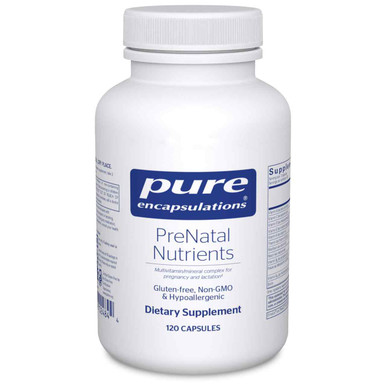
Pure Encapsulations: fewer capsules, with separate choline and DHA planning
PreNatal Nutrients is worth discussing if swallowing fewer capsules matters: its full serving is two daily. It provides 27 mg iron and 100 mg choline, with methylfolate as its folate source. The larger 120-capsule bottle supplies 60 daily servings at the labeled dose.
Who should pass or reconsider: someone seeking a single product that also supplies DHA and the full pregnancy choline target. Neither is covered that way here. It also is not an iron-free choice. Do not assume a simpler pill count means you can skip reviewing the rest of your diet.
PreNatal Nutrients
$32.00
PreNatal Nutrients by Pure Encapsulations – Pregnancy Nutrient Support PreNatal Nutrients by Pure Encapsulations is a vegan capsule multivitamin and mineral complex for women of… Click here to read more
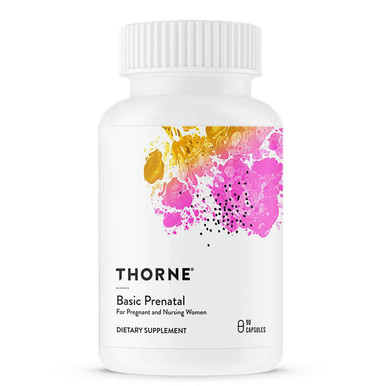
Thorne: a three-capsule option with higher iron
Basic Prenatal provides 45 mg iron in a three-capsule serving, compared with 27–30 mg in the other options here. It may fit an OB-directed plan that specifically calls for this amount, alongside its methylfolate and 110 mg choline.
Who should pass or reconsider: someone avoiding higher supplemental iron or already taking separate iron without coordinated advice. The adult upper intake level is 45 mg daily from all sources; this serving reaches that amount before food. Clinicians may prescribe different amounts for individual needs, but “more iron” is not a general reason to choose it. DHA still needs separate consideration.
Basic Prenatal 90c
$37.00
Basic Prenatal 90c by Thorne – Maternal Nutrition Prenatal Multivitamin Thorne Basic Prenatal is a prenatal multivitamin in capsule form for women preparing for pregnancy,… Click here to read more
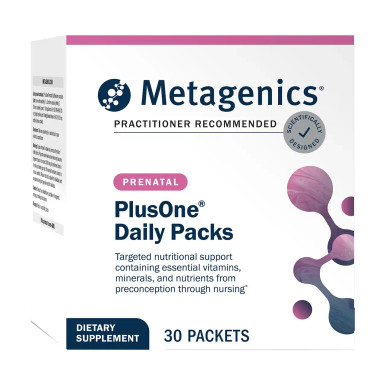
Metagenics: choline and DHA together, with more pills
Plus One Daily Prenatal includes 450 mg choline and 1,000 mg DHA in one organized daily packet. That can simplify managing several bottles when those amounts fit your clinician’s plan—but one packet contains seven pills, not one.
Who should pass or reconsider: someone avoiding fish or calamari ingredients, following a vegan diet, or struggling with a seven-pill routine. The packet includes marine oils and gelatin. Its DHA amount is a product-label fact, not a recommendation that everyone needs that supplemental dose. Review existing fish oil before adding it.
Plus One Daily Prenatal 30pkt
$94.95
PlusOne Daily Prenatal 30 pkt by Metagenics PlusOne Daily Prenatal Packs by Metagenics provide comprehensive supplements to nutritionally support women, featuring vitamins, minerals, and phytonutrients,… Click here to read more
Xymogen: two folate forms and an intermediate choline amount
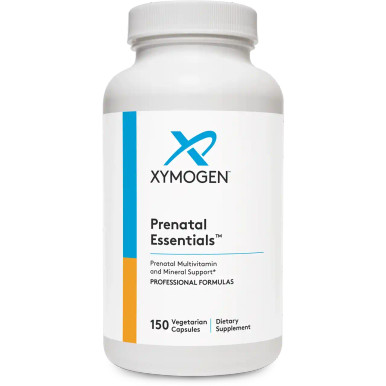
Prenatal Essentials 150 capsules combines 5-MTHF with calcium folinate and provides 200 mg choline. It may fit someone whose clinician prefers that formulation and who is comfortable with five capsules daily.
Who should pass or reconsider: someone who wants fewer pills or expects a DHA softgel in the bottle. The current 150-capsule product does not include DHA. Its label gives total folate in DFE, but does not disclose the individual microgram amounts of the two forms; do not infer those amounts from the DFE number.
Prenatal Essentials 150c
$67.99
Prenatal Essentials™ by Xymogen – Nutritional Support Before and During Pregnancy Planning for a baby brings plenty of decisions. Prenatal Essentials™ offers a practical starting… Click here to read more
What should you ask your OB before choosing a prenatal?
Bring photographs of the Supplement Facts panel, the directions, and every other supplement you use. Before you settle on one of the best prenatal vitamins, ask your OB to check the complete daily amounts and the gaps, not just approve a brand name.
- “Does this folate form fit my plan?” Point to the actual ingredient and both the mcg and DFE values. Mention any folic-acid dose your fertility or obstetric clinician has already recommended.
- “How much supplemental iron do I need?” Ask whether your current blood tests and diet support this amount, and what to do if it causes digestive trouble.
- “Where will my choline and DHA come from?” Describe what you actually eat, especially eggs, soy foods, fish, and dairy. A realistic food plan is more useful than buying an extra supplement automatically.
- “What should I stop taking?” Include your regular multivitamin, fertility blend, separate vitamin D, and hair-and-nail supplements. Removing overlap may be the most useful change.
- “What timing works with my medicines?” Check whether meals, calcium supplements, or prescriptions change the schedule. Agree on a routine you can follow even on a nauseated morning.
How can you tell whether your prenatal routine is working?
Look first at consistent use, tolerability, and whether the regimen matches your clinician’s nutrition plan—not at whether you feel an immediate boost. Even the best prenatal vitamins support daily nutrient intake; they are not a test of pregnancy health or a substitute for routine appointments.
There is no universal “results in two weeks” timeline. If your clinician is monitoring a nutrient concern, ask when to repeat the relevant tests and whether your dose should change. If the bottle is lasting twice as long as expected because you take half a serving, raise that practical problem at your next visit rather than assuming the printed amounts still apply.
Bottom line: Discuss Pure for fewer capsules, Metagenics for an organized choline-and-DHA packet, Thorne when its higher iron fits your care plan, and Xymogen when its two-form folate formulation fits. Compare full-day costs and needed add-ons—not bottle price alone. The best prenatal vitamins for you are the regimen your OB approves and you can consistently take.
Where can you read more about individual prenatal nutrients?
For background on individual nutrients—not instructions to add them to a prenatal—see:
- Our overview of iron supplementation and Pure Encapsulations Iron Liquid.
- Vitamin D in winter and Pure Encapsulations D3 Liquid.
Use pregnancy-specific advice from your obstetric team when reading general supplement articles.
FAQs
When should I start taking prenatal vitamins?
Plan before conception when possible. ACOG recommends a daily prenatal containing at least 400 mcg of folic acid starting at least one month before pregnancy and during the first 12 weeks. If you are already pregnant, discuss your current supplement with your obstetric clinician now rather than waiting for the perfect product. If the formula uses methylfolate instead of folic acid, ask how it fits your clinician’s folic-acid recommendation.
Is methylfolate better than folic acid in a prenatal?
Not automatically. Both can support folate status, but the public-health recommendation before conception specifically names folic acid. A small randomized pregnancy trial found similar blood folate status with 5-MTHF and folic acid; it did not establish a universally superior prenatal. Bring the exact form and amount on your label to your OB, especially if you have been told to follow a particular folic-acid regimen.
Does my prenatal cover all of my choline and DHA needs?
Do not assume it does. Look for a separate choline line and a DHA amount, not simply “omega-3” or “fish oil.” Pregnancy’s choline intake target is 450 mg daily from food and supplements combined. Some prenatals provide only a small contribution, and capsule-only multivitamins may not include DHA. Review your eggs, soy foods, fish intake, dietary restrictions, and label with your clinician before adding another bottle.
Can I take a prenatal together with my regular multivitamin?
Usually the practical approach is to use one planned multivitamin regimen, not stack two. Combining them can duplicate iron, folate, vitamin A, vitamin D, and B vitamins. Bring all supplements—including fertility blends, hair-and-nail products, and separate iron—to your OB or pharmacist. Add single nutrients only when there is a clear reason and a coordinated dose.
What if my prenatal makes me nauseated or constipated?
Check whether the label directs you to take it with food, and ask your clinician about timing, dividing the daily serving, or a different formulation. Iron can contribute to digestive discomfort. Do not simply take fewer capsules indefinitely: that reduces all the nutrients in the serving. Contact your obstetric team if vomiting keeps you from holding down fluids, food, or your prescribed supplements.
Do I need a stronger prenatal because I am over 35?
Age alone does not tell you which bottle or dose is right. Your diet, medications, laboratory results, pregnancy history, and prenatal care plan matter more than choosing the largest nutrient numbers. If you are working with a fertility specialist or have an individualized pregnancy plan, have that team review the exact label. A prenatal is nutritional support, not a fertility treatment or a replacement for obstetric care.
Not sure which prenatal fits your plan?
Holistic Health Partners, led by Carolyn Mulally BS, RN, HN-BC, offers complimentary 15-minute consultations for questions about a specific product. Book a time to ask about a prenatal label; have your OB review your complete supplement regimen.
Get a Free Consultation
These statements have not been evaluated by the Food and Drug Administration. These products are not intended to diagnose, treat, cure, or prevent any disease.