Reacted Magnesium and Potassium: Dose, Uses & Safety
Table of Contents
- What is Reacted Magnesium and Potassium?
- Why pair magnesium with potassium in one capsule?
- Why is there only 85 mg of potassium per serving?
- What does the magnesium in Reacted Magnesium and Potassium do?
- How do you take Reacted Magnesium and Potassium?
- Who should take Reacted Magnesium and Potassium, and who should be cautious?
- How does Reacted Magnesium and Potassium compare to Reacted Magnesium and drugstore minerals?
- Is Reacted Magnesium and Potassium safe, and are there side effects?
- Is Reacted Magnesium and Potassium worth it?
- FAQs
Quick answer: Reacted Magnesium and Potassium is Ortho Molecular's two-mineral capsule: each 2-capsule serving gives you 170 mg of magnesium (as dimagnesium malate and TRAACS® magnesium lysinate glycinate chelate) and 85 mg of potassium (as potassium glycinate complex). The label dose is 1–2 capsules three times a day, which works out to 255–510 mg of magnesium. It's meant for adults whose practitioner wants both electrolytes topped up for heart, muscle and nerve support, often people on a diuretic their prescriber is already monitoring.
Reviewed by the clinical team at Holistic Health Partners
The note was stapled to the front of the intake form, in pharmacist's block capitals on the back of a receipt: HCTZ 3 YRS + LEG CRAMPS. ASK ABOUT MG/K. ASK PRESCRIBER FIRST.
Teodora Lindqvist, 52, directs the marching band at a high school outside Dayton. In August that means band camp, and band camp means the tower: a twelve-foot scaffold on the fifty-yard line where she stands with a megaphone and watches 140 teenagers try to make a straight line. Three times that summer, halfway up the ladder, her right calf locked so hard she had to hook an elbow through a rung and wait it out while the drumline pretended not to watch.
“I thought it was just August,” she told us. “Then I mentioned it to my pharmacist, mostly as a joke, and he stopped joking.”
What he'd noticed was the hydrochlorothiazide. Teddie had taken it for three years for her blood pressure, and thiazide diuretics increase how much magnesium and potassium leave through the urine. A month of sweating through a polo shirt on a football field doesn't help either.
Our part was mostly putting things in order. She called her prescriber first, who ran a metabolic panel with a magnesium level: potassium at the low end of normal, magnesium the same. With her prescriber's okay, we went through the label with her (two capsules twice a day with meals, which is 340 mg of magnesium and 170 mg of potassium) and explained why the potassium number is so small. She asked whether she should just eat more bananas. We said yes, that too.
The six-week recheck came back with both numbers sitting more comfortably in the middle. Teddie's own report was more careful than the labs: one tower cramp since Labor Day, and she isn't sure whether to credit the capsules, the cooler mornings, or the gallon jug of water she now hauls up the ladder. She's keeping all three.
If you take a water pill, sweat for a living, or keep getting stopped halfway up your own version of that tower, here's what's in the bottle Teddie's pharmacist pointed her toward, and what it can and can't do.
Reacted Magnesium & Potassium - 60 CT
$32.70
Reacted Magnesium & Potassium by Ortho Molecular Products – Cardiovascular and Muscle Support Reacted Magnesium & Potassium by Ortho Molecular Products is a professional-strength mineral… Click here to read more
What is Reacted Magnesium and Potassium?
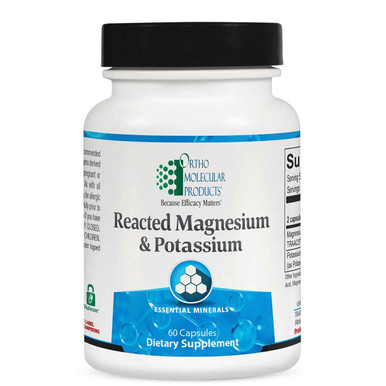
It's a vegetable-capsule mineral formula from Ortho Molecular Products that pairs 170 mg of magnesium with 85 mg of potassium in every 2-capsule serving, or 85 mg of magnesium and 42.5 mg of potassium per capsule. The name comes from the way the minerals are “reacted” with organic acids and amino acids rather than sold as plain mineral salts like magnesium oxide.
The magnesium comes from two sources. Dimagnesium malate is magnesium bound to malic acid, the compound that gives apples their tartness. TRAACS® magnesium lysinate glycinate chelate is an Albion Laboratories chelate in which magnesium is bound to the amino acids lysine and glycine. The potassium is a potassium glycinate complex. The rest of the capsule is natural vegetable capsule, microcrystalline cellulose, stearic acid, magnesium stearate and silicon dioxide, with no gluten, yeast, or artificial colors or flavors.
Reacted Magnesium and Potassium is the two-mineral sibling of Ortho Molecular's Reacted Magnesium, which leaves out the potassium and adds magnesium citrate. Ortho Molecular sells only through licensed practitioners, and at Covenant it's a clinic-access product: you register (free) before ordering.
Why pair magnesium with potassium in one capsule?
Because the two tend to run low together, and potassium is hard to hold onto when magnesium is short. A 2007 review in the Journal of the American Society of Nephrology describes magnesium deficiency as frequently found alongside low potassium, making it worse and harder to correct with potassium alone. The mechanism sits in the kidney: when magnesium inside cells drops, it releases a brake on the ROMK channels that secrete potassium, so more potassium ends up in the urine. The NIH Office of Dietary Supplements potassium fact sheet makes the same point: magnesium depletion can contribute to low potassium by increasing urinary losses.
The same prescriptions also pull on both. Long-term use of loop diuretics such as furosemide and thiazide diuretics such as hydrochlorothiazide can increase magnesium loss in the urine, according to the NIH magnesium fact sheet, and experts recommend monitoring potassium in people on these drugs and supplementing when warranted. That's Teddie's situation exactly. One fair caveat from the review: low magnesium on its own doesn't necessarily cause low potassium. It mostly makes an existing potassium drain worse.
Why is there only 85 mg of potassium per serving?
Because most potassium supplements stop under 100 mg a serving. The NIH notes that many manufacturers limit potassium to 99 mg per product serving, about 2% of the Daily Value, because of two safety concerns tied to potassium-containing drugs. Reacted Magnesium and Potassium sits just under that line at 85 mg.
Put that next to what you actually need. The adequate intake for adults is 3,400 mg a day for men and 2,600 mg for women. Even the top label dose of six capsules supplies 255 mg, a little more than the 229 mg in half a cup of cooked broccoli. So the potassium here is a top-up that keeps the two minerals together. It isn't a repair for a real potassium shortfall.
If your labs show genuinely low potassium, that's a prescription conversation. Prescription potassium chloride tablets commonly come in 8, 10 or 20 mEq strengths, roughly 310 to 780 mg each, and they're dosed and monitored by your prescriber. Don't try to close that gap with extra capsules: you'd run into the magnesium ceiling long before the potassium made a difference.
What does the magnesium in Reacted Magnesium and Potassium do?
Magnesium is a working part of more than 300 enzyme systems, including the ones behind energy production, muscle contraction and relaxation, nerve signaling, glucose metabolism and the tone of your blood vessels. One 2-capsule serving gives you 170 mg, about 40% of the 420 mg Daily Value. Plenty of people fall short from food alone: a national survey analysis cited by the NIH found that 48% of Americans take in less magnesium from food and drinks than their estimated requirement, with men over 70 among the most likely to run low.
Magnesium, potassium and blood pressure
The effect is real but small. A 2016 meta-analysis in Hypertension pooled 34 double-blind, placebo-controlled trials with 2,028 adults. Magnesium at a median dose of 368 mg a day for a median of three months lowered systolic blood pressure by 2.00 mm Hg and diastolic by 1.78 mm Hg compared with placebo. Two capsules twice a day (340 mg) lands right in that range. Potassium has its own long track record here: a 2024 review of potassium intake and human health notes that several studies find an inverse relationship between potassium intake and blood pressure, and that potassium-rich diets are linked to better cardiovascular outcomes. Those studies are about food-level intakes measured in thousands of milligrams, though, not the 85 mg in a serving. This is support for blood pressure that's already in the normal range, not a substitute for blood pressure medication.
Will it stop muscle cramps?
For ordinary nighttime leg cramps, probably not, and it's worth saying plainly. A 2020 Cochrane review of magnesium for skeletal muscle cramps found that in older adults with cramps of no known cause, mostly nocturnal leg cramps, the differences between magnesium and placebo in cramp frequency were small and not statistically significant. The authors concluded magnesium is unlikely to offer clinically meaningful cramp prevention in that group.
The case for this formula is narrower. Muscle cramps are one of the recognized signs of magnesium deficiency, and people with a clear reason to be losing magnesium and potassium, such as a diuretic, long-term acid-blocker use or heavy sweating, are the ones for whom correcting low levels makes sense. If your cramps come with none of those, a mineral capsule is a long shot, and new or worsening cramps deserve a visit with your provider.
Why the chelated and malate forms?
Because magnesium oxide, the form in many inexpensive tablets, absorbs poorly. In a study of US commercial magnesium preparations, magnesium oxide showed a fractional absorption of about 4%, while magnesium chloride, lactate and aspartate were absorbed significantly better and about equally well. That study didn't test malate or glycinate chelates, so it supports a general point (soluble, organic forms beat oxide) rather than a specific claim for Ortho Molecular's blend. The manufacturer chose the chelate and malate forms for absorption and for gentler digestion, since oxide and citrate are the forms most associated with loose stools.
How do you take Reacted Magnesium and Potassium?
The label says 1–2 capsules three times a day, or as your healthcare professional recommends. That's 3 to 6 capsules daily, delivering 255–510 mg of magnesium and 128–255 mg of potassium.
- Spread it across meals. Splitting the dose into two or three servings with food is easier on digestion than taking it all at once.
- Know the 350 mg line. The tolerable upper intake level for supplemental magnesium is 350 mg a day for adults. Four capsules (340 mg) stays under it; five or six capsules go over, so that end of the label range is for use your practitioner has specifically directed. Count magnesium from any multivitamin or other supplement too.
- Do the bottle math. A 60-capsule bottle lasts 30 days at 2 capsules a day, 15 days at 4, and only 10 days at 6. Set a Shop and Save interval to match your actual dose.
- Space it from certain medications. Take tetracycline or quinolone antibiotics (doxycycline, ciprofloxacin, levofloxacin) at least 2 hours before or 4–6 hours after a magnesium supplement, and keep oral bisphosphonates such as alendronate at least 2 hours apart.
- Recheck if you're on a diuretic. Teddie's prescriber retested at six weeks. Let yours set the schedule, because the right dose depends on what your labs do.
Who should take Reacted Magnesium and Potassium, and who should be cautious?
It suits adults who need both minerals and have a reason for it, ideally confirmed by a practitioner. That usually looks like:
- People on a loop or thiazide diuretic whose prescriber wants magnesium and potassium monitored and supported
- Outdoor workers, coaches and endurance athletes who sweat heavily for weeks at a stretch
- Long-term proton pump inhibitor users (more than a year, by the FDA's warning), since PPIs can lower magnesium
- Anyone whose diet runs light on leafy greens, beans, nuts and whole grains
- People who get loose stools from magnesium oxide or citrate and want a gentler form
Be cautious, and talk to your provider first, if you:
- Have kidney disease or reduced kidney function. Your kidneys clear both minerals, and excess potassium or magnesium can build up.
- Take an ACE inhibitor (lisinopril, enalapril), an ARB (losartan, valsartan) or a potassium-sparing diuretic (spironolactone, amiloride, triamterene). These reduce potassium excretion, and the NIH notes they can lead to high potassium.
- Take tetracycline or quinolone antibiotics or an oral bisphosphonate (see the spacing rules above)
- Are pregnant or nursing. The manufacturer's warning reads: “If you are pregnant or nursing, consult your physician before taking this product.”
Not sure which list you're on? Holistic Health Partners offers a free product consultation, and it's a good place to bring your medication list and recent labs.
How does Reacted Magnesium and Potassium compare to Reacted Magnesium and drugstore minerals?
It's the only option here that gives you both minerals in one chelated capsule, but per serving it carries less magnesium than Reacted Magnesium (170 mg against 235 mg) and far too little potassium to fix a true shortfall.
| Reacted Magnesium & Potassium | Reacted Magnesium | Typical drugstore magnesium oxide | Typical drugstore potassium | |
|---|---|---|---|---|
| Magnesium per serving | 170 mg (2 capsules) | 235 mg (2 capsules) | Often 250–500 mg per tablet | None |
| Potassium per serving | 85 mg | None | None | Usually 99 mg |
| Mineral forms | Dimagnesium malate, TRAACS® magnesium lysinate glycinate chelate, potassium glycinate complex | Dimagnesium malate, magnesium citrate, TRAACS® magnesium lysinate glycinate chelate | Magnesium oxide (about 4% absorbed in one study) | Usually gluconate or citrate |
| Label dose | 1–2 capsules, 3 times daily | 2 or more capsules daily | Varies | Varies |
| Bottle sizes | 60 capsules | 60, 120 or 180 capsules | Varies | Varies |
| Digestive tolerance | Gentle forms; no citrate | Gentle forms; citrate can loosen stools at higher doses | Most likely to cause loose stools | Can upset the stomach |
| Best fit | Practitioner-guided support for both electrolytes | Magnesium only, at a higher dose per capsule | Low cost; laxative effect is often the point | Small potassium top-up on its own |
Here's the honest read. If nobody has given you a reason to want potassium, Reacted Magnesium is the better buy: more magnesium per capsule and bigger bottles. Our Reacted Magnesium guide covers it in depth. If your practitioner wants a broad mineral base rather than two minerals, Reacted Multimin spreads its dose across 11 chelated minerals.
Reacted Magnesium and Potassium earns its place when the two minerals belong together: a diuretic, a long hot season of sweating, or labs that show both sitting at the low end of normal.
Is Reacted Magnesium and Potassium safe, and are there side effects?
For most healthy adults taking up to four capsules a day, yes: 340 mg of magnesium stays under the 350 mg upper limit for supplemental magnesium, and 170 mg of potassium is a small fraction of the daily adequate intake.
Digestive side effects. The NIH notes that high doses of supplemental magnesium can cause diarrhea, nausea and abdominal cramping. The chelated and malate forms are chosen to keep that down, and taking the capsules with meals helps.
High potassium. This is the risk that matters most, and it depends on your kidneys and your medications. ACE inhibitors, ARBs and potassium-sparing diuretics all reduce how much potassium you excrete, and the NIH recommends monitoring potassium in people taking them, especially with reduced kidney function.
Too much magnesium. Very high magnesium intakes can cause low blood pressure, vomiting and an irregular heartbeat. That's mostly a concern with impaired kidney function or doses far above the label, but it's another reason not to go past six capsules.
Medication spacing and pregnancy. Keep the 2-hour and 4–6-hour windows for antibiotics and bisphosphonates, and check with your physician first if you're pregnant or nursing.
As with any supplement, consult your healthcare provider before use, especially if you take prescription medications.
What won't it do?
- It won't fix a real potassium deficiency. At 85 mg a serving, that needs a prescription.
- It won't replace your blood pressure medication. The pooled trials showed about 2 mm Hg, which is support, not treatment.
- It probably won't stop ordinary nighttime leg cramps. The Cochrane review found magnesium no better than placebo for that.
- It won't work overnight. Give it several weeks, then let a lab recheck tell you more than a guess can.
Reacted Magnesium & Potassium - 60 CT
$32.70
Reacted Magnesium & Potassium by Ortho Molecular Products – Cardiovascular and Muscle Support Reacted Magnesium & Potassium by Ortho Molecular Products is a professional-strength mineral… Click here to read more
Is Reacted Magnesium and Potassium worth it?
Yes, if you need both minerals and someone is watching your labs. Reacted Magnesium and Potassium puts 170 mg of chelated and malate-bound magnesium and 85 mg of potassium glycinate into two gentle capsules, which makes it a tidy fit for people on diuretics, people who sweat hard for a living, and anyone whose practitioner wants the two electrolytes kept together.
It's the wrong buy if you only need magnesium (Reacted Magnesium gives you more per capsule), if you need real potassium replacement, or if you take an ACE inhibitor, ARB or potassium-sparing diuretic without your prescriber's input. And at the top of the label range, a 60-count bottle is gone in ten days, so do the math before you order.
Teddie, for the record, has also put a banana in the milk crate at the top of the tower. The drumline assumes it's for them.
Not sure if this is the right product for you?
The licensed wellness professionals at Holistic Health Partners, led by Carolyn Mulally BS, RN, HN-BC, offer free product consultations — no appointment required. They can help you find the right supplement for your specific health goals.
Get a Free Consultation
FAQs
How much magnesium and potassium is in Reacted Magnesium and Potassium?
How many Reacted Magnesium and Potassium capsules should I take a day?
Can I take Reacted Magnesium and Potassium with a diuretic?
Why is the potassium dose so low?
Who should avoid Reacted Magnesium and Potassium?
What's the difference between Reacted Magnesium and Reacted Magnesium and Potassium?

These statements have not been evaluated by the Food and Drug Administration. This product is not intended to diagnose, treat, cure, or prevent any disease.