Ortho Molecular Reacted Magnesium: Why It Works & Dosing
Table of Contents
- What is Ortho Molecular Reacted Magnesium?
- What does each form of magnesium in Reacted Magnesium do?
- How do you take Ortho Molecular Reacted Magnesium?
- Who should take Reacted Magnesium, and who should skip it?
- How does Reacted Magnesium compare to other magnesium we carry?
- Is Reacted Magnesium the same as Reacted Magnesium and Potassium?
- Does Reacted Magnesium cause diarrhea?
- Is Ortho Molecular Reacted Magnesium worth it?
- FAQs
Quick answer: Ortho Molecular Reacted Magnesium is a capsule that combines three forms of magnesium (dimagnesium malate, magnesium citrate and an Albion® magnesium lysinate glycinate chelate) for 235 mg of magnesium in every 2-capsule serving, 56% of the Daily Value. It suits adults who want a gentle, well-absorbed magnesium and would rather not rely on magnesium oxide. The label says to take 2 or more capsules a day, or as your health care professional recommends; at Covenant it is available through our clinic.
Clinical review pending — Holistic Health Partners
| Key fact | Reacted Magnesium |
|---|---|
| Form | Vegetable capsule; three magnesium forms (malate, citrate, lysinate glycinate chelate) |
| Serving and dose | 2 capsules = 235 mg magnesium (56% DV), about 117.5 mg per capsule |
| Bottle sizes | 60, 120 or 180 capsules (30, 60 or 90 servings) |
| Who it suits | Adults wanting a gentle, multi-form magnesium for muscle relaxation and energy production |
| Take it | 2 or more capsules daily, or as your practitioner recommends |
| Details | Available through our clinic: see Reacted Magnesium |
Delphine Okafor, 48, keeps the books for three dental offices and does not trust anything she cannot reconcile. When a friend from her Thursday walking group swore by her magnesium, Delphine set the friend’s bottle next to her own drugstore tablet on the kitchen counter and read both Supplement Facts panels line by line, the way she reads a ledger. Hers listed one form, magnesium oxide; her friend’s listed three. “Same mineral, different paperwork,” she said, and went looking for what the difference actually meant.
Here is what she found, and what the label does and doesn’t promise.
What is Ortho Molecular Reacted Magnesium?
Ortho Molecular Reacted Magnesium is a magnesium-only capsule from Ortho Molecular Products® that delivers 235 mg of magnesium per 2-capsule serving from three “reacted” sources. “Reacted” means the magnesium is bound to an organic acid (malic acid, citric acid) or to amino acids (lysine and glycine) rather than sold as a plain mineral salt such as magnesium oxide.
The manufacturer’s reasoning is that most magnesium supplements rely on one source, and spreading the dose across three forms uses more than one absorption pathway while keeping the gut comfortable. The capsule shell is vegetable-based, and the other ingredients are magnesium stearate and stearic acid. It contains no gluten, corn, yeast, or artificial colors or flavors.
Ortho Molecular sells only through licensed health care practitioners, so at Covenant this formula goes through our partner clinic, Holistic Health Partners. Joining is free.
What does each form of magnesium in Reacted Magnesium do?
All three forms deliver the same mineral; the difference is how readily each dissolves and how your gut tolerates it. Magnesium itself is a working part of more than 300 enzyme systems, including the ones behind energy production, muscle contraction and relaxation, and nerve signaling. The manufacturer describes Ortho Molecular Reacted Magnesium as promoting energy production and muscle relaxation.
- Dimagnesium malate. Magnesium bound to malic acid, the compound that gives apples their tartness. Malate is part of the cycle cells use to make energy, which is why malate forms are often chosen for energy-focused formulas.
- Magnesium citrate (USP). A soluble, well-studied organic form. In a 1990 study in healthy volunteers, magnesium citrate dissolved far better than magnesium oxide across simulated stomach-acid conditions and produced a significantly larger rise in urinary magnesium after a dose, a standard marker of how much was absorbed. Citrate is also the form most likely to loosen stools at higher amounts, which is one reason the formula doesn’t rely on it alone.
- Albion® magnesium lysinate glycinate chelate. Magnesium bound to the amino acids lysine and glycine. Chelated forms like this are generally chosen for digestive comfort. (Older Covenant listings call it by Albion’s TRAACS® trade name; the current Ortho Molecular label says Albion® Minerals.)
The evidence on organic and chelated forms versus oxide is consistent. In a 60-day randomized, double-blind trial of 46 healthy adults taking 300 mg of elemental magnesium a day, magnesium citrate and an amino-acid chelate both showed greater absorption than magnesium oxide by 24-hour urinary magnesium, and magnesium oxide was no different from placebo. Citrate produced the highest blood levels in that study.
The honest fine print: neither study tested this exact blend, and the label does not say how much of the 235 mg comes from each form. What the research supports is the general design choice behind Ortho Molecular Reacted Magnesium: soluble organic and chelated forms over oxide.
How do you take Ortho Molecular Reacted Magnesium?
Take 2 capsules a day to start, which is the label serving and 235 mg of magnesium; going above that is a decision for your practitioner. The label wording is “2 or more capsules per day or as recommended by your health care professional.”
| Question | Answer | Source |
|---|---|---|
| Daily dose | 2 capsules (235 mg magnesium) | Label |
| More than 2 capsules? | Only as your practitioner directs. 3 capsules is about 353 mg; 4 capsules is 470 mg | Label + arithmetic |
| Upper limit to know | 350 mg a day of supplemental magnesium for adults, counting every supplement and antacid you take | NIH Office of Dietary Supplements |
| When | The label sets no time of day. Splitting 1 capsule at two meals is a practical way to stay comfortable | Editorial suggestion |
| With food? | The label doesn’t specify. With a meal is easier on a sensitive stomach | Editorial suggestion |
| Spacing from medications | Tetracycline or quinolone antibiotics: 2 hours before or 4–6 hours after. Oral bisphosphonates: at least 2 hours apart | NIH Office of Dietary Supplements |
| How long before you judge it | The label gives no timeline. Agree on a check-in with your practitioner, and a magnesium level if you have a reason to test | Editorial suggestion |
A 60-capsule bottle lasts 30 days at 2 capsules a day, a 120-count lasts 60 days and a 180-count lasts 90 days. If your practitioner moves you to 4 capsules, those numbers halve.
Reacted Magnesium
$20.00
Ortho Molecular Reacted Magnesium – High-Absorption Formula for Optimal Cardiovascular & Muscle Support Ortho Molecular Reacted Magnesium delivers a highly absorbable blend of magnesium forms… Click here to read more

Who should take Reacted Magnesium, and who should skip it?
It suits adults who want a daily magnesium in gentle forms, especially people who have had loose stools from magnesium oxide or a citrate-only product. Plenty of diets fall short on magnesium-rich foods, so this is common ground:
- People whose diet runs light on leafy greens, beans, nuts, seeds and whole grains
- Active adults and people who sweat heavily for work or training
- Anyone who wants magnesium support for muscle relaxation and energy production in a formula their practitioner can dose up or down
- People who want a multi-form magnesium rather than a single source
Skip it, or talk to your provider first, if you:
- Have reduced kidney function. Your kidneys clear excess magnesium. The NIH notes that the risk of magnesium toxicity rises when kidney function is impaired.
- Take tetracycline or quinolone antibiotics (doxycycline, ciprofloxacin, levofloxacin) or an oral bisphosphonate such as alendronate. Magnesium can reduce their absorption; use the spacing in the table above.
- Take a diuretic or a long-term proton pump inhibitor. Both can change magnesium levels, and the FDA advises prescribers to check magnesium in long-term PPI users. Your prescriber should know you’re adding magnesium.
- Are pregnant or nursing. The manufacturer’s caution reads: “If you are pregnant or nursing, consult your physician before taking this product.”
- Already take magnesium elsewhere, such as a multivitamin, a sleep formula or a magnesium-containing antacid. Add up every label before you add another.
Side effects. The usual one is digestive: loose stools, cramping or nausea, mostly at higher doses. Cutting back to 1 capsule with a meal and building up usually settles it. If it doesn’t, stop and ask.
How does Reacted Magnesium compare to other magnesium we carry?
Ortho Molecular Reacted Magnesium has the most forms of the three below and the largest labeled serving (235 mg in 2 capsules). Thorne’s CitraMate has slightly more magnesium per capsule, and both alternatives are available directly on Covenant without a clinic step.
| Ortho Molecular Reacted Magnesium | Pure Encapsulations Magnesium (glycinate) | Thorne Magnesium CitraMate | |
|---|---|---|---|
| Magnesium forms | Dimagnesium malate, magnesium citrate, magnesium lysinate glycinate chelate | Magnesium glycinate | Dimagnesium malate, magnesium citrate |
| Magnesium per capsule | About 117.5 mg (235 mg per 2-capsule serving) | 120 mg | 135 mg (80 mg from malate, 55 mg from citrate) |
| Label directions | 2 or more capsules daily | 1–4 capsules daily, with food | 1 capsule, 1–3 times daily |
| Bottle sizes | 60, 120 or 180 capsules | 90, 180 or 360 capsules | 90 capsules |
| How to get it at Covenant | Through our clinic (free to join) | Directly on covenanthealthproducts.com | Directly on covenanthealthproducts.com |
| Best fit | People who want three forms in one capsule under practitioner guidance | A single glycinate form with flexible 1–4 capsule dosing | Malate plus citrate, the most magnesium per capsule, one 90-count size |
Who each fits. Pure Encapsulations® Magnesium (glycinate) is the simplest choice if you want one well-tolerated form and fine control over the dose, one 120 mg capsule at a time. Thorne® Magnesium CitraMate pairs two of the same organic forms found in Reacted Magnesium, malate and citrate, with 135 mg per capsule in a single 90-count bottle, and it costs less than the Pure option. Reacted Magnesium fits when you want all three forms in one capsule and you’re already working with our clinic team, or would like to.
Is Reacted Magnesium the same as Reacted Magnesium and Potassium?
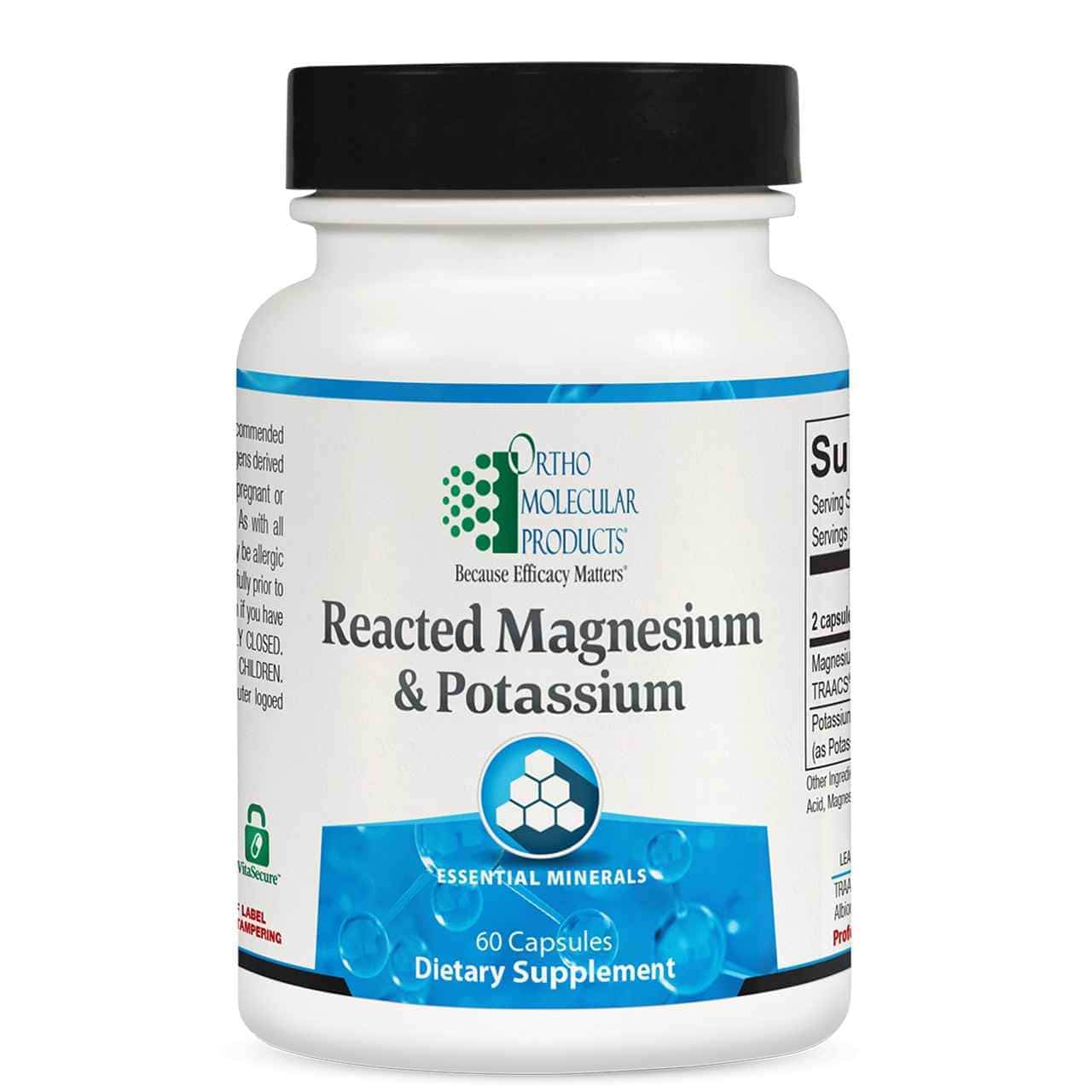
No. They are siblings with different jobs. Reacted Magnesium is magnesium only, 235 mg per 2 capsules, and includes magnesium citrate. Reacted Magnesium and Potassium gives 170 mg of magnesium plus 85 mg of potassium per 2 capsules and leaves out the citrate. If nobody has given you a reason to want potassium, the magnesium-only formula is the more direct choice. Our Reacted Magnesium and Potassium guide covers when the two-mineral version makes sense.
Does Reacted Magnesium cause diarrhea?
It can at higher doses, as any magnesium can, but the formula is built to keep that down. Oxide and citrate are the forms most associated with loose stools, and Ortho Molecular Reacted Magnesium skips oxide entirely and uses citrate as only one of three sources. If you notice it, take the capsules with food, split the dose, or drop to one capsule and build up.
Is Ortho Molecular Reacted Magnesium worth it?
Yes, if you want a well-designed, multi-form magnesium and you value having a practitioner set the dose. Ortho Molecular Reacted Magnesium gives you 235 mg in two vegetable capsules from malate, citrate and an amino acid chelate, with no oxide and no gluten, corn or yeast. It’s less of a fit if you want to skip the clinic step (Pure’s glycinate or Thorne’s CitraMate are right on our shelves), if the skip list above applies to you, or if you already get magnesium from two other bottles.
Delphine, for the record, now keeps a spreadsheet of every supplement label in the house. The magnesium column has a running total, and it stops at 350.
FAQs
What is reacted magnesium?
How much magnesium is in Ortho Molecular Reacted Magnesium?
How many capsules of Reacted Magnesium should I take a day?
Can I take Reacted Magnesium with antibiotics or osteoporosis medication?
What is the difference between Reacted Magnesium and magnesium glycinate?
Why is Reacted Magnesium only available through the clinic?
Keep reading
- Reacted Magnesium and Potassium: Dose, Uses & Safety
- Pure Encapsulations Magnesium Glycinate 360: Benefits, Dosage & More
- Pure Encapsulations Magnesium Citrate: Gentle, Effective Digestive Support
Want to know if Reacted Magnesium is right for you?
Ortho Molecular products are available through our partner clinic, Holistic Health Partners. Book a free appointment and the clinic team will look at what you already take, or join the clinic (it’s free) and save 20%. Prefer to talk it through? Call 800-627-6518.
Book my free appointment Join the clinic & save 20%
These statements have not been evaluated by the Food and Drug Administration. This product is not intended to diagnose, treat, cure, or prevent any disease.