Fiber Formula Integrative Therapeutics: Ingredients & Dosage
Table of Contents
- What is Fiber Formula Integrative Therapeutics?
- What's in Fiber Formula, and what does each fiber do?
- Who is Fiber Formula a good fit for?
- How does Fiber Formula Integrative Therapeutics compare to Blue Heron and psyllium powder?
- How much Fiber Formula Integrative Therapeutics should I take, and when?
- What won't Fiber Formula do?
- Is Fiber Formula safe, and what does the warning say?
- Is Fiber Formula Integrative Therapeutics worth it?
- FAQs
Lorraine Petrakis has run the pastry case at her family's bakery in Tarpon Springs for twenty-two years, and she can tell from the sheen on a tray of koulourakia whether the egg wash went on too thick. At her checkup in August, her nurse practitioner asked what she had eaten the day before, heard "two coffees, a spanakopita triangle, and a lot of bread," and wrote "Fiber Formula Integrative Therapeutics" on the back of her visit summary.
The NP told her to get more fiber, one way or another. Lorraine has watched her husband stir orange psyllium powder into a glass of water every morning for ten years, and she has no intention of drinking it. The summary has been propped against her kitchen windowsill for three weeks.
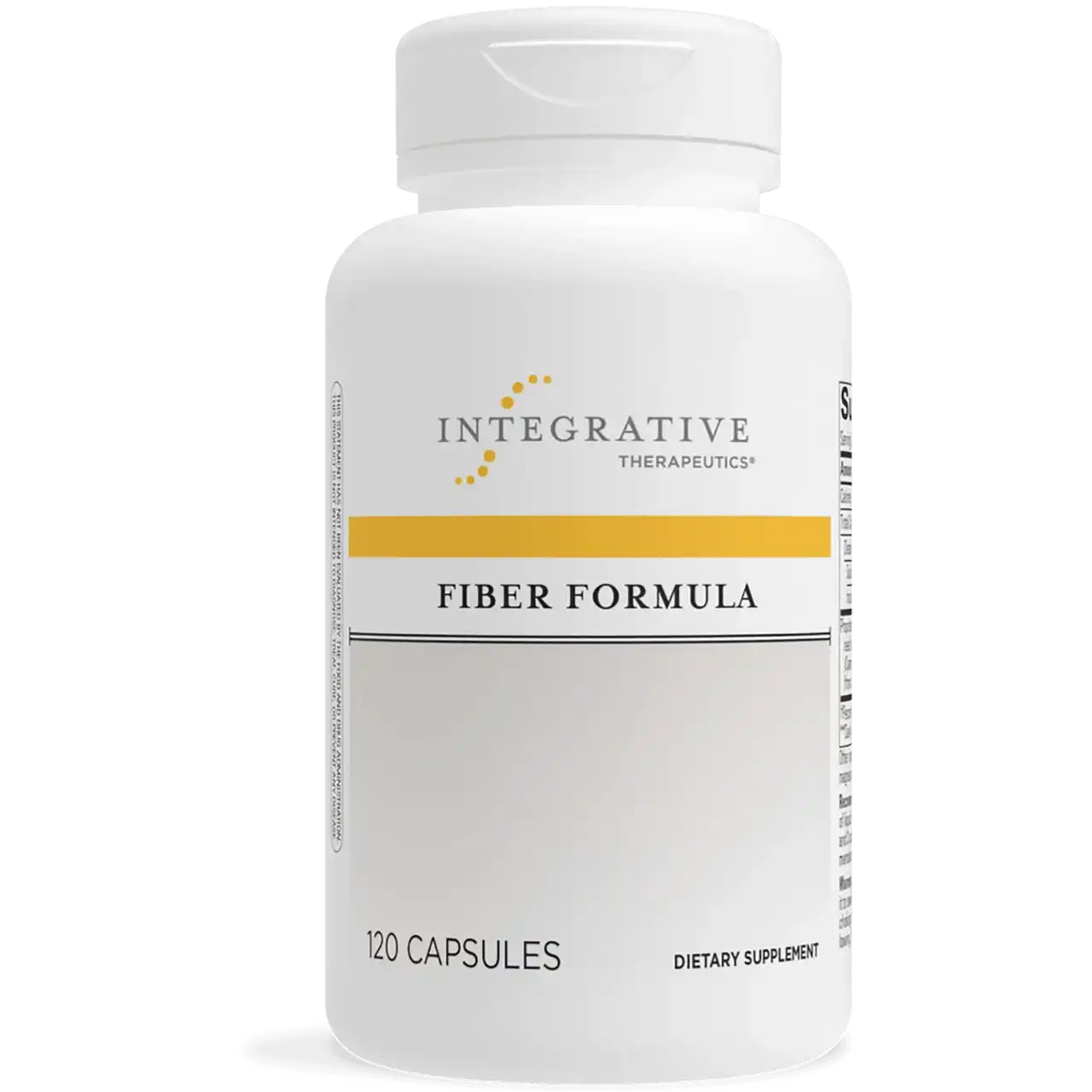
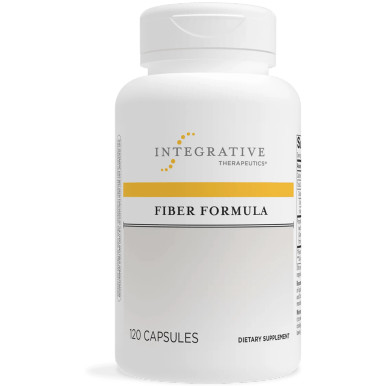
Fiber Formula by Integrative Therapeutics is a capsule fiber supplement that supports colon function. Five vegetarian capsules provide 3 grams of dietary fiber (1 gram soluble, 2 grams insoluble) from a blend of psyllium seed husk, oat hull fiber, guar gum and citrus pectin. The dose is 5 capsules a day with at least 8 ounces of liquid, or 2 capsules in the morning and 3 at night, each with at least 8 ounces. It suits adults who want a small, measured fiber top-up without mixing a powder. It does not replace fiber from food: 3 grams is about 11% of the 28-gram Daily Value.
What is Fiber Formula Integrative Therapeutics?
It is a four-fiber blend in a plant-based capsule, made by a brand that sells mostly through practitioners. Because "Fiber Formula" is a common product name, most people find this one by searching for Fiber Formula Integrative Therapeutics. Integrative Therapeutics makes one benefit statement for it: the fiber and herbs in the formula support colon function. That is the whole claim, and this article sticks to it.
The formula mixes two kinds of fiber that behave differently. Psyllium, guar gum and pectin are soluble fibers that absorb water and thicken into a gel. Oat hull fiber is insoluble and mostly adds bulk. The label puts the split at 1 gram soluble to 2 grams insoluble per serving, so the formula leans toward bulk, with a gel-forming component alongside it.
The company also describes something it calls True Dispersion Technology, which it says ensures the fiber is completely released and dispersed throughout the colon. Integrative Therapeutics doesn't publish how the technology works or what testing sits behind it, so read that as the manufacturer's description of its own process, not as an independent finding.
A few practical details from the label: it is vegan and dairy free, the capsule is hypromellose rather than gelatin, and it contains no soy, artificial colors or flavors. Each bottle holds 120 capsules, which is 24 days at the full dose.
Does "practitioner-grade" matter much for a fiber supplement? Less than it does for a standardized herbal extract, honestly. Psyllium is psyllium. What you're paying for here is a specific blend of four fibers in a capsule, sold by a company that answers to the clinicians who recommend it.
Fiber Formula 120c
$14.75
Fiber Formula 120c by Integrative Therapeutics Integrative Therapeutics' Fiber Formula is a dietary supplement that helps to promote optimal colon health. It is formulated with… Click here to read more
What's in Fiber Formula, and what does each fiber do?
The 3.1-gram proprietary blend lists four fibers in this order: psyllium seed husk, oat hull fiber, guar gum, and pectin from citrus peels. Integrative Therapeutics doesn't disclose how much of each is in the blend, only the order and the total. Here is what each one does on its own.
Psyllium (Plantago ovata) seed husk
Psyllium husk is the outer coating of the seed of a plantain plant grown mostly in India. Stirred into water, it thickens within minutes into a slick gel. The part that matters is what happens after that. Research on the gel-forming fraction of psyllium seed husk found that it largely escapes fermentation by colon bacteria, so it keeps holding water all the way through the colon instead of being broken down early. That same swelling is the reason the label carries a choking warning, covered in the safety section below.
Oat (Avena sativa) hull fiber
This is the ingredient most listings get wrong. Several retail pages for Fiber Formula Integrative Therapeutics, including an older description of this product, say it contains oat bran. The current label says oat hull fiber, and they aren't the same thing. Oat bran comes from the inner layer of the grain and is known for its soluble beta-glucan. Oat hull fiber comes from the tough outer husk and is mostly insoluble: cellulose, hemicellulose and lignin. It adds bulk and doesn't form a gel. It is the main reason two of the three grams in each serving are insoluble.
Guar gum (Cyamopsis tetragonoloba) seed
Guar gum is a galactomannan, a chain of sugars pulled from the seed of the guar bean. Food manufacturers use it to thicken ice cream and sauces because a small amount turns a lot of water viscous. In the colon, resident bacteria ferment guar gum, which sets it apart from the psyllium gel sitting alongside it in the capsule.
Pectin (from citrus peels)
Pectin is what makes jam set. It is concentrated in the peel and pith of citrus fruit, which is where this pectin comes from. Colon bacteria ferment it readily, producing short-chain fatty acids such as acetate and butyrate. Older copy for this product described it as apple pectin. The current label says citrus.
Put together, the blend combines one fiber that holds its gel (psyllium), two that bacteria ferment (guar and pectin), and one that mostly adds bulk (oat hull). Since the amounts aren't disclosed, you can't tell which one carries most of the weight.
Who is Fiber Formula a good fit for?
Fiber Formula makes the most sense for someone who has already decided to add a little supplemental fiber and has a reason to want capsules over powder:
- People like Lorraine who eat plenty of refined flour, know they should add fiber, and simply won't drink a psyllium drink every morning.
- Anyone on the road for a week or more. Five capsules pack easier than a canister, and you still need a full glass of water, which a hotel room or airport can supply.
- A person whose practitioner has asked them to add a small, consistent amount of fiber and track how they feel. Five capsules give the same 3 grams every day, with no scoop-to-scoop variation.
- Vegans who've been put off by gelatin capsules on other products.
- Someone who wants more than one fiber type in a single product, not straight psyllium.
If you're not sure whether this fits your situation, Holistic Health Partners offers a free product consultation. We don't want you to buy more supplements. We want you to buy the right ones.
Who should not take Fiber Formula Integrative Therapeutics?
The label is direct about the most important exclusion: "Do not take this product if you have difficulty swallowing." That covers anyone with a known swallowing disorder, a narrowing of the esophagus, or trouble getting pills down.
If you are pregnant, nursing, or taking any medications, the label says to consult a healthcare professional before use. The directions are written for adults, and the label says to keep it out of reach of children.
People taking lithium should talk to their prescriber before starting. The drug-nutrient interaction database on the manufacturer's page lists psyllium as reducing lithium's effectiveness.
If you have celiac disease, check before you buy. Integrative Therapeutics doesn't make a gluten-free claim for this product, and it contains oat hull fiber. Call us or read the bottle's allergen statement first.
How does Fiber Formula Integrative Therapeutics compare to Blue Heron and psyllium powder?
Integrative Therapeutics makes a second fiber capsule, Blue Heron, and the obvious alternative for most people is a plain psyllium husk powder. Here is how they line up. The food column is there because it wins on almost every row.
| Fiber Formula | Blue Heron (Integrative Therapeutics) | Plain psyllium husk powder | A medium pear | |
|---|---|---|---|---|
| Fiber per serving | 3 g (5 capsules) | 2 g (6 capsules) | Varies by brand; check the label per scoop | About 5 to 6 g |
| Fiber sources | Psyllium, oat hull, guar gum, citrus pectin | Flax seed, rice bran, psyllium, plum | Psyllium only | Whole-fruit fiber |
| Extras | None | Fenugreek, slippery elm, triphala, marshmallow root, probiotic blend, papain | None | Water, vitamin C, potassium |
| Format | Capsule | Capsule | Powder stirred into liquid | Food |
| Easy to adjust the dose? | In steps of about 0.6 g per capsule | In small steps | Yes, by the scoop | Yes |
| Best for | A measured fiber top-up, no powder | Someone who wants herbs and probiotics in the same capsule | The most fiber for the money | Everyone, first |
The honest read: if you'll drink a powder, plain psyllium gives you more fiber per dollar and lets you scale the dose up or down by the spoonful. Fiber Formula wins for people who won't do that. Blue Heron delivers less fiber per serving than Fiber Formula and asks for one more capsule, but it adds a set of herbs and a probiotic blend that Fiber Formula doesn't have. Choose Blue Heron for the extras, and Fiber Formula if fiber is the whole point.
If you're weighing powders, we've covered two in detail: Thorne FiberMend and Fiber Prebiotic Complete by Designs for Health. Both deliver more fiber per serving than any capsule can.
How much Fiber Formula Integrative Therapeutics should I take, and when?
The label dose for adults is 5 capsules daily with at least 8 ounces of liquid. If you'd rather split it, take 2 capsules in the morning and 3 at night, each time with at least 8 ounces of liquid, or follow your healthcare professional's directions.
The liquid is not optional, and the label spells out why: "Taking this product without enough liquid may cause choking." Psyllium and guar gum both swell when they meet water. Drinking a full glass makes sure that swelling happens in your stomach, not in your throat. The split schedule also spreads the capsules and the fluid across the day, which some people find easier than swallowing five capsules at once.
The manufacturer doesn't give a timeline for when to judge whether it's working. A fair test is one full bottle, which lasts 24 days at 5 capsules a day. It's common to notice some gas or bloating when fiber intake goes up. If that happens, ask your practitioner whether starting at fewer capsules and building up makes sense for you. Don't cut back on the water.
If you take prescription medications, ask your pharmacist how to time Fiber Formula around them. Fiber can change how some drugs are absorbed, and your pharmacist can tell you whether to separate the doses.
People on GLP-1 medications ask us about fiber often, since digestion tends to change on those drugs. We wrote about that separately in supporting digestive health on GLP-1 medications.
What won't Fiber Formula do?
It won't close a fiber gap by itself. The Adequate Intake for fiber is 14 grams per 1,000 calories, which works out to about 28 grams a day on a 2,000-calorie diet, and Integrative Therapeutics itself notes that many Americans fall short. A full serving of this product supplies 3 of those grams. Someone eating 12 grams a day who adds Fiber Formula is now eating 15. The rest has to come from beans, whole grains, vegetables and fruit, and MedlinePlus's dietary fiber overview is a reasonable place to start on that.
It isn't a detox product. Some retail listings describe this formula as adsorbing and eliminating toxins. The manufacturer's current page doesn't say that, and neither will we.
It isn't a cholesterol or blood sugar product either. Integrative Therapeutics files it under its cardiometabolic category, but the only benefit the company claims is colon function. If a heart-health reason is why you're shopping, talk to your practitioner about what actually addresses that.
And it won't explain a change in your body. A shift in bowel habits that lasts more than a couple of weeks, blood in the stool, or weight loss you can't explain is a reason to see a doctor, not a reason to buy fiber.
This product probably isn't for you if you already eat 25 to 30 grams of fiber a day, or if a spoonful of powder in water doesn't bother you. In the first case you don't need it. In the second, the powder is cheaper.
Fiber Formula 120c
$14.75
Fiber Formula 120c by Integrative Therapeutics Integrative Therapeutics' Fiber Formula is a dietary supplement that helps to promote optimal colon health. It is formulated with… Click here to read more
Is Fiber Formula safe, and what does the warning say?
For most adults who take it with enough liquid, fiber supplements are well tolerated. The warning on the Fiber Formula Integrative Therapeutics label is serious, though, and it's reproduced here in full:
Do not take this product if you have difficulty swallowing. Taking this product without adequate fluid may cause it to swell and block your throat or esophagus and may cause choking. If you experience chest pain, vomiting, or difficulty swallowing or breathing after taking this product, seek immediate medical attention. If you are pregnant, nursing, or taking any medications, consult a healthcare professional before use. Keep out of reach of children. Safety sealed with inner seal. Do not use if seal is broken or missing. Keep tightly closed. Store at room temperature. Avoid excessive heat and direct sunlight.
Two interactions from the drug-nutrient database on the manufacturer's page are worth knowing. Psyllium is listed as reducing the effectiveness of lithium, and soluble fiber is listed as reducing the effectiveness of lovastatin. If you take either one, talk to your prescriber before you start Fiber Formula. If you take any other medication, ask your pharmacist about timing, as covered above.
As with any supplement, consult your healthcare provider before use, especially if you are pregnant, nursing, or taking medications.
Is Fiber Formula Integrative Therapeutics worth it?
For an adult who needs a modest, predictable fiber top-up and won't take a powder, yes. At $14.75 for a 24-day bottle, Fiber Formula Integrative Therapeutics costs about 61 cents a day for 3 grams of fiber from four sources, in a vegan capsule, from a practitioner brand.
It isn't worth it for someone hoping capsules will stand in for vegetables, or for anyone comfortable with a psyllium drink, which delivers more fiber for less money. The trade-off is simple: you pay extra for not having to drink your fiber.
For Lorraine, the capsules solve the orange-drink problem. They don't solve the bread problem, and her nurse practitioner will probably tell her the same thing at her next visit.
Not sure if this is the right product for you?
The licensed wellness professionals at Holistic Health Partners, led by Carolyn Mulally BS, RN, HN-BC, offer free product consultations — no appointment required. They can help you find the right supplement for your specific health goals.
Get a Free Consultation
These statements have not been evaluated by the Food and Drug Administration. This product is not intended to diagnose, treat, cure, or prevent any disease.