Betaine HCl with Pepsin Integrative Therapeutics: Dosage
Table of Contents
- What is Betaine HCl with Pepsin Integrative Therapeutics?
- What do betaine HCl and pepsin actually do?
- Who may benefit
- How do I know if my problem is protein?
- How does Betaine HCl with Pepsin Integrative Therapeutics compare to a plant enzyme blend?
- How do I take Betaine HCl with Pepsin?
- What this product won't do
- Safety considerations
- Is Betaine HCl with Pepsin Integrative Therapeutics worth it?
- FAQs
Daniela has worked nights in a cardiac ICU for nineteen years, and she eats her real meal at two in the morning: tuna from a foil packet, two hard-boiled eggs, whatever protein fits in a locker. One of the pharmacists wrote Betaine HCl with Pepsin Integrative Therapeutics on a sticky note for her back in March, and it is still stuck to the inside of her locker door.
That meal used to disappear somewhere between the end of her break and the end of her shift. For the last two years it hasn't. She gets home at eight, lies down, and can still feel it sitting high and solid, like something that never quite went down. She has not once looked the note up.
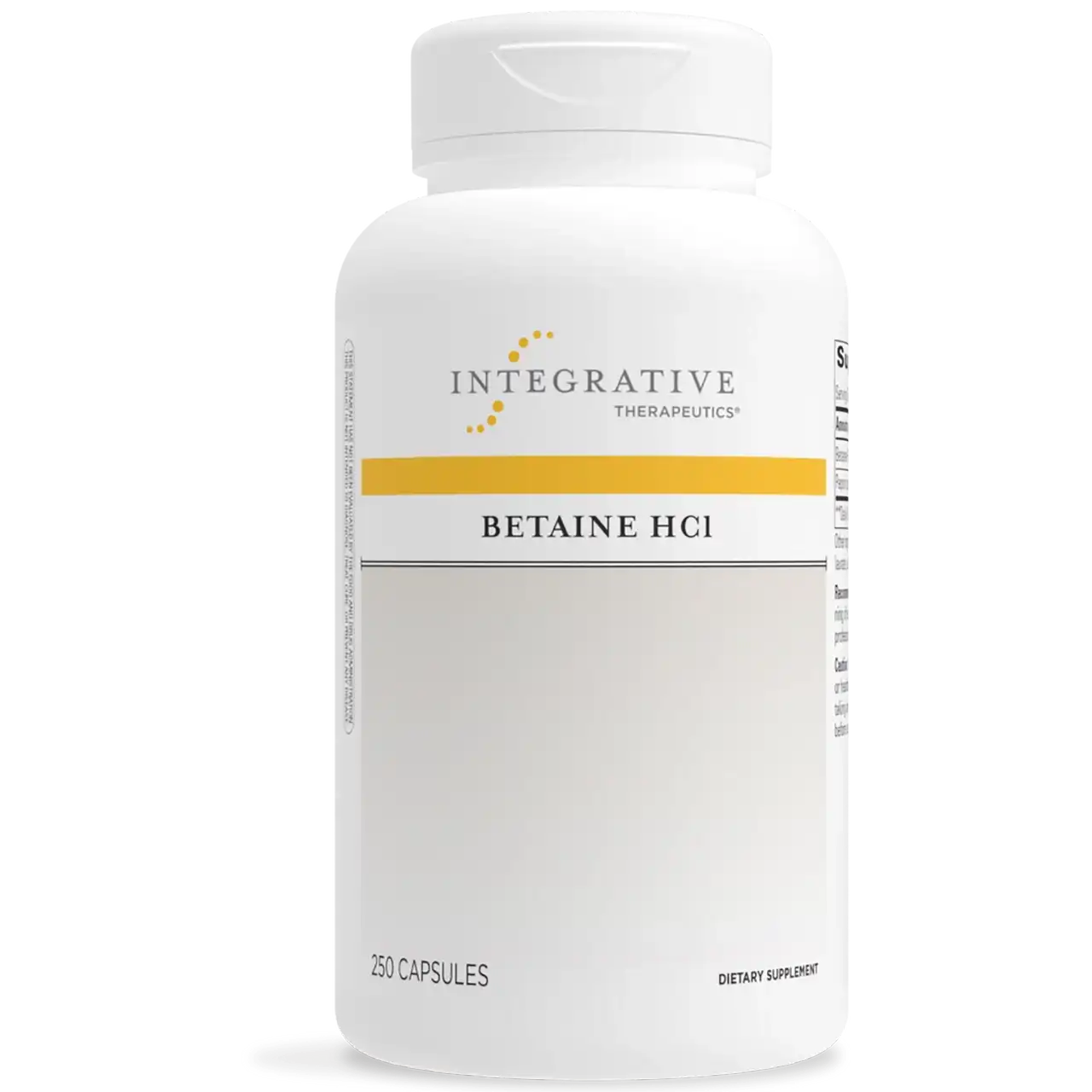
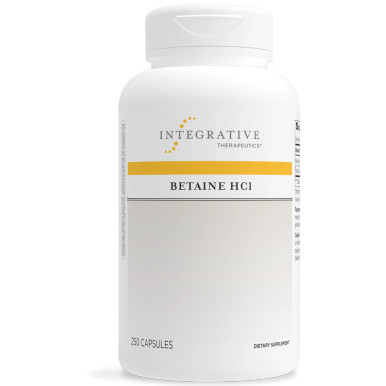
Betaine HCl with Pepsin Integrative Therapeutics is a digestive supplement that supplies hydrochloric acid and pepsin, the two things a healthy stomach produces on its own to break down protein. A two-capsule serving provides 1.3 g of betaine hydrochloride and 260 mg of acid-stable pepsin. Integrative Therapeutics directs adults to take 1 or 2 capsules at the beginning of each meal, and not to chew them. It is built for people whose complaint is specifically about heavy, protein-dense meals sitting too long. It is not for anyone who currently has heartburn, gastritis, or a peptic ulcer, and the label says exactly that.
What is Betaine HCl with Pepsin Integrative Therapeutics?
Betaine HCl with Pepsin Integrative Therapeutics is a two-ingredient formula, and the two ingredients only make sense together.
Betaine hydrochloride is betaine, also called trimethylglycine, bound to hydrochloric acid. In the moisture of the stomach the bond comes apart and the hydrochloric acid is released, briefly lowering gastric pH. Pepsin is the enzyme the stomach itself makes for protein, and it is the reason the acid matters. Pepsin is only active in an acidic environment. Above roughly pH 5 it does almost nothing at all.
That is the part most product pages skip. Pepsin added to a supplement without an acid source is largely along for the ride in a stomach that isn't acidic enough to switch it on. Pairing the two is not a marketing flourish; it is the mechanism.
Integrative Therapeutics frames the rationale this way on their own product page: "Research suggests that the healthy production of hydrochloric acid and gastric enzymes are uniquely vulnerable to the effects of stress, occasional sleeplessness, and the aging process." Their stated purpose for the product is support for healthy stomach acidity, gastric function, and protein digestion.
What makes this a practitioner-grade product rather than a retail one is mostly what it refuses to do. There is no proprietary blend hiding the ratio. There are two actives, both disclosed to the milligram. The other ingredients are a plant-derived capsule (hypromellose), calcium laurate, cellulose, and silica, and the formula contains no wheat, soy, dairy, artificial colors, or flavors. The bottle holds 250 capsules, which is a practitioner-sized count rather than a thirty-day retail box.
Betaine HCL w/pepsin 250c
$46.00
Betaine HCL with pepsin 250c by Integrative Therapeutics Betaine HCL with Pepsin by Integrative Therapeutics is a dietary supplement that works in harmony with the… Click here to read more
What do betaine HCl and pepsin actually do?
The two actives in Betaine HCl with Pepsin Integrative Therapeutics do different jobs, and one of them is close to useless without the other.
Betaine hydrochloride, 1.3 g per serving
The clearest human data on what betaine HCl does to stomach pH comes from pharmacology rather than from digestion research. In a study of healthy volunteers whose stomach acid had been suppressed with a proton pump inhibitor, a single 1,500 mg dose of betaine HCl dropped gastric pH below 3 within a few minutes, and pH climbed back toward its suppressed baseline over roughly the next half hour.
Two capsules of this product supply 1.3 g, which puts a full serving in the same neighborhood as the amount studied. That is a useful reference point, and it comes with a caveat worth stating plainly: those volunteers had their acid suppressed by a drug, under controlled conditions, and the outcome measured was gastric pH, not whether anyone felt better after dinner. It tells you the compound does what it claims chemically. It does not tell you it will fix your afternoon.
The effect is also short. Reacidification in that study was measured in minutes, not hours, which is precisely why the label puts the dose at the start of a meal rather than once a day.
Pepsin, acid-stable protease, 260 mg per serving
Your stomach secretes pepsin's inactive precursor, pepsinogen, and acid converts it into working pepsin. Once active, it cleaves proteins at specific points along the chain, preferentially next to the bulky aromatic amino acids, breaking a steak down into peptides small enough for the small intestine to finish the job.
Its activity peaks somewhere around pH 1.5 to 2.5. The "acid-stable protease" label on the Supplement Facts panel is describing exactly this: an enzyme that needs an acidic environment and holds up in one. Supply pepsin and the acid together and you have replicated, roughly, the two halves of what the stomach does to protein.
If your digestive complaint has nothing to do with protein, none of this applies to you. That is not a small caveat, and it is covered further down.
Who may benefit
Betaine HCl with Pepsin Integrative Therapeutics suits a narrower group than most digestive supplements do, and the list below is close to the whole of it.
- Someone past fifty who can date the change, and who notices it after brisket and eggs but never after a salad.
- People eating high-protein on purpose. The lifter chasing 160 grams a day, the patient told after surgery to hit a protein target, the night-shift nurse whose only real meal lands at two in the morning.
- Anyone already working with a practitioner who has ruled out the things that need ruling out, and who wants a per-meal tool rather than a daily one.
- Someone who tried a plant-based enzyme blend, gave it a fair run, and felt nothing.
Who should not take this
Integrative Therapeutics' warning is short and it is not hedged: not recommended for use if peptic ulcer, gastritis, or heartburn is present. If you are currently burning, this product is the wrong direction, and adding acid to an already irritated stomach lining is not an experiment worth running on yourself.
If you take thyroid medication, speak with your prescriber before starting. Read more in Safety Considerations below.
If you are pregnant, nursing, or taking any medications, the label directs you to consult a healthcare professional before use.
How do I know if my problem is protein?
Nobody can answer that for you from a product page, but the pattern is usually legible if you look for a week.
Keep a note of what you ate and how you felt ninety minutes later. The signal you are looking for is specificity. Heaviness that follows steak, eggs, and a protein shake but not toast, rice, or fruit points one direction. Discomfort that follows everything, or that tracks with stress rather than with food, points somewhere else entirely and will not be solved by acid.
Three things are worth ruling out before you spend money, because all three are common and none of them need a supplement:
- Meal size and speed. A stomach handling forty grams of protein in eight minutes will feel like a stomach with a problem. Half the portion, twice the time, and see whether the complaint survives.
- Alcohol with the meal. It changes gastric emptying, and the effect is easy to miss when it's a habit rather than an event.
- Acid-suppressing medication you are already taking. If you are on a proton pump inhibitor or an H2 blocker, whether prescribed or picked up off a shelf years ago and never revisited, that is a conversation with the prescriber and not a problem to solve by adding acid on top.
If the pattern is still clearly about protein after that, you have a much better case for trying acid replacement than you did a week earlier, and a much better description to bring to whoever you're working with.
How does Betaine HCl with Pepsin Integrative Therapeutics compare to a plant enzyme blend?
| Betaine HCl with Pepsin Integrative Therapeutics | Broad-spectrum plant enzyme blend | |
|---|---|---|
| What it supplies | Hydrochloric acid plus one protein enzyme | Protease, amylase, lipase, often cellulase |
| Where it works | The stomach, at low pH | Stomach and small intestine, across a wider pH range |
| Best suited to | Heavy protein meals specifically | General heaviness after mixed meals, fats, fiber |
| If heartburn or gastritis is present | Not recommended, per the label | Usually tolerated, but read the specific label |
| Thyroid medication | Requires a doctor's supervision | Not flagged for this interaction |
| Where it genuinely wins | Nothing else replaces the acid itself | Safer and more sensible as a first attempt if your symptoms are vague |
That last row is the honest one. If you cannot describe your problem more precisely than "bloated after eating," a broad enzyme blend is the better place to start, and our write-up on Gluten/Dairy Digest by Pure Encapsulations covers what that category does. Acid replacement is the more targeted tool, and targeted tools are only better when you have correctly identified the target.
If you're not sure which of those describes you, the licensed wellness professionals at Holistic Health Partners offer a free product consultation, and sorting that out is exactly the kind of question they're for.
How do I take Betaine HCl with Pepsin?
Betaine HCl with Pepsin Integrative Therapeutics is taken at the beginning of each meal: 1 or 2 capsules, swallowed whole, or as recommended by your healthcare professional. Do not chew them. The capsule exists to carry hydrochloric acid past your mouth and esophagus, which have no business being exposed to it.
The timing is not arbitrary. Acid released before the food arrives is acid that is already in place when the protein does, and pepsin needs that low pH established before a large meal buffers the stomach upward. Taking it afterward, once everything has already diluted, works against the mechanism.
A 250-capsule bottle gives you real numbers to plan with. At two capsules with three meals a day, that is about 41 days. At one capsule per meal, closer to 83. Servings per container is listed as 125 at the two-capsule serving size.
One point worth understanding before you go looking for it elsewhere: the doses used in published research are higher than what this label recommends. In a controlled trial examining food and acid supplementation, 1,500 mg of betaine HCl failed to reacidify the stomach after a meal while 4,500 mg succeeded. Those studies were designed around drug absorption, not digestive comfort, and they are not dosing instructions. The label says 1 or 2 capsules at the start of a meal. That is the dose to follow, and anyone who believes they need more than that needs a clinician rather than a bigger handful.
As for timeframe, this is a per-meal product and not a cumulative one, so you are not waiting six weeks for a blood level to build. Give it a week of honest use with the meals that actually bother you. If three weeks of consistent use changes nothing, it isn't your answer, and continuing to buy it is just a habit.
What this product won't do
Five things Betaine HCl with Pepsin Integrative Therapeutics is not for, and they matter more than the list of things it is.
It won't help reflux. There is a widely repeated idea online that heartburn is caused by too little acid rather than too much, and that acid supplements are therefore the fix. Whatever the merits of that argument, it is not Integrative Therapeutics' position, and their label is unambiguous that this product is not recommended when heartburn is present. We are not going to talk you around that.
It won't tell you whether you have low stomach acid. Very few people asking this question have ever had gastric pH measured. The popular self-test of escalating capsules until you feel a warm sensation is not a validated diagnostic, it is not described anywhere by the manufacturer, and it amounts to titrating an acid against your own stomach lining without a way to read the result. Don't use the product that way.
It won't correct a nutrient deficiency. Stomach acid does play a role in freeing vitamin B12 from the protein it's bound to in food, a point the NIH Office of Dietary Supplements covers in detail. That is physiology, not a product claim. Integrative Therapeutics does not claim this supplement improves B12, iron, or mineral status, and neither do we. If you suspect a deficiency, the answer is a blood test.
It won't do anything for fat or fiber. Pepsin is a protease. If your discomfort follows a cream sauce or a bowl of beans rather than a ribeye, you are looking at the wrong shelf, and a gut-focused approach like the one we covered in our Anaerostipes probiotic write-up may be closer to the mark.
It won't substitute for a workup. New or persistent upper-abdominal symptoms in your fifties deserve an actual examination. A supplement that makes lunch more comfortable can also make you less inclined to go find out why lunch stopped being comfortable.
Betaine HCL w/pepsin 250c
$46.00
Betaine HCL with pepsin 250c by Integrative Therapeutics Betaine HCL with Pepsin by Integrative Therapeutics is a dietary supplement that works in harmony with the… Click here to read more
Safety considerations
Betaine HCl with Pepsin Integrative Therapeutics carries a warning from the manufacturer, and this is it in full: not recommended for use if peptic ulcer, gastritis, or heartburn is present. If you are pregnant, nursing, or taking any medications, consult a healthcare professional before use. Keep out of reach of children.
Thyroid medication is the interaction to know about. The manufacturer's own interaction reference flags betaine hydrochloride against desiccated thyroid, levothyroxine, liothyronine, and liotrix. The reasoning is that stomach acid influences how thyroid hormone is absorbed. Drugs that suppress stomach acid reduce that absorption, so adding acid back would be expected to increase it. Their reference states the consequence directly: people taking thyroid hormones should not take betaine hydrochloride without the supervision of a doctor, who can determine whether a change in thyroid hormone dose is necessary.
Read that as written. It is not a suggestion to mention it at your next appointment sometime. If you take thyroid hormone, the conversation happens before the first capsule, because the variable being changed is how much of your prescription you absorb.
As with any supplement, consult your healthcare provider before use, especially if you are pregnant, nursing, or taking medications.
Is Betaine HCl with Pepsin Integrative Therapeutics worth it?
Betaine HCl with Pepsin Integrative Therapeutics is worth it for a fairly narrow group: people whose difficulty is specifically with protein-heavy meals, who have no heartburn, no gastritis, no ulcer, and no thyroid prescription, and who would rather address the stomach directly than add another daily capsule to a pile. For that person it is a clean, single-purpose formula with both actives disclosed and a dose that lines up sensibly with what has been studied. Integrative Therapeutics has been making this kind of unglamorous clinical product for decades, and our Multiplex-1 review gets into how the brand approaches formulation generally.
The honest trade-off is the bottle. Two hundred and fifty capsules is a serious commitment of money and shelf space for something you may well know isn't working inside of two weeks. A smaller bottle from another brand is a cheaper way to find out, even if it costs more per capsule. We would rather tell you that than sell you eight months of something you'll abandon in March, because we don't want you to buy more supplements, we want you to buy the right ones.
Daniela's sticky note is still on the locker door, and her sensible next step is not the bottle but a short conversation with someone who can ask what else changed two years ago.
Not sure if this is the right product for you?
The licensed wellness professionals at Holistic Health Partners, led by Carolyn Mulally BS, RN, HN-BC, offer free product consultations — no appointment required. They can help you find the right supplement for your specific health goals.
Get a Free Consultation
These statements have not been evaluated by the Food and Drug Administration. This product is not intended to diagnose, treat, cure, or prevent any disease.