Biotonic Biocidin Botanicals: Ingredients & Dosage
Table of Contents
- What is Biotonic Biocidin Botanicals?
- What is actually in Biotonic, and how do the herbs work?
- Who may benefit from Biotonic Biocidin Botanicals?
- How does Biotonic Biocidin Botanicals compare to Biocidin liquid?
- How much Biotonic should I take?
- What won't Biotonic do?
- Is Biotonic safe to take?
- Is Biotonic Biocidin Botanicals worth it?
- FAQs
Rita has been a large-animal vet in eastern Ohio for twenty-two years, and she can spot a foundering horse from forty feet by the way it shifts its weight off the front hooves. What she cannot do anymore is eat lunch. She starts at five, works out of the back of a truck, and by two in the afternoon her stomach is tight and she is running on coffee she no longer tastes. Her acupuncturist wrote Biotonic Biocidin Botanicals on the back of a feed receipt in March.
The receipt is still in the console of the truck. Rita has never taken a Chinese herbal formula and is not sure whether this is a supplement, a medicine, or something she is supposed to believe in.
Biotonic Biocidin Botanicals is a liquid herbal elixir built on a 219 mg proprietary blend of 13 botanicals drawn from Traditional Chinese Medicine, among them astragalus, eleuthero, Fo Ti, sweet wormwood and honey-prepared licorice root. Biocidin positions it as a daily adaptogenic formula for digestion and vitality, with stated nutritional support for the adrenals and liver, immune health, microbial balance and a healthy inflammatory response. The dose is 20 drops, two to three times per day, taken straight or stirred into a beverage. A 2 fl oz bottle holds roughly 88 servings. It is not recommended during pregnancy.
What is Biotonic Biocidin Botanicals?
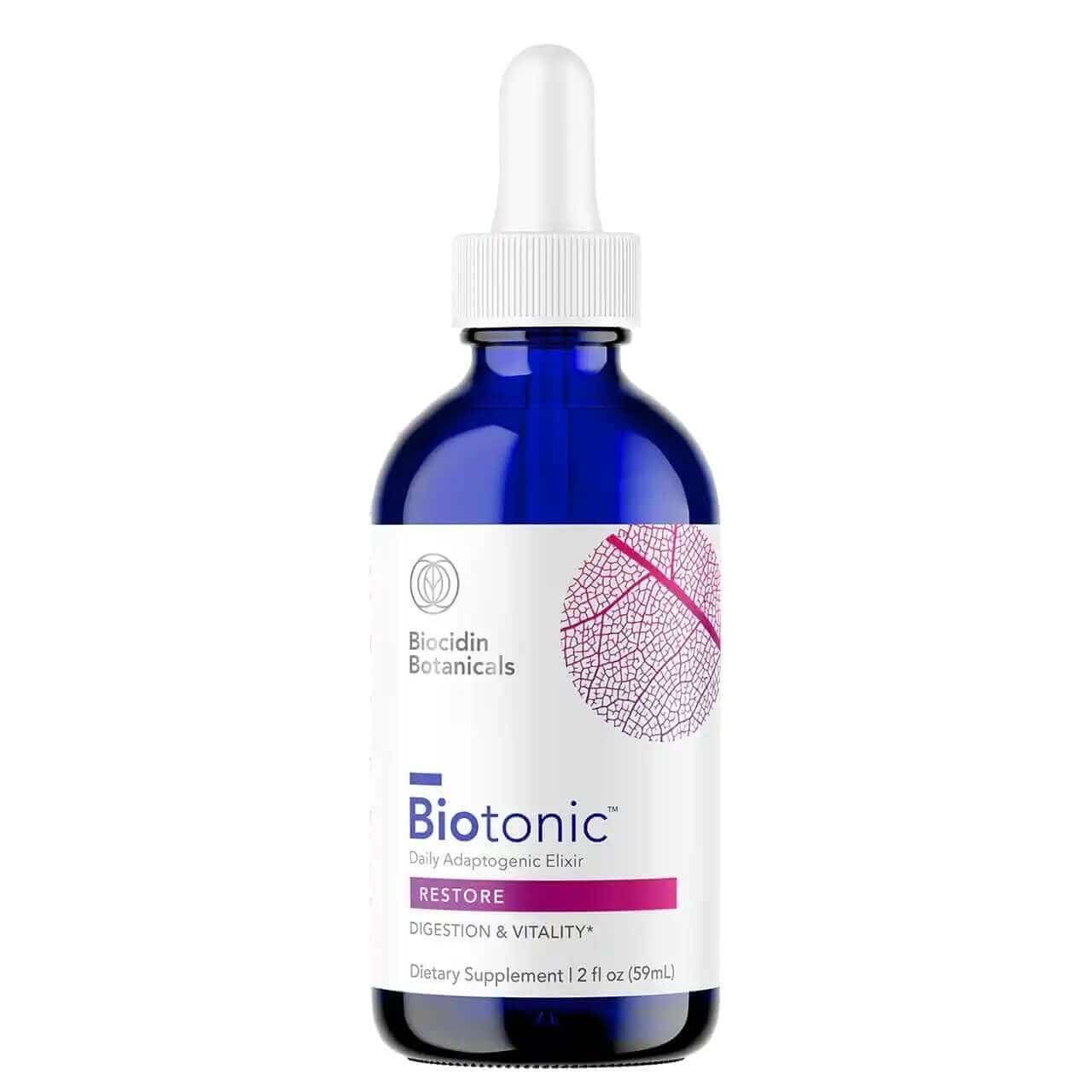
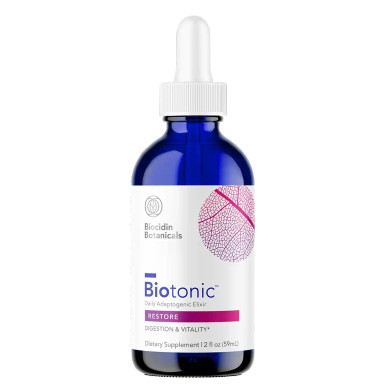
Biotonic Biocidin Botanicals is a glycerin-and-water tincture in a 2 fl oz dropper bottle. Biocidin Botanicals calls it a Daily Adaptogenic Elixir, and the front label carries two words that tell you most of what you need: Restore, and Digestion & Vitality.
That framing matters, because Biocidin Botanicals is best known for a different kind of product. The flagship Biocidin line is built around broad-spectrum botanical blends that practitioners reach for when they want to challenge something. Biotonic is the other half of that approach. It is a tonifying formula — the herbal category meant to build a person back up rather than clear something out — and it is designed to sit alongside the rest of the line rather than replace any of it.
The base is water at 48–54%, vegetable glycerin at 24–26%, and ethanol at 10–12% by volume. Glycerin does two things here. It extracts a different fraction of plant constituents than alcohol alone, and it makes the formula sweet enough to take off a spoon, which is not a small consideration for a product you are meant to dose three times a day for months. The ethanol is sourced from potato or sugar cane. Seven of the thirteen botanicals are certified organic, as are the glycerin and the ethanol.
Practitioner-grade in this case is less about milligram counts than about sourcing and formulation lineage. Biocidin builds from named traditional formulas rather than assembling a list of trending adaptogens, and the identity of each herb in a Chinese formula matters in ways a retail label rarely tracks. The panel does not just say "licorice." It says honey-prepared licorice root, Zhi Gan Cao — licorice that has been fried in honey, which changes what the herb is used for. It says Black Bean-prepared Fo Ti, not raw Fo Ti. Those preparation methods are the difference between two genuinely different medicines, and most supplement labels drop them. Biotonic keeps them on the panel.
Biotonic 2 oz
$39.99
Biotonic 2 oz by Biocidin Botanicals Biotonic by Biocidin Botanicals is a synergistic companion to Biocidin, drawing inspiration from millennia of herbal wisdom in Traditional… Click here to read more
What is actually in Biotonic, and how do the herbs work?
Here is the thing almost every article about this product misses. Biotonic Biocidin Botanicals is not thirteen adaptogens thrown in a bottle. Buried in the middle of the ingredient list is a complete, recognizable classical formula, and the rest of the blend is built on top of it.
The Four Gentlemen at the center
Codonopsis root (Dang Shen), Atractylodes root (Bai Zhu), Poria sclerotium (Fu Ling) and honey-prepared Licorice root (Zhi Gan Cao) are, together and in that order, Si Jun Zi Tang — the Four Gentlemen Decoction. It is roughly a thousand years old and it is the foundational digestive tonic in Chinese herbal medicine, the formula students learn first. Add Tangerine rind (Chen Pi), which Biotonic also contains, and you have the Five Gentlemen variation used when digestion feels heavy and stagnant rather than simply weak.
Each part has a job. Codonopsis is the gentle qi tonic, a milder stand-in for ginseng. Atractylodes is the drying herb, used where there is dampness and sluggishness. Poria is a diuretic fungus that moves fluid. Honey-prepared licorice harmonizes the other three and moderates their edges — that is its explicit role in the formula, not an afterthought. You can read a plain-language overview of licorice root at the National Center for Complementary and Integrative Health.
The adaptogenic layer
Astragalus root (Huang Qi) and Eleuthero root (Wu Jia Shen) are the two herbs doing the adaptogenic work in the name. Astragalus is the classical qi tonic associated with the body's defensive layer, and it is the single most-studied herb in this formula; NCCIH maintains a summary of the astragalus evidence base, which is honest about how preliminary most of it is. Eleuthero, once marketed as Siberian ginseng, is not a ginseng at all and belongs to a different genus entirely — a distinction worth knowing if you are comparing labels.
Black Bean-prepared Fo Ti root (He Shou Wu) is the third. This is the herb behind Biocidin's stated liver support, and the preparation is not cosmetic: raw and prepared Fo Ti are used for different purposes in traditional practice, and Biotonic specifies the prepared form.
Sweet wormwood, and why it is here
Sweet Wormwood herb (Qing Hao), Artemisia annua, is the ingredient that most distinguishes Biotonic from a generic energy tonic. It is the odd one out in a formula otherwise made of builders — a clearing herb sitting inside a tonifying blend. Its presence is consistent with Biocidin's stated claim that the formula assists in microbial balance and supports a healthy inflammatory response. Note the wording. Biocidin does not claim Biotonic kills anything, and neither will this article.
The supporting botanicals
Chinese Yam root (Shan Yao) is a moistening tonic, the counterweight to the drying herbs. Chinese Peony root (Bai Shao) is a blood tonic traditionally paired with licorice to ease cramping and tension. Ginger root (Gan Jiang) is the warming, carminative herb most people already know from tea; NCCIH's page on ginger covers the digestive research. Turmeric root (Yu Jin) rounds out the blend — and note that this is turmeric used as a Chinese herb, at a fraction of the dose found in a standalone curcumin product. If concentrated curcumin is what you are after, Biotonic is the wrong bottle.
All thirteen share a single 219 mg proprietary blend, so individual amounts are not disclosed. That is the honest limitation of this label. You cannot know how much astragalus you are getting, and 219 mg is a modest total by the standards of single-herb capsules. Biotonic is a traditional tincture built on synergy across a formula, not a high-dose extract, and it should be judged that way.
Who may benefit from Biotonic Biocidin Botanicals?
- Someone already working with a practitioner on the Biocidin line who has been told to add a tonifying formula alongside it
- People who find capsules difficult, or who are already taking so many that one more bottle of pills is a non-starter
- Anyone drawn to Traditional Chinese Medicine who wants a prepared classical base rather than assembling single herbs
- Someone who wants daily adaptogenic support in a form that can go into tea or seltzer rather than be swallowed dry
- People whose interest is digestion and general resilience together, rather than one narrow target
Who should not take Biotonic Biocidin Botanicals
Biocidin's label is direct: not recommended for use during pregnancy. That is the manufacturer's wording and it is not a suggestion to check in with someone first. If you are nursing, have a medical condition, or take any medication, consult your physician before starting. Keep it out of reach of children.
Two more groups should think twice. Anyone avoiding alcohol entirely — in recovery, or for religious reasons — should know this is an alcohol-containing tincture, and there is a real number attached to that below. And anyone with a licorice sensitivity should look closely at the ingredient list, because licorice is not a trace component here; it is one of the four structural herbs.
If you are not sure whether this fits your situation, Holistic Health Partners offers a free product consultation. That is a better use of ten minutes than guessing at a formula with thirteen moving parts.
How does Biotonic Biocidin Botanicals compare to Biocidin liquid?
These two products get confused constantly, largely because of the shared name. Biotonic and Biocidin liquid do close to opposite things.
| Biotonic | Biocidin Liquid | |
|---|---|---|
| Herbal category | Tonifying — builds up | Clearing — challenges |
| Tradition | Traditional Chinese Medicine | Broad-spectrum Western and Ayurvedic botanicals |
| Stated focus | Digestion, vitality, adrenal and liver support | Broad microbial balance |
| Typical use | Daily, ongoing | Protocol-based, often ramped |
| Taste | Sweet, glycerin-forward | Strong and bitter |
| Better if you want | Steady daily support you will actually keep taking | Direct, targeted botanical action |
Biocidin liquid wins outright on one dimension, and it is worth saying plainly: if what you actually want is targeted microbial support, Biotonic is not a substitute for it and buying Biotonic instead will disappoint you. Biotonic assists in microbial balance as one of five stated benefits. That is a supporting role. Choosing it as your primary tool for that job is choosing the wrong product, and no amount of shared branding changes it.
How much Biotonic should I take?
Biocidin Botanicals suggests 20 drops, two to three times per day, or as directed by your healthcare professional. One serving is 0.66 ml, roughly 20 drops, and the bottle holds about 88 servings.
Run the arithmetic, because the label's "88 servings" reads like a three-month supply and it is not. At the top of the range — 20 drops three times daily — you are using about 2 ml a day, and a 59 ml bottle is empty in roughly 29 days. At twice daily it stretches to about six weeks. Budget for a bottle a month if you follow the upper dose.
Biotonic is sweet enough to take straight from the dropper. It also goes into water, tea, or seltzer without much argument, which is the practical reason people stay on it. Traditional digestive tonics of this type are conventionally taken between or before meals rather than with them, but Biocidin does not specify timing on the label, so if your practitioner has given you a schedule, follow theirs.
Give it a real trial before judging. Tonifying formulas are slow by design — they are not built for a next-day effect, and four to six weeks of consistent use is a fair window before deciding whether it is doing anything for you. If you have taken it sporadically for two weeks and felt nothing, you have not run the experiment yet.
What won't Biotonic do?
It will not fix a diet. Thirteen botanicals at 219 mg total is a nudge, and Rita eating actual lunch would do more for her digestion than any tincture. Herbal tonics are additive to a functioning routine; they do not substitute for one.
It is not a curcumin supplement, not an astragalus supplement, and not an eleuthero supplement. If you want a clinical dose of any single herb in this blend, buy that herb. Proprietary blends are the wrong vehicle for single-ingredient goals, and you will pay more for less of what you came for.
It is not alcohol-free. At 10–12% by volume, one 0.66 ml serving carries roughly 0.07 ml of ethanol, and three servings a day is about 0.2 ml — somewhere near one percent of a standard drink. For most people that is negligible. For someone in recovery, the number is not the point and the answer is still no.
It will not tell you what is in it. The proprietary blend means you cannot audit the dose of anything, cannot compare it ingredient-for-ingredient against another product, and have to extend the manufacturer some trust. That is a genuine trade-off and you should make it knowingly.
And it is not a first move for a diagnosed condition. Persistent digestive symptoms, ongoing fatigue, or anything that has been getting worse deserves a workup, not a tonic. We would rather you spend money on the right thing than on more bottles — including none of ours.
Biotonic 2 oz
$39.99
Biotonic 2 oz by Biocidin Botanicals Biotonic by Biocidin Botanicals is a synergistic companion to Biocidin, drawing inspiration from millennia of herbal wisdom in Traditional… Click here to read more
Is Biotonic safe to take?
Biocidin Botanicals' warning, in full: Not recommended for use during pregnancy. Consult your physician before using any supplement, especially if you are nursing, have a medical condition, or are taking medication. Discontinue use should adverse reactions occur. Keep out of reach of children. Store in a cool, dry place.
Take the medication clause seriously rather than skimming it. A thirteen-herb formula has more surface area for interaction than a single-ingredient capsule, and licorice in particular is a well-documented herb where a conversation with your prescriber is warranted if you are on anything ongoing — blood pressure medication especially. Biocidin does not single licorice out on the label, so treat this as an application of their existing warning rather than a separate one.
The pregnancy line is the one people try to negotiate. Don't. "Not recommended for use during pregnancy" is the manufacturer's own position on their own product, and several herbs in this formula have traditional contraindications in pregnancy independent of that.
Biotonic Biocidin Botanicals contains no dairy, gluten, corn, soy, artificial coloring or artificial flavoring. If you are managing a broader gut protocol, our write-ups on liver support formulas and on targeted probiotics for bloating cover adjacent ground.
As with any supplement, consult your healthcare provider before use, especially if you are pregnant, nursing, or taking medications.
Is Biotonic Biocidin Botanicals worth it?
Biotonic Biocidin Botanicals is worth it if you want a prepared classical Chinese tonic in a form you will actually take every day, and if you understand that you are buying a formula rather than a dose. The Four Gentlemen base is the real argument for this bottle — that is a thousand years of clinical refinement you cannot assemble yourself from single-herb capsules without knowing what you are doing.
It is not worth it if you want measurable amounts of specific actives, if you need targeted microbial support, or if you are expecting something to happen this week. The honest trade-off is transparency: you give up knowing what is in the blend in exchange for a formula that holds together, and whether that trade is acceptable depends entirely on how much you trust the formulator.
Rita, if she ever gets the receipt out of the console, will still be starting at five and working out of the truck. A bottle of anything does not change a schedule. What it might do is give a system that has been running on coffee since 2004 something else to work with — and that is a smaller, more honest claim than most of what she will read about Biotonic Biocidin Botanicals.
Not sure if this is the right product for you?
The licensed wellness professionals at Holistic Health Partners, led by Carolyn Mulally BS, RN, HN-BC, offer free product consultations — no appointment required. They can help you find the right supplement for your specific health goals.
Get a Free Consultation
These statements have not been evaluated by the Food and Drug Administration. This product is not intended to diagnose, treat, cure, or prevent any disease.