Liver Nutrients Seeking Health: Ingredients & Dosage
Table of Contents
- What is Liver Nutrients Seeking Health?
- What's in Liver Nutrients Seeking Health, and how does each ingredient work?
- Who may benefit from Liver Nutrients Seeking Health?
- How does Liver Nutrients Seeking Health compare to plain milk thistle?
- How much Liver Nutrients should I take?
- What won't Liver Nutrients Seeking Health do?
- What should you know about safety and interactions?
- Is Liver Nutrients Seeking Health worth it?
- FAQs
Dale Rutkowski has sprayed two-part urethane clearcoat in the same body shop for twenty-eight years, and he can hear when a spray tip needs cleaning before the finish ever shows it — a faint dry rasp in the gun that nobody else on the floor picks up. He wears a supplied-air hood and changes cartridges on schedule. His daughter sent him a link to something called Liver Nutrients Seeking Health sells, with a message that read, in full, "read the panel, Dad."
He hasn't opened it. What he has noticed is that the two beers he used to have after a Friday shift now cost him most of Saturday morning, in a way they didn't at forty. His last physical was unremarkable. That is most of the reason the link is still sitting there unread — nothing is wrong, exactly.
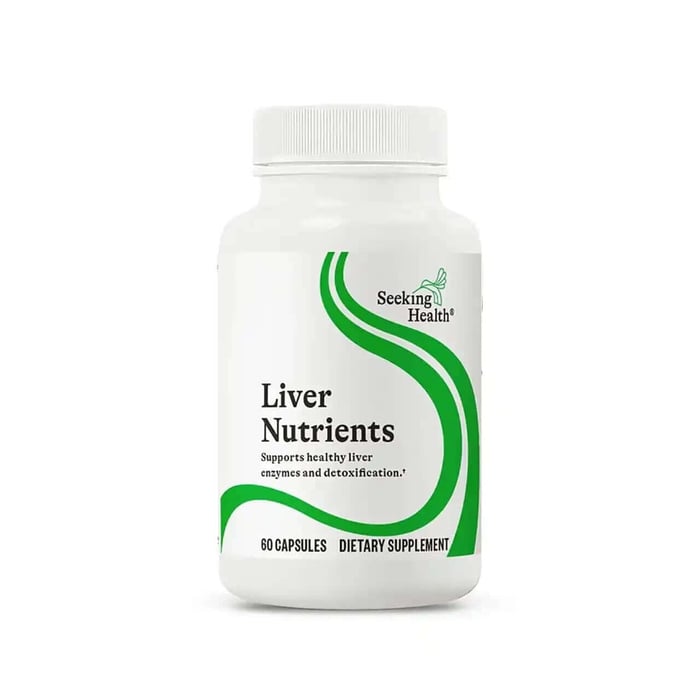
Liver Nutrients by Seeking Health is a five-ingredient, 60-capsule formula built on 250 mg of milk thistle extract standardized to 80% silymarin, paired with N-acetyl-L-cysteine (150 mg), taurine (150 mg), betaine anhydrous as trimethylglycine (150 mg), and alpha-lipoic acid (75 mg). The directions are one capsule daily with food, so a bottle is a two-month supply. It is free from gluten, dairy, soy, and artificial additives, and suitable for vegetarians. What separates it from the single-herb liver products beside it on the shelf is the assembly: rather than being a milk thistle capsule with extras bolted on, it supplies raw material to three different conjugation routes the liver uses to package compounds for excretion. It suits someone who wants broad daily support for normal detoxification rather than a high dose of any one ingredient. It is not a treatment for any diagnosed liver condition.
What is Liver Nutrients Seeking Health?
Seeking Health was founded by Dr. Ben Lynch, whose work centers on genetic variation in methylation and nutrient metabolism, and the house style is visible in the small decisions on this panel. The capsule shell is hypromellose rather than gelatin. The excipient list is three items long — ascorbyl palmitate, L-leucine, and silica — with no dyes, no titanium dioxide, and no magnesium stearate, and the formula is free from gluten, dairy, soy, and artificial additives. The milk thistle carries a stated standardization rather than a raw herb weight, which is the single most useful number on any milk thistle label and the one budget products most often leave off. Those choices are part of what you are paying for with Liver Nutrients Seeking Health, as much as the actives themselves are.
There is a detail here that matters specifically to the people who buy this brand, and no retailer page mentions it. Much of the Seeking Health line is built for methyl-sensitive customers, and several of their formulas are deliberately free of methyl donors. This one is not. Betaine anhydrous is trimethylglycine, and trimethylglycine is a methyl donor by definition — the name is the mechanism. If you are someone who reacts to methylfolate or methylcobalamin and you buy this brand precisely because it tends to accommodate that, read this panel before you assume it does. It may still be fine for you; betaine donates its methyl group through a different enzyme than the folate cycle uses. But it is not the methyl-free product that some of its shelf-mates are, and finding that out from a blog post beats finding it out from a headache.
Liver Nutrients 60c
$29.00
Liver Nutrients by Seeking Health Introduction: Liver Nutrients is a targeted formula combining milk thistle extract with synergistic nutrients to support healthy liver function and… Click here to read more
What's in Liver Nutrients Seeking Health, and how does each ingredient work?
Five actives, one capsule. Here is what each one is doing, and where the research on it is thinner than the marketing around it usually suggests.
Milk Thistle Extract — 250 mg (80% silymarin)
Silymarin is not a single compound. It is a complex of flavonolignans — silybin A and B, silychristin, silydianin, and several minor relatives — extracted from the seeds of Silybum marianum. Silybin is the most studied of them and is generally treated as the fraction carrying most of the activity. At 80% standardization, 250 mg of extract delivers roughly 200 mg of silymarin per capsule.
The mechanisms that have held up best in laboratory work are membrane-level: silymarin appears to stabilize the hepatocyte membrane, act directly as an antioxidant, and support intracellular glutathione status. The National Center for Complementary and Integrative Health is worth reading before you form an opinion in either direction, because it is candid that the human evidence is mixed rather than settled.
The honest problem with silymarin is absorption. It is poorly water-soluble and orally bioavailable at a low percentage of what you swallow, which is why phytosome preparations that bind silybin to phosphatidylcholine exist and why they cost more. This formula uses standard extract, not a phytosome. If milk thistle absorption is the specific thing you are optimizing, our breakdown of Designs for Health Milk Thistle covers that comparison in more depth.
N-Acetyl-L-Cysteine — 150 mg
NAC is a stabilized delivery form of cysteine, and cysteine is the rate-limiting amino acid in glutathione synthesis. Glutathione is the substrate for one of the liver's major conjugation pathways, so the logic of including it is direct: you cannot conjugate with glutathione you have not made, and you cannot make glutathione without cysteine to build it from.
Now the caveat, because it is a real one. Standalone NAC is typically sold at 600 mg per capsule, and most of the human research uses 600 to 1,800 mg daily. This panel has 150 mg. That is a contribution to daily cysteine availability, not a therapeutic loading dose, and anyone coming to this product because they read something about NAC specifically should know they are getting a quarter of a standard capsule. It is a formulation ingredient here, not the headline.
Taurine — 150 mg
Taurine is the ingredient most people skim past, and it is arguably the most interesting inclusion on the panel. In the liver, taurine conjugates with bile acids to form taurine-conjugated bile salts such as taurocholic acid. That matters because bile is an excretion route. Compounds the liver has processed and packaged have to physically leave, and a meaningful share of them leave in bile.
This is where most liver supplements stop short. The category is overwhelmingly focused on protecting the liver cell — antioxidants, membrane stabilizers, hepatoprotectants — and comparatively quiet about whether anything actually gets out at the other end. Taurine is a small nod to the second half of that process. If bile flow specifically is your interest, our write-up on BodyBio TUDCA goes considerably deeper on bile acids than this formula does.
Betaine Anhydrous (trimethylglycine) — 150 mg
Betaine donates a methyl group to homocysteine, converting it to methionine, via an enzyme called betaine-homocysteine methyltransferase. The relevant fact for a liver formula is that this enzyme is concentrated in the liver and kidney — it is not a whole-body pathway. Methionine then feeds S-adenosylmethionine, the body's universal methyl donor, which the liver draws on both for methylation conjugation and for building phosphatidylcholine, a structural component of cell membranes and of the packaging the liver uses to export fat.
So betaine is the second of the three conjugation routes represented on this panel. It is also the ingredient responsible for the methyl-donor point made above, and the two facts are the same fact viewed from different sides.
Alpha-Lipoic Acid — 75 mg
Alpha-lipoic acid is unusual among antioxidants in being soluble in both water and fat, which lets it operate in cell membranes and in the cytosol rather than being restricted to one compartment. It also functions as a recycler: it can regenerate glutathione, vitamin C, and vitamin E back to their active forms after they have been spent. Separately, it serves as a cofactor for mitochondrial enzyme complexes including pyruvate dehydrogenase.
Alpha-lipoic acid also carries the most practically relevant interaction on this panel, and it gets its own treatment in the safety section below. In short: it can lower blood glucose, and that is not a footnote if you take medication that does the same thing.
What the formula is actually built around
Put the five together and a design becomes visible that no individual ingredient explains.
Liver detoxification runs in two broad phases. Phase I, largely cytochrome P450 enzymes, chemically modifies a compound — oxidizing it, usually. The awkward truth about Phase I is that the intermediate it produces is frequently more reactive than the substance it started with. Phase II then conjugates that intermediate, attaching a water-soluble molecule to it so the result can be excreted in bile or urine. The two phases need to keep pace with each other; Phase I running ahead of Phase II is the mechanistic worry behind a lot of poorly designed "cleanse" products.
Three of the five ingredients on this panel feed Phase II directly. NAC supplies cysteine for glutathione conjugation. Betaine supports methylation conjugation. Taurine supports bile acid conjugation. Milk thistle and alpha-lipoic acid sit alongside as antioxidant and glutathione-recycling support. That is a coherent formulation argument, and it is a genuinely different one from a milk thistle monoproduct. It is also our reading of the panel rather than a claim printed on the bottle, and it should be read that way.
Who may benefit from Liver Nutrients Seeking Health?
- Someone with a long occupational exposure history — solvents, paints, adhesives, degreasers, print shop chemistry — who takes their PPE seriously and wants nutritional support for normal detoxification alongside it, which is Dale's situation.
- People who want daily maintenance support rather than a high dose of one thing. If you have looked at four separate bottles and quietly concluded you will not remember four bottles, this is one capsule.
- Anyone who already understands the Phase II conjugation argument and specifically wants glutathione, methylation, and bile support in a single formula.
- Customers of this brand who want the short excipient list and the hypromellose capsule, and who have checked that a methyl donor is acceptable for them.
- Someone starting out with liver support who would rather begin with a modest combination than a high-dose single ingredient.
Who should not take Liver Nutrients Seeking Health?
Take the alpha-lipoic acid interaction seriously. Alpha-lipoic acid can lower blood glucose, so if you take insulin, a sulfonylurea, metformin, or any other glucose-lowering medication, adding it can stack with what your prescription is already doing. That conversation belongs with your prescriber before the first capsule, not after a reading you did not expect.
Milk thistle belongs to the Asteraceae family, alongside ragweed, daisies, marigolds, and chrysanthemums. Cross-reactivity in people allergic to that family is documented and is a reason to avoid it rather than to try it cautiously.
Silymarin has documented potential to affect drug-metabolizing enzymes, which means it can in principle alter how the liver handles other medications. If you take anything with a narrow therapeutic window, this is a pharmacist conversation.
Pregnant and nursing women and children should not take this without a healthcare practitioner's direction. Follow the warning text printed on your bottle as the governing instruction — it is the manufacturer's word and it supersedes any general guidance here.
How does Liver Nutrients Seeking Health compare to plain milk thistle?
Nearly everyone comparing this product is weighing it against a standalone milk thistle capsule, which is the cheapest and most transparent option in the category. They are built for different jobs.
| Liver Nutrients (Seeking Health) | Standalone milk thistle | TUDCA | |
|---|---|---|---|
| Silymarin per serving | ~200 mg (250 mg at 80%) | Commonly 120–300 mg, often higher | None |
| Design focus | Phase II conjugation across three routes | Hepatocyte protection and antioxidant support | Bile acid and bile flow support |
| Glutathione support | NAC plus ALA recycling | Indirect, via silymarin only | Not the mechanism |
| Absorption-optimized herb form | No — standard extract | Phytosome versions widely available | N/A |
| Dose transparency | Full — every ingredient broken out | Full | Full |
| Daily capsules | 1, with food | 1–2 | 1–2 |
| Cost | Higher — five actives | Usually the cheapest option | Typically the most expensive |
Plain milk thistle wins outright on two counts, and we would rather say so than dance around it. It is cheaper, and it is available in phytosome forms that absorb better than the standard extract used here. If silymarin is the only thing you want and you want as much of it as you can absorb per dollar, buy that instead. Where Liver Nutrients Seeking Health earns its place is the conjugation support surrounding the herb, which a milk thistle capsule does not attempt. One useful point in its favor: full dose transparency. Every one of the five ingredients is broken out on the panel with no proprietary blend, which is not something we can say about every product in this line.
If you are not sure which of these fits your situation, the licensed wellness professionals at Holistic Health Partners offer a free product consultation. We would rather you buy the right one than buy all three.
How much Liver Nutrients should I take?
Liver Nutrients Seeking Health carries simple directions: one capsule daily with food, or as directed by a healthcare professional. At 60 servings per container, a bottle is a two-month supply.
The "with food" instruction is worth a second look, because it settles a real tension inside this formula. Alpha-lipoic acid absorbs better on an empty stomach; food measurably reduces how much of it you take up. N-acetyl-cysteine is a common cause of nausea when taken without food. A single capsule containing both has to pick one, and this label picks food. Read that as a tolerability decision: you give up some alpha-lipoic acid absorption in exchange for a capsule most people can take daily without their stomach objecting. At 75 mg, that is a defensible trade. If you were taking alpha-lipoic acid on its own at a higher dose, you would likely make the opposite call, and that difference is worth knowing if you are already taking one.
Give it eight to twelve weeks before deciding anything. This is not a product with a same-day sensation attached to it, and there is no feeling that tells you conjugation is proceeding well. Decide in advance what you are actually tracking — energy in the afternoon, how a Saturday morning goes after a Friday shift, whatever is concrete for you — and write it down before you start. Two months later, memory is a poor witness.
What won't Liver Nutrients Seeking Health do?
Liver Nutrients Seeking Health will not offset heavy drinking. Nothing on this panel changes the arithmetic there, and a supplement that makes a person feel licensed to drink more is doing active harm rather than none.
It will not treat diagnosed liver disease. Fatty liver, hepatitis, cirrhosis, and elevated liver enzymes found on a blood panel are all medical situations that belong with a physician. MedlinePlus is a reasonable starting point for understanding what those diagnoses actually mean, but the follow-up is an appointment, not a bottle.
It will not "flush toxins." That framing is the marketing convention of an entire category and it does not describe anything the liver does. The liver chemically modifies compounds and routes them to bile or urine. Nothing is being flushed, and any product that talks that way is telling you something about its copywriting rather than its chemistry.
It is not a high-dose NAC protocol. At 150 mg you are getting a quarter of a standard NAC capsule, and if a specific NAC dose is what you are after, buy NAC.
It will not fix fatigue that is really low iron, low B12, low vitamin D, poor sleep, or an underactive thyroid. Those are inexpensive blood tests, and a fair number of people who think they need detoxification support need one of those instead.
And it will not compensate for a bad respirator seal. For Dale specifically, the hood, the cartridge schedule, and the shop's ventilation are doing something no capsule replicates, and the capsule is the smallest item on that list.
Liver Nutrients 60c
$29.00
Liver Nutrients by Seeking Health Introduction: Liver Nutrients is a targeted formula combining milk thistle extract with synergistic nutrients to support healthy liver function and… Click here to read more
What should you know about safety and interactions?
Of everything in Liver Nutrients Seeking Health, the interaction that deserves the most attention is alpha-lipoic acid and blood sugar. It has a plausible glucose-lowering effect, and stacked on top of insulin or an oral hypoglycemic it can compound. If you manage diabetes, treat this as a product to clear with your prescriber and to introduce while you are actually watching your numbers, not during a week you are travelling.
Milk thistle carries two considerations. The Asteraceae cross-reactivity noted above is an avoid, not a caution. And silymarin's potential to influence hepatic drug metabolism means it deserves a mention to your pharmacist if you take medications where blood levels matter, which is a five-minute conversation at a counter you are already standing at.
Betaine at 150 mg is a modest amount, though it is worth adding up your intake across bottles if you also take a methylation formula or a B-complex containing TMG. Taurine at 150 mg is well within the range found in ordinary diets.
Follow the warning text on your own bottle as the authoritative version. Manufacturers update label language, and the printed warning in your hand outranks anything written here.
As with any supplement, consult your healthcare provider before use, especially if you are pregnant, nursing, or taking medications.
Is Liver Nutrients Seeking Health worth it?
Buy Liver Nutrients Seeking Health if you want daily, broad-based support across the liver's conjugation pathways in a single transparent capsule, you have checked that a methyl donor is fine for you, and you are not on glucose-lowering medication without having cleared it. The three-route design is real, the panel hides nothing behind a proprietary blend, and one capsule a day with a meal is a habit most people can actually keep for two months.
Skip it if you want maximum silymarin per dollar, in which case a phytosome milk thistle beats it on the one ingredient you care about. Skip it if you came for NAC, because 150 mg is not that product. And skip it if you are hoping it will offset something you already know is the actual problem.
That is the honest trade-off: you are paying for a thoughtfully assembled combination at moderate doses rather than a high dose of anything. If you want to see how the same formulator handles a different system, our breakdown of HistaminX by Seeking Health is the closest comparison in the line, and our guide to liver support while on GLP-1 medications covers a situation this formula gets asked about often.
Dale is not sick and does not need fixing. He has twenty-eight years of solvent exposure behind him, a respirator he has never once skipped, and a Saturday morning that costs more than it used to. Whether a capsule is worth it in that situation is a question worth answering with the panel in front of him, which is more than the unopened link on his phone was ever going to give him.
Not sure if this is the right product for you?
The licensed wellness professionals at Holistic Health Partners, led by Carolyn Mulally BS, RN, HN-BC, offer free product consultations — no appointment required. They can help you find the right supplement for your specific health goals.
Get a Free Consultation
These statements have not been evaluated by the Food and Drug Administration. This product is not intended to diagnose, treat, cure, or prevent any disease.
FAQs
What is in Liver Nutrients by Seeking Health?
Liver Nutrients Seeking Health is a five-ingredient formula. Each capsule contains milk thistle extract (Silybum marianum seeds) standardized to 80% silymarin at 250 mg, N-acetyl-L-cysteine at 150 mg, taurine at 150 mg, betaine anhydrous (trimethylglycine) at 150 mg, and alpha-lipoic acid at 75 mg. Other ingredients are a vegetarian hypromellose capsule, ascorbyl palmitate, L-leucine, and silica. It is free from gluten, dairy, soy, and artificial additives, and there is no proprietary blend — every amount is disclosed.
How much Liver Nutrients should I take?
Take one capsule daily with food, or as directed by a healthcare professional. At 60 servings per container, a bottle is a two-month supply. The "with food" instruction matters: N-acetyl-cysteine is a common cause of nausea on an empty stomach, so the label trades a little alpha-lipoic acid absorption for day-to-day tolerability. Allow eight to twelve weeks before evaluating it.
Is Liver Nutrients methyl-free?
No. Betaine anhydrous is trimethylglycine, which is a methyl donor, so Liver Nutrients Seeking Health is not a methyl-free formula. Several other Seeking Health products are deliberately free of methyl donors, so if you buy this brand specifically because you react to methylated B vitamins, check this panel rather than assuming. Betaine donates its methyl group through a different enzyme than the folate cycle, so it may still suit you — but it is worth knowing before you take it.
Can I take Liver Nutrients with diabetes medication?
Not without clearing it with your prescriber first. Alpha-lipoic acid can lower blood glucose, so taking it alongside insulin, a sulfonylurea, metformin, or another glucose-lowering medication may compound that effect. This is the most practically significant interaction in Liver Nutrients Seeking Health and it deserves a conversation before the first capsule.
How does Liver Nutrients compare to plain milk thistle?
Standalone milk thistle is cheaper and is available in phytosome forms that absorb better than the standard extract used here, so it wins if silymarin per dollar is your priority. Liver Nutrients adds support for three Phase II conjugation routes — glutathione via NAC, methylation via betaine, and bile acid conjugation via taurine — which a milk thistle capsule does not attempt.
Does Liver Nutrients treat fatty liver or elevated liver enzymes?
No. Fatty liver, hepatitis, cirrhosis, and elevated liver enzymes on a blood panel are medical diagnoses that belong with a physician. This is a dietary supplement intended to support normal function, not to diagnose, treat, cure, or prevent any disease. It also will not offset heavy alcohol use.