Trace Minerals Complex II Seeking Health: Copper-Free
Table of Contents
- What is Trace Minerals Complex II Seeking Health?
- What's actually in each capsule?
- Iodine — 250 mcg (167% DV), as potassium iodide
- Zinc — 30 mg (273% DV), as zinc bisglycinate chelate
- Selenium — 200 mcg (364% DV), as SelenoExcell high-selenium yeast
- Manganese — 4 mg (174% DV), as manganese bisglycinate chelate
- Chromium — 200 mcg (571% DV), as chromium nicotinate glycinate chelate
- Molybdenum — 150 mcg (333% DV), as molybdenum glycinate chelate
- Potassium — 99 mg (2% DV), as potassium chloride
- Boron — 500 mcg, as Bororganic Glycine
- Vanadium — 150 mcg, as vanadium nicotinate glycinate chelate
- Horsetail — 100 mcg (aerial parts)
- Who may benefit from this formula?
- How does Trace Minerals Complex II Seeking Health compare to the original?
- How do you take it?
- What this won't do
- Safety considerations
- Is Trace Minerals Complex II Seeking Health worth it?
- FAQs
Gus has shod horses for twenty-six years and can tell from the sound of the rasp whether a hoof will hold a nail. He's 58, his multivitamin already contains copper, and the note his wife left by the coffee maker says Trace Minerals Complex II Seeking Health. His practitioner had suggested adding a trace mineral supplement on top of the multi, and the first three bottles Gus picked up at the store listed copper as well.
He hasn't looked it up yet. What he wants to know about Trace Minerals Complex II Seeking Health is narrower than what the label tells him: whether he'd be doubling up on something.
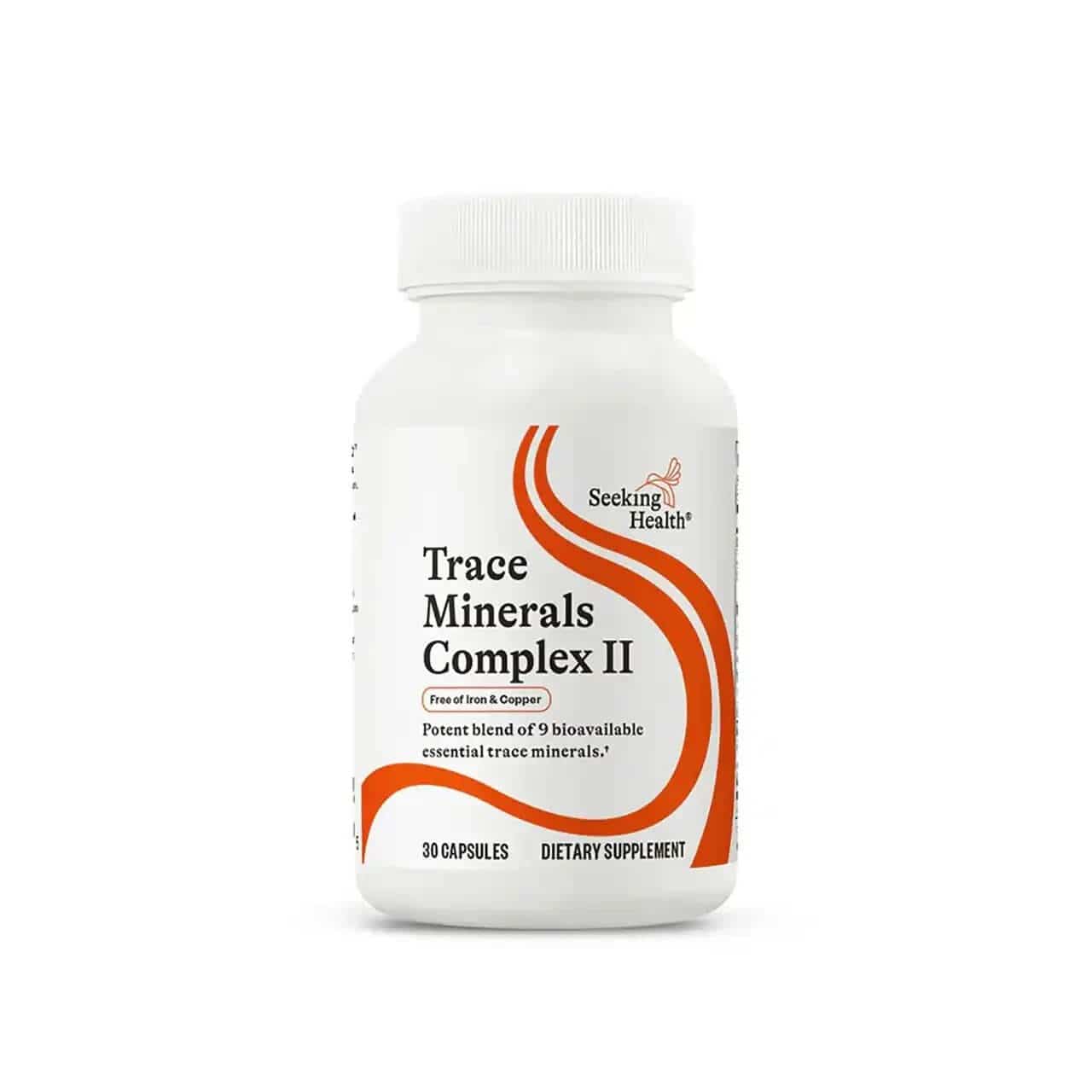
Trace Minerals Complex II is a once-daily capsule from Seeking Health that supplies nine essential trace minerals — iodine, zinc, selenium, manganese, chromium, molybdenum, potassium, boron and vanadium — with no iron and no copper. Six of the nine use Albion amino acid chelates, and the selenium is SelenoExcell high-selenium yeast. One capsule daily, thirty capsules per bottle. It exists for the person who wants the rest of the trace mineral panel but is already getting copper from somewhere else, or has been told to leave copper out.
What is Trace Minerals Complex II Seeking Health?
People searching for Trace Minerals Complex II Seeking Health are usually trying to settle one question: why does this exist when the same company already sells a Trace Minerals Complex? The answer is copper, and that's genuinely the whole of it.
Minerals split roughly into two groups. Macrominerals — calcium, magnesium, potassium — are needed in hundreds of milligrams or grams per day, and they get most of the attention. Trace minerals are needed in milligrams or micrograms, which makes them sound optional. They aren't. Seeking Health's framing is that trace minerals are required for a large number of enzymatic reactions, and support the healthy functioning of the immune system, neurotransmitters, hormones, energy production and metabolism.
The formula is deliberately subtractive. Most broad mineral products include copper, because copper is genuinely essential and because leaving it out looks like an omission. Seeking Health makes two versions instead: the original with copper, and this one without. Iron is absent from both — a common choice in practitioner-grade formulas, since iron shouldn't be supplemented without knowing your ferritin, and it competes for absorption with several of the minerals sitting next to it in this capsule.
What separates this from a supermarket multimineral is mostly the forms. Six of the nine minerals are Albion amino acid chelates — the mineral is bound to glycine rather than paired with a sulfate or oxide anion. Minerals are difficult for the body to handle in supplement form, and cheaper inorganic salts are the main reason a mineral tablet can pass through you having delivered very little. In a crossover trial in twelve healthy women, zinc bis-glycinate raised oral zinc bioavailability by about 43% compared with zinc gluconate — and gluconate is already a step up from sulfate. That's the practical argument for chelation, and it's the same logic behind the glycinate forms we've written about in magnesium glycinate.
Trace Minerals Complex II 30c
$20.00
Trace Minerals Complex II by Seeking Health Introduction: Trace Minerals Complex II by Seeking Health provides a comprehensive blend of essential and rare trace minerals… Click here to read more
What's actually in each capsule?
Here's the full panel in a one-capsule serving of Trace Minerals Complex II Seeking Health, with what each mineral is doing rather than a restatement of the label.
Iodine — 250 mcg (167% DV), as potassium iodide
Iodine has one job in human physiology, and it's a narrow one: it's the raw material the body builds thyroid hormone from. There is no substitute atom. The RDA is 150 mcg and the tolerable upper limit for adults is 1,100 mcg, so 250 mcg sits comfortably between the two. Worth knowing: Seeking Health does not list thyroid support among this formula's benefits, and we're not going to add a claim they didn't make. What we can tell you is the dose and what iodine is used for.
Zinc — 30 mg (273% DV), as zinc bisglycinate chelate
Zinc is a cofactor in hundreds of enzymes and a structural component of a large family of DNA-binding proteins. It's also the most consequential number on this label. The RDA is 11 mg for men and 8 mg for women; the upper limit is 40 mg. At 30 mg you're well under the ceiling but roughly three times the requirement, and this is a copper-free formula. More on that below.
Selenium — 200 mcg (364% DV), as SelenoExcell high-selenium yeast
Selenium is incorporated into around twenty-five human selenoproteins, including the glutathione peroxidases and the deiodinases. The form matters more here than almost anywhere else on the label. In a human dose-ranging trial, selenomethionine and selenium yeast raised plasma selenium in a dose-dependent way while sodium selenite did not. SelenoExcell is a high-selenium yeast, so it belongs to the group that moved the needle. 200 mcg is a research-typical dose and sits under the 400 mcg upper limit — but it is not a small amount, and it stacks with any other selenium you're taking.
Manganese — 4 mg (174% DV), as manganese bisglycinate chelate
Manganese is the metal at the center of mitochondrial superoxide dismutase and is required by the enzymes that assemble cartilage matrix. Deficiency is rare in people eating plants; excess manganese, mostly from industrial inhalation rather than diet, is neurologically unpleasant. The upper limit is 11 mg, so 4 mg leaves room, but it's a mineral to keep an eye on if you're taking a multivitamin alongside this.
Chromium — 200 mcg (571% DV), as chromium nicotinate glycinate chelate
Chromium's role in the body relates to insulin signaling, and 200 mcg is the dose most of the older literature used. That percentage looks alarming until you notice the Daily Value is 35 mcg and no upper limit has been established, because chromium from food and supplements has proven difficult to overdo. We're describing what the mineral does, not promising an effect.
Molybdenum — 150 mcg (333% DV), as molybdenum glycinate chelate
Molybdenum is the one nobody thinks about. It's the cofactor for sulfite oxidase, xanthine oxidase and aldehyde oxidase — the enzymes that handle sulfur compounds and purines. The upper limit is 2,000 mcg, so 150 mcg is a modest inclusion.
Potassium — 99 mg (2% DV), as potassium chloride
Here's the thing most write-ups skip. Potassium is a macromineral, not a trace mineral, and 99 mg against a 4,700 mg Daily Value is 2%. It's in here because Seeking Health notes that many people are short on potassium — but the reason it's exactly 99 mg is regulatory convention, not formulation strategy. Oral potassium supplements are held to 99 mg per unit dose in the US. So treat this as a token amount. If you need potassium, you need food or a prescription, not this capsule.
Boron — 500 mcg, as Bororganic Glycine
Boron has no established Daily Value, which is why the label shows an asterisk. It shows up in research on bone and on steroid hormone metabolism. 500 mcg is within the range typical diets supply.
Vanadium — 150 mcg, as vanadium nicotinate glycinate chelate
Vanadium is the most speculative inclusion on the label. No Daily Value, no clearly established human requirement, and the studies that used it for anything interesting used doses hundreds of times larger. 150 mcg is a nutritional-insurance amount rather than an active one.
Horsetail — 100 mcg (aerial parts)
This is a tenth of a milligram of dried herb, and we're not going to pretend it's doing meaningful work. Horsetail is usually included as a plant source of silica, but at 100 mcg the amount of silica delivered is negligible — and silica appears separately in the Other Ingredients as an excipient. If you're buying this bottle for the horsetail, buy something else.
Who may benefit from this formula?
Seeking Health states that Trace Minerals Complex II supports healthy nervous system function, hormone production, enzyme cofactor activity, hair, skin and nails, immune system function, cardiovascular function, bones, fertility, cognition, and growth, development and healing. Those are broad because trace minerals are broad — they're cofactors, so they show up wherever the enzymes do.
In practical terms, Trace Minerals Complex II Seeking Health tends to fit:
- Anyone already taking copper from a multivitamin or a separate supplement, who wants trace mineral coverage without stacking a second copper dose on top
- People whose practitioner has specifically asked them to avoid supplemental copper
- Anyone who's been assembling this coverage from four or five separate bottles and would rather have one capsule
- People eating a limited or repetitive diet, or one built on produce from depleted soil — Seeking Health cites declining food mineral content as part of the rationale
- Anyone who doesn't tolerate iron-containing formulas
Who should not take this
If you need copper, this is the wrong bottle — buy the original Trace Minerals Complex instead. If you're pregnant or nursing, the iodine and selenium doses are meaningful enough that this is a conversation to have with your provider first, not after. If you already take a comprehensive multivitamin, add up the zinc, selenium, manganese and iodine across both labels before you start; overlap is the norm, not the exception.
If you're not sure which of those describes you, the licensed wellness professionals at Holistic Health Partners offer a free product consultation. We'd rather you buy the right bottle than a second one.
How does Trace Minerals Complex II Seeking Health compare to the original?
This is the only comparison that really matters, because Seeking Health makes both and points buyers between them.
| Trace Minerals Complex II | Trace Minerals Complex (original) | |
|---|---|---|
| Minerals | 9 | 10 |
| Copper | None | Included |
| Iron | None | None |
| Chelated forms | Albion chelates | Albion chelates |
| Best for | Copper covered elsewhere, or being avoided | No other copper source |
If you have no other copper source, the original wins outright and this page shouldn't talk you out of it. Copper is essential, most people aren't getting an excess of it, and the original formula is otherwise built the same way. Trace Minerals Complex II Seeking Health earns its place only when copper is already handled — which, for anyone on a decent multivitamin, it usually is.
How do you take it?
Taking Trace Minerals Complex II Seeking Health is simple, but one detail on the label is easy to skip past. One capsule daily with food, thirty capsules per bottle, so a bottle is a month.
The "with food" part is worth honoring rather than ignoring. Food slows gastric emptying, which spreads absorption out instead of dumping 30 mg of zinc into an empty stomach — and zinc on an empty stomach is a well-known way to feel briefly nauseated. If you take a separate calcium or iron supplement, put several hours between them and this capsule, since those minerals compete for the same transporters.
Give it a fair trial before deciding anything. Correcting a genuine trace mineral shortfall isn't something you feel in a week; tissue stores rebuild over one to three months. If you're taking it as nutritional insurance rather than to correct a known deficiency, there may be nothing to feel at all, and that's not a failure of the product.
What this won't do
Trace Minerals Complex II Seeking Health won't tell you whether you needed it. Nothing on this label is testable by how you feel, and a mineral panel or a red-cell zinc is the only way to know if you were short in the first place.
It won't correct a potassium deficiency. 99 mg is 2% of the Daily Value.
It won't deliver anything meaningful from the horsetail.
And here's the one that matters most: taken indefinitely without any copper in the picture, 30 mg of zinc a day is not a neutral choice. Zinc and copper compete for absorption in the gut, and sustained high-dose zinc is a recognized route to copper deficiency, which is easy to miss clinically. The copper-free design is a feature when copper is coming from elsewhere, and a liability when it isn't. That's not a warning Seeking Health prints on the bottle — it's mineral physiology, and it's the single most important thing to understand before you make this a permanent part of your routine. If you plan to take it for more than a few months, copper status is worth checking.
Trace Minerals Complex II 30c
$20.00
Trace Minerals Complex II by Seeking Health Introduction: Trace Minerals Complex II by Seeking Health provides a comprehensive blend of essential and rare trace minerals… Click here to read more
Safety considerations
Trace Minerals Complex II Seeking Health safety starts with an absence: there is no warning statement printed on the label. That's not unusual for a mineral formula at these doses, but a label silence isn't the same as an all-clear.
Every dose here sits under its established tolerable upper limit as a single product. The risk isn't this capsule in isolation — it's this capsule plus a multivitamin plus a zinc lozenge in February, all counted together. Zinc has a 40 mg ceiling and this contributes 30 mg. Selenium has a 400 mcg ceiling and this contributes 200 mcg. Two products can put you over without either one looking aggressive on its own. Compare labels and add.
The formula contains no gluten, dairy, soy or GMO ingredients, and the capsule is vegetarian (hypromellose). Other ingredients are ascorbyl palmitate and silica.
As with any supplement, consult your healthcare provider before use, especially if you are pregnant, nursing, or taking medications.
Is Trace Minerals Complex II Seeking Health worth it?
It's worth it for a specific person: someone who wants broad trace mineral coverage in one capsule, in forms that actually absorb, and who has a real reason to leave copper out. For that person it replaces several bottles and does it in well-chosen chemistry — Albion chelates and a selenium yeast rather than the cheap oxides and selenite.
It's not worth it if copper isn't covered elsewhere, in which case the original formula is the better buy. It's not worth it as a potassium source. And the honest trade-off: nine minerals at fixed doses means you're accepting someone else's ratios, including 30 mg of zinc whether or not that's your number. Anyone who knows they need a lot of one mineral and none of another is better served buying two bottles than one.
Gus's question turns out to be the right question. He's already getting copper from his multivitamin, so a second copper dose is the thing to avoid — which is exactly what this formula was built around. Whether he needed the other nine is a blood test rather than a bottle, and that's the part worth settling before he decides whether Trace Minerals Complex II Seeking Health belongs in his cupboard at all.
Not sure if this is the right product for you?
The licensed wellness professionals at Holistic Health Partners, led by Carolyn Mulally BS, RN, HN-BC, offer free product consultations — no appointment required. They can help you find the right supplement for your specific health goals.
Get a Free Consultation
These statements have not been evaluated by the Food and Drug Administration. This product is not intended to diagnose, treat, cure, or prevent any disease.
More on this brand: Liver Nutrients Seeking Health and HistaminX Seeking Health.