B Complex MF Seeking Health: Methyl-Free B Vitamins
Table of Contents
- What is B Complex MF Seeking Health?
- What's in each capsule, and what does each B vitamin actually do?
- Thiamin — 25 mg (2,083% DV), as thiamine hydrochloride
- Riboflavin — 20 mg (1,538% DV), as riboflavin 5'-phosphate sodium
- Niacin — 95 mg NE (594% DV), as inositol hexanicotinate and niacin
- Vitamin B6 — 20 mg (1,176% DV), as pyridoxal 5'-phosphate
- Folate — 400 mcg DFE (235 mcg), as folinic acid from calcium folinate
- Vitamin B12 — 50 mcg (2,083% DV), as adenosylcobalamin and hydroxocobalamin
- Biotin — 750 mcg (2,500% DV)
- Pantothenic Acid — 125 mg (2,500% DV), as d-calcium pantothenate
- Who should take B Complex MF Seeking Health?
- How does B Complex MF Seeking Health compare to B Complex Plus?
- How do you take it?
- What this won't do
- Safety considerations
- Is B Complex MF Seeking Health worth it?
- FAQs
Priya has bound books for nineteen years and can tell hide glue from PVA with her eyes shut. She's 47. Twice now she's started a B-complex and quit inside a week — wired by ten in the morning, heart going like she'd had four coffees, a headache parked behind one eye. The last bottle listed methylfolate. Her pharmacist wrote B Complex MF Seeking Health on the back of the receipt and told her to look at the folate line.
She hasn't bought it. What she wants to know is whether "methyl-free" means the B vitamins are weaker or just different, and whether the thing that made her feel wired is the same thing this formula leaves out.
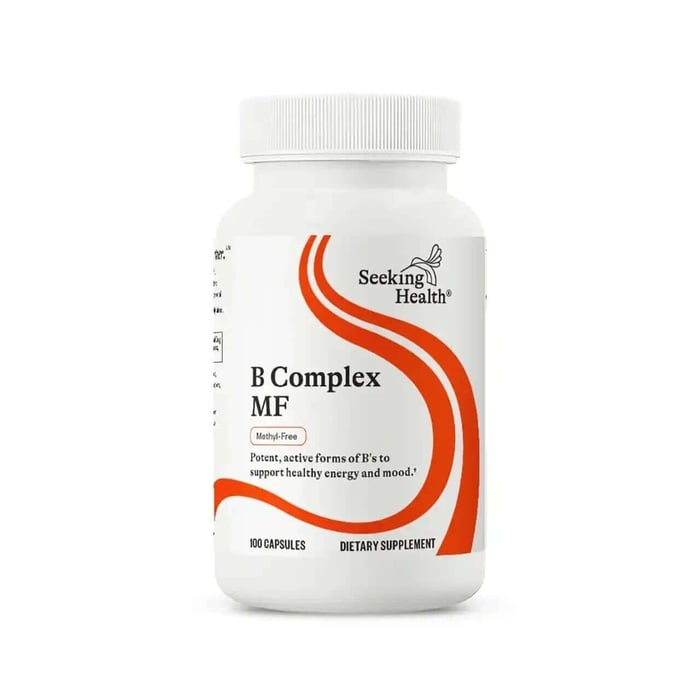
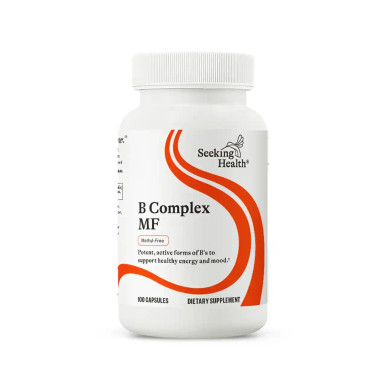
B Complex MF Seeking Health is a once-daily capsule containing all eight essential B vitamins, built on two deliberate substitutions: folate as folinic acid from calcium folinate instead of methylfolate, and vitamin B12 as adenosylcobalamin and hydroxocobalamin instead of methylcobalamin. One capsule with food, 100 capsules per bottle. Seeking Health positions it for people sensitive to methyl donors, and lists it as suitable for bariatric patients, pregnancy, breastfeeding, vegetarians, vegans, and ages four and up.
What is B Complex MF Seeking Health?
People searching for B Complex MF Seeking Health are usually trying to settle one question: what does the MF actually change? It stands for methyl-free, and that suffix is doing all the work. Seeking Health sells several B-complex formulas that overlap heavily on seven of the eight vitamins. What separates this one is the chemistry of two rows on the panel.
The bottle puts the design in a single sentence: B Complex MF provides a potent blend of unmethylated, active forms of B vitamins. Both halves matter. Unmethylated describes the folate and B12. Active describes most of the rest, which arrive in their coenzyme forms rather than as precursors.
Seeking Health's own explanation of why is more candid than most label copy: some people experience nervousness, headaches, or rapid heartbeat when they take methylcobalamin and methylfolate. They don't claim to know why, and neither will we. The formula's answer is to supply folate and B12 in forms that sit further upstream. Folinic acid and the adenosyl and hydroxo forms of B12 take additional enzyme steps before they become methyl donors, and the company's stated rationale is that this slower delivery may provide comfort for those sensitive to methylated nutrients.
Seeking Health states that B Complex MF supports healthy energy production, hormone balance, positive mood, nerves and brain, red blood cells, homocysteine levels, and immune system function. It provides more than 100% of the Daily Value for all eight essential B vitamins.
The exclusion list is as informative as the ingredient list. B Complex MF contains no methylated B vitamins, no methylcobalamin, no methylfolate, no SAMe, no choline, no inositol, and no trimethylglycine. A conventional "methylation support" B-complex usually includes several of those on purpose. This one is defined by their absence, which is why it isn't simply a cheaper or weaker version of the standard formula — it's a different tool.
B Complex MF 100c
$32.00
B Complex MF 100c by Seeking Health Key Benefits and Actions* Methyl-free vitamin B complex Supports healthy energy production Supports a healthy mood Neurotransmitter balance,… Click here to read more
What's in each capsule, and what does each B vitamin actually do?
One capsule is a full serving, and the bottle holds 100. Here's the panel with what each nutrient does, rather than a restatement of the label.
Thiamin — 25 mg (2,083% DV), as thiamine hydrochloride
Thiamin becomes thiamine pyrophosphate, the cofactor for pyruvate dehydrogenase and alpha-ketoglutarate dehydrogenase. Those are the two gates carbohydrate carbon passes through on its way into the Krebs cycle. Block them and pyruvate backs up as lactate, which is why thiamin deficiency shows up as fatigue and neurological trouble rather than anything localized. The RDA is around 1.2 mg, so 25 mg is roughly twenty times a day's requirement. This is plain thiamine hydrochloride, not benfotiamine or TTFD — fine for general repletion, but not the lipid-soluble derivative used in nerve-specific protocols.
Riboflavin — 20 mg (1,538% DV), as riboflavin 5'-phosphate sodium
Riboflavin 5'-phosphate is FMN, the already-phosphorylated form. Normally riboflavin kinase does that step; here it's done for you. FMN and FAD are the flavin electron carriers that complexes I and II of the respiratory chain run on.
There's a detail here that ties the whole formula together and almost nobody mentions it. MTHFR — the enzyme that converts folate into methylfolate — is a flavoprotein. It requires FAD to work. So the riboflavin in this capsule supports the exact conversion step that folinic acid depends on downstream. If you're taking a methyl-free folate on the assumption your body will finish the job, riboflavin status is part of whether that assumption holds.
One concrete thing to expect: riboflavin at this dose turns urine bright yellow within a few hours. It's harmless and it's the excess being cleared.
Niacin — 95 mg NE (594% DV), as inositol hexanicotinate and niacin
Niacin becomes NAD and NADP, the redox currency for several hundred enzymes. The interesting part is the split form. Inositol hexanicotinate is six niacin molecules esterified onto a single inositol ring; it hydrolyzes slowly, which is the basis for calling it a no-flush niacin. Plain niacin is also present, and the label doesn't break out the ratio.
Worth a footnote for anyone reading that exclusion list closely. Inositol hexanicotinate releases inositol when it hydrolyzes. The quantity is small and inositol isn't a methyl donor, so it doesn't undercut the methyl-free premise — but if you're avoiding inositol itself rather than methyl groups, that's something to know before ordering.
Vitamin B6 — 20 mg (1,176% DV), as pyridoxal 5'-phosphate
P5P is the active coenzyme form, skipping the liver conversion that pyridoxine requires. B6 is a cofactor for well over a hundred enzymes, including the decarboxylases that build serotonin, dopamine, and GABA from their amino acid precursors.
It also matters for the homocysteine claim. There are two routes for clearing homocysteine: remethylation back to methionine, which needs folate and B12, and transsulfuration down to cysteine, which needs B6. This formula supplies inputs for both. B6 is also the one B vitamin with a real ceiling — chronic high intakes are associated with sensory neuropathy, and the tolerable upper limit for adults is 100 mg per day. At 20 mg you have room, but B6 appears in a lot of products, so add up your labels.
Folate — 400 mcg DFE (235 mcg), as folinic acid from calcium folinate
This is the row Priya's pharmacist pointed at. Folinic acid is 5-formyl-tetrahydrofolate. It enters the folate pool upstream of MTHFR, so the body has to run it forward to reach 5-MTHF, the active circulating form. Seeking Health's framing is that folinic acid is readily transformed into methylfolate in the body — readily, but not instantly, and that lag is the entire design intent.
The two numbers confuse people. Folate is measured in Dietary Folate Equivalents, which apply a 1.7x factor to supplemental folate taken with food. 235 mcg times 1.7 gives 400 mcg DFE. Same folate, two units.
Now notice something the marketing doesn't point out: folate is the only nutrient on this entire panel at exactly 100% of the Daily Value. Thiamin is at 2,083%, biotin at 2,500%. Folate is at 100%. That is a deliberate restraint, and it means this is a maintenance dose of folate sitting inside an otherwise generous B-complex.
Vitamin B12 — 50 mcg (2,083% DV), as adenosylcobalamin and hydroxocobalamin
Two forms, neither of them methylcobalamin. Adenosylcobalamin is the mitochondrial form, the cofactor for methylmalonyl-CoA mutase. Hydroxocobalamin is a stable transport and storage form the body converts as needed. Seeking Health notes that both convert readily to methylcobalamin.
Fifty micrograms sounds like a lot against a 2.4 mcg RDA, but oral B12 absorption is unusual: the intrinsic factor pathway saturates at roughly 1.5 to 2 mcg per dose, and everything above that is absorbed by passive diffusion at around 1% efficiency. So 50 mcg is a sensible daily-maintenance number and not a repletion dose.
Biotin — 750 mcg (2,500% DV)
Biotin is the cofactor for four carboxylases that handle gluconeogenesis, fatty acid synthesis, and the breakdown of certain amino acids. Outright deficiency is rare because gut bacteria make some and requirements are small. At 750 mcg this is a generous inclusion, and it has a practical consequence for anyone getting blood work — covered in safety below.
Pantothenic Acid — 125 mg (2,500% DV), as d-calcium pantothenate
Pantothenic acid is the backbone of coenzyme A. Every acetyl group your metabolism moves rides on CoA, which makes it as close to universally required as a nutrient gets. The d- prefix matters: it's the biologically active enantiomer, and the racemic dl- mixture found in cheaper products is half inert.
Other ingredients are the vegetarian capsule (hypromellose and water), ascorbyl palmitate, and silica. The bottle's exclusion list is broad: it does not contain dairy, eggs, fish, shellfish, tree nuts, peanuts, wheat, soy, sesame, gluten, GMO, artificial colors, or artificial flavors. That covers all nine major US allergens, which is worth knowing if you've been reading labels for one of them.
Who should take B Complex MF Seeking Health?
Seeking Health lists the formula as suitable for bariatric patients, the methyl sensitive, pregnancy, breastfeeding, vegetarians, vegans, and ages four and up. In practical terms, B Complex MF Seeking Health tends to fit:
- Anyone who has felt wired, headachy, or unusually jittery after starting a methylated B-complex or a multivitamin containing methylfolate
- People told by a practitioner to trial a methyl-free protocol before reintroducing methyl donors
- Vegetarians and vegans, who need a reliable B12 source and often want B-complex coverage alongside it
- Post-bariatric patients, whose absorption of B vitamins is altered by anatomy rather than by diet
- Anyone managing several food allergies, given how short the exclusion list leaves the risk surface
- Anyone wanting to add B coverage on top of a multivitamin that's thin on B vitamins — Seeking Health explicitly frames it as a companion to a daily multi
Who should not take this
If you tolerate methylated B vitamins perfectly well, there's no advantage here and a methylated formula gets you to the active forms in fewer steps. If you have a diagnosed B12 deficiency, 50 mcg orally is a maintenance amount and not a correction — that's a conversation about injections or high-dose sublinguals with your provider. And if you're taking this because you read something about MTHFR online but have never had symptoms from methyl donors, you're solving a problem you may not have.
If you're not sure which of those describes you, the licensed wellness professionals at Holistic Health Partners offer a free product consultation. We'd rather you buy the right bottle than a second one.
How does B Complex MF Seeking Health compare to B Complex Plus?
This is the comparison that matters, because Seeking Health makes both and the choice between them is the only real decision.
| B Complex MF | B Complex Plus | |
|---|---|---|
| Folate form | Folinic acid (calcium folinate) | Methylfolate (5-MTHF) |
| B12 form | Adenosylcobalamin + hydroxocobalamin | Methylcobalamin + adenosylcobalamin |
| B12 amount | 50 mcg | 50 mcg |
| Conversion steps to active folate | Additional steps required | Already active |
| Best for | Reacts badly to methyl donors | Tolerates methyl donors well |
If methyl donors don't bother you, B Complex Plus is the better buy and this page shouldn't talk you out of it. Delivering 5-MTHF directly removes a conversion step, which is a genuine advantage for anyone whose MTHFR activity is reduced. B Complex MF Seeking Health earns its place on one condition only: that the methylated forms have actually caused you trouble. Buying the methyl-free version as a precaution against a reaction you've never had means accepting slower conversion for no benefit.
For the other side of that argument, we've written about Methyl B-Complex by Quicksilver Scientific and about XaQuil XR, an extended-release methylfolate.
How do you take it?
Taking B Complex MF Seeking Health is simple, but one line on the label is easy to skip past. Seeking Health's directions, verbatim from the bottle: as needed, take 1 capsule with food. Use as directed by your healthcare professional. One capsule is the full serving and the bottle holds 100, so a bottle is a little over three months at daily use.
Then there's the instruction almost no retailer reprints, and it's the most useful sentence on the label: do not take within 5 hours of bedtime, as it may interfere with sleep. Not "avoid if sensitive" — do not. A B-complex at these amounts is stimulating for a lot of people, and five hours is a wider margin than most labels bother to specify. If you take it with breakfast or lunch you'll never think about it again. If you take it with dinner, you may spend the night wondering why you're staring at the ceiling.
The "with food" part is not filler either. Food buffers the niacin and slows absorption, and the DFE conversion factor for folate assumes it's taken with a meal.
Give it a fair trial. If you're switching because methylated forms made you feel wired, you'll know within a week or two whether the symptom is gone — that part is fast. Repleting an actual B vitamin shortfall is slower, on the order of one to three months, and if you weren't short to begin with there may be nothing to feel at all. That's not a failure of the product.
What this won't do
B Complex MF Seeking Health won't fix an MTHFR variant. Folinic acid still has to travel through MTHFR to become 5-MTHF, so if reduced enzyme activity is your issue, the methyl-free route asks more of that enzyme, not less. What it changes is the speed of delivery, not the destination.
It won't correct a diagnosed B12 deficiency. Fifty micrograms orally is maintenance.
It won't deliver a high-dose folate. 400 mcg DFE is 100% of the Daily Value, full stop, and protocols calling for more will need a separate folate product.
It won't replace a multivitamin. There are no minerals here, no vitamin D, no vitamin A, no antioxidants. Eight B vitamins is the whole product, and Seeking Health frames it as an addition to a daily multi rather than a substitute for one.
And the honest one: it won't tell you whether you needed it. Nothing on this label is measurable by how you feel unless you were deficient or reacting to methyl donors. If neither is true, this is nutritional insurance, and insurance is something you buy without expecting to notice it working.
B Complex MF 100c
$32.00
B Complex MF 100c by Seeking Health Key Benefits and Actions* Methyl-free vitamin B complex Supports healthy energy production Supports a healthy mood Neurotransmitter balance,… Click here to read more
Safety considerations
B Complex MF Seeking Health safety starts with the label's own instructions, carried at full strength: do not take within 5 hours of bedtime, as it may interfere with sleep. Use as directed by your healthcare professional. Keep closed in a cool, dry place out of reach of children. Do not use if the inner tamper seal is damaged.
The item most likely to affect you outside your own body is biotin. At 750 mcg, this capsule contains far more biotin than a diet supplies, and supplemental biotin can interfere with immunoassays that use biotin-streptavidin binding — a category that includes many thyroid panels and some cardiac troponin tests, where it can push results falsely high or falsely low depending on the assay design. Seeking Health does not print this, and it isn't unique to their product; it applies to any biotin-containing supplement. The practical step is simple: tell your doctor or the phlebotomist that you take a biotin-containing supplement before blood is drawn, and ask whether to pause it beforehand. This matters most if you're being worked up for a thyroid problem or evaluated for chest pain.
Two other things worth expecting rather than worrying about. Riboflavin will turn your urine bright yellow. And because part of the niacin is present as plain niacin rather than the inositol ester, a warm flush across the face or chest is possible in sensitive people, particularly on an empty stomach — which is one more reason the "with food" instruction is there.
B6 at 20 mg sits well below the 100 mg adult upper limit, but B6 is common in multivitamins, energy drinks, and nerve formulas. If you take several products, total the B6 across all of them.
On allergens, the bottle states the formula does not contain dairy, eggs, fish, shellfish, tree nuts, peanuts, wheat, soy, sesame, gluten, GMO, artificial colors, or artificial flavors.
As with any supplement, consult your healthcare provider before use, especially if you are pregnant, nursing, or taking medications.
Is B Complex MF Seeking Health worth it?
It's worth it for a narrow and real group: people who have tried a methylated B-complex, felt genuinely bad on it, and still need B vitamins. For them this solves a specific problem, and it does it without cutting corners elsewhere on the panel — riboflavin as R5P, B6 as P5P, pantothenic acid as the active d- enantiomer. Those are the choices of a formulator who cared about the other six vitamins too.
It's not worth it if methylated forms have never given you trouble, in which case B Complex Plus is the better product. It's not worth it as a folate dose or a B12 correction.
The honest trade-off is that you're paying for slower conversion. Folinic acid and hydroxocobalamin ask your enzymes to do work that a methylated formula does for you. For someone who feels awful on methyl donors, that extra work is precisely the point. For everyone else, it's a step backward dressed as a feature.
Priya's question was the right one to ask. Methyl-free doesn't mean weaker — seven of the eight vitamins here are identical to the standard formula, several in their activated forms. It means two ingredients arrive by a longer road. Whether B Complex MF Seeking Health suits her is something she'll know inside a fortnight, which is a faster answer than most supplements offer.
Not sure if this is the right product for you?
The licensed wellness professionals at Holistic Health Partners, led by Carolyn Mulally BS, RN, HN-BC, offer free product consultations — no appointment required. They can help you find the right supplement for your specific health goals.
Get a Free Consultation
These statements have not been evaluated by the Food and Drug Administration. This product is not intended to diagnose, treat, cure, or prevent any disease.
More on this brand: Liver Nutrients Seeking Health and HistaminX Seeking Health.