Magnesium Glycinate vs Citrate: What to Know
Table of Contents
- Magnesium glycinate vs citrate: what is the difference?
- Magnesium glycinate vs citrate: which absorbs better?
- Why does magnesium citrate loosen stools when glycinate usually doesn't?
- Magnesium glycinate vs citrate for sleep: which is better?
- How do you dose magnesium glycinate vs citrate?
- Which magnesium glycinate and citrate products does Covenant carry?
- What won't magnesium glycinate or citrate do?
- Who should skip magnesium supplements or check with a clinician first?
- Can you take magnesium glycinate and citrate together?
- What about other magnesium forms?
- The bottom line on magnesium glycinate vs citrate
- FAQs
Quick answer: In the magnesium glycinate vs citrate choice, the deciding factor is your gut, not the mineral. Magnesium glycinate is magnesium bound to the amino acid glycine. It is gentle on the gut and is the usual pick for an evening dose aimed at relaxation and sleep support. Magnesium citrate is magnesium bound to citric acid. It dissolves easily, absorbs well, and draws water into the bowel, so it suits people who also want help with regularity. Both are taken as 1 to 4 capsules a day with food, and adults should keep supplemental magnesium at or under 350 mg a day unless a clinician advises otherwise.
On a Tuesday in October, Constance Adeyemi, a nurse practitioner who keeps a jar of butterscotch candies on her desk, heard the same question twice before lunch. At 9:00, Wendell Pruitt, a 58-year-old freight dispatcher who sits for ten hours a shift, asked which magnesium to buy. At 11:30, Priya Venkataraman, a 44-year-old cellist with a stomach that objects to almost every supplement she tries, asked the same thing. Constance gave them different answers and wrote both on a sticky note headed "Magnesium glycinate vs citrate" so she would stop explaining it from scratch: "Citrate if you want things moving. Glycinate if you want things quiet."
That sticky note is most of the story. Here is the rest of it.
Magnesium glycinate vs citrate: what is the difference?
The difference is the molecule the magnesium is attached to, and that partner changes how the supplement behaves in your gut. The magnesium itself is the same mineral either way.
- Magnesium glycinate (also sold as bisglycinate or "chelate") binds magnesium to glycine, an amino acid. The bond holds up well in the digestive tract, and people with sensitive stomachs tend to tolerate it.
- Magnesium citrate binds magnesium to citric acid. It dissolves readily in water, which helps absorption, and the part that is not absorbed pulls water into the bowel. In larger amounts that has a laxative effect.
Almost everything else in the magnesium glycinate vs citrate comparison follows from those two bonds.
One label detail trips people up. Every product in this guide lists elemental magnesium per capsule, meaning the amount of the mineral itself, not the weight of the whole compound. When you compare bottles, compare that elemental number.
| Magnesium glycinate | Magnesium citrate | |
|---|---|---|
| Bound to | Glycine (an amino acid) | Citric acid |
| Effect on the bowel | Usually minimal at label doses | Mild to noticeable loosening, more as the dose climbs |
| Typical elemental Mg per capsule (products below) | 120 mg | 135–150 mg |
| Common timing | Evening, with dinner | Morning or split, with meals |
| Usually chosen for | Relaxation and sleep support, sensitive stomachs | General magnesium intake plus bowel regularity, lower cost |
Magnesium glycinate vs citrate: which absorbs better?
Both absorb well, and both are clearly better absorbed than magnesium oxide, the cheap form in many drugstore multis. The gap between glycinate and citrate is small and depends on how you measure it.
The best head-to-head data comes from a 60-day randomized, double-blind study of 46 healthy adults who took 300 mg of elemental magnesium a day as an amino-acid chelate, as citrate, or as oxide. Both organic forms, the chelate and the citrate, showed greater absorption than oxide by 24-hour urine magnesium at 60 days. Citrate produced the highest average blood magnesium after both the first dose and two months of daily use, and the highest saliva magnesium. Oxide performed no better than placebo.
The NIH Office of Dietary Supplements reaches a similar conclusion in its magnesium fact sheet for health professionals: forms that dissolve well in liquid, including citrate, tend to absorb better than oxide and sulfate.
So if absorption is your only question, citrate has a slight edge in the one direct comparison, and glycinate is close behind. There is no single best form of magnesium for everyone. For most people, the better question is which side effects and timing fit your day.
Why does magnesium citrate loosen stools when glycinate usually doesn't?
It comes down to osmosis. Any magnesium your intestine does not absorb holds water in the bowel and speeds things along. The NIH fact sheet explains that the diarrhea and laxative effects of magnesium salts come from the osmotic activity of unabsorbed salts in the intestine and colon, plus stimulation of gut motility.
Citrate is the classic example, and that osmotic pull is what people mean by the magnesium citrate laxative effect. At capsule doses it is usually mild, and some people count it as a feature: a capsule or two of citrate in the morning supports regularity along with their magnesium intake. Glycinate is generally described as gentler on digestion, which is why it is the common choice for people who react to other forms.
Neither form is immune. Thorne's label for its citrate-malate blend says it plainly: gas, bloating, or diarrhea may occur in some people taking magnesium, and it resolves when the amount is reduced. That holds for glycinate at high enough doses too.
Magnesium glycinate vs citrate for sleep: which is better?
Glycinate is the form most people mean when they ask about magnesium for sleep, and it now has a placebo-controlled trial of its own. The case for it over citrate rests more on tolerance and on the glycine than on a direct comparison, because no trial has tested the two head to head for sleep.
In a 2025 randomized, double-blind trial, 155 adults aged 18 to 65 who reported poor sleep took either magnesium bisglycinate (250 mg of elemental magnesium daily) or a placebo. After four weeks, scores on a standard sleep-severity questionnaire improved more in the magnesium group than in the placebo group. The authors called the benefit modest, with a small effect size, and noted that people who ate the least magnesium at baseline seemed to respond most. That is an honest result: real, small, and probably largest for people whose diet runs low.
The glycine half of the molecule may also play a part. Glycine is an amino acid studied on its own for sleep. In one study of sleep-restricted healthy volunteers, 3 grams of glycine at bedtime reduced next-day fatigue and improved a reaction-time test compared with placebo. Keep the scale in mind: 3 grams is far more glycine than a few magnesium glycinate capsules supply, so the glycine in your capsule is a supporting player, not a sleep dose.
The practical takeaway: if your goal is an evening routine and a calm stomach, glycinate is the sensible default. If citrate already agrees with you, it still delivers magnesium, and taking it with dinner is fine as long as the loosening effect does not interrupt your night.
How do you dose magnesium glycinate vs citrate?
Take it with food, start low, and build up. The four products in this guide all suggest a range of 1 to 3 or 1 to 4 capsules a day. Here is how that plays out.
| Magnesium glycinate | Magnesium citrate | |
|---|---|---|
| Starting dose | 1 capsule (120 mg) with dinner | 1 capsule (135–150 mg) with a meal |
| Label range | Pure: 1–4 capsules daily with meals. Douglas: 1 capsule 1–2 times daily | Pure: 1–4 capsules daily with food. Thorne: 1 capsule 1–3 times daily |
| When | Evening, or split between lunch and dinner | Morning or split across meals |
| With food? | Yes | Yes |
| How to adjust | Add 1 capsule every few days if needed | If stools get loose, drop back one capsule |
| Give it | About 4 weeks (the length of the 2025 sleep trial) | A few days to judge bowel effects; several weeks for the rest |
| Upper limit | 350 mg a day of supplemental magnesium for adults (NIH), counting every supplement you take. Higher only under a clinician's direction. | |
Two things people miss about the magnesium upper limit. First, the 350 mg figure covers magnesium from all supplements combined: a multivitamin, a calcium-magnesium blend, and a sleep formula can add up quickly. Read every label. Second, four capsules of the Pure Encapsulations citrate is 600 mg of elemental magnesium, well above that limit. The top of a label's range is for use with a healthcare professional's guidance, not a target.
Which magnesium glycinate and citrate products does Covenant carry?
To make the magnesium glycinate vs citrate choice concrete, we compared four capsules from three of our core professional brands: two glycinates and two citrates. Starting prices are Covenant's listed prices as of November 8, 2026.
| Product | Form | Mg per capsule | Sizes | Starting price | Best for |
|---|---|---|---|---|---|
| Pure Encapsulations Magnesium (glycinate) | Glycinate | 120 mg | 90, 180, 360 | $27.00 (90 ct) | Sensitive stomachs, evening use, long-term users who want the big bottle |
| Douglas Laboratories Magnesium Glycinate | Glycinate | 120 mg | 120, 240 | $27.00 (120 ct) | Glycinate at a lower cost per capsule; 1–2 a day |
| Pure Encapsulations Magnesium (citrate) | Citrate | 150 mg | 90, 180 | $20.50 (90 ct) | Lowest cost; magnesium plus regularity support |
| Thorne Magnesium CitraMate | Citrate + malate | 135 mg (80 mg malate, 55 mg citrate) | 90 | $22.00 (90 ct) | A citrate-malate middle path; one bottle size |
Who does Pure Encapsulations Magnesium (glycinate) fit?
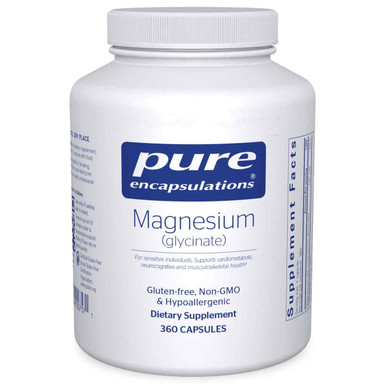
Pure Encapsulations® Magnesium (glycinate) is the glycinate we point most people to first. Each vegetarian capsule supplies 120 mg of magnesium as magnesium glycinate, and the only other ingredients are the cellulose capsule and ascorbyl palmitate. It is made without wheat, soy, dairy, gluten, magnesium stearate, or artificial colors and flavors, which matters to people like Priya who react to fillers as much as to the mineral. The three sizes make it easy to start small and move to the 360-count once you know it agrees with you. Our full guide to Pure Encapsulations Magnesium Glycinate goes deeper.
Magnesium (glycinate)
$27.00
Magnesium (Glycinate) by Pure Encapsulations – Highly Bioavailable Magnesium for Heart Health, Sleep, and Stress Relief Pure Encapsulations Magnesium (Glycinate) is a highly bioavailable form… Click here to read more
Who does Douglas Laboratories Magnesium Glycinate fit?
Douglas Laboratories® Magnesium Glycinate matches the Pure glycinate milligram for milligram, at 120 mg per capsule, in a 120-count bottle at the same starting price as Pure's 90-count. If you take one or two capsules a day and want glycinate for less per capsule, this is the one. The capsule is hydroxypropyl methylcellulose, and the formula contains no yeast, wheat, gluten, soy, dairy, corn, or sugar. Douglas suggests 1 capsule once or twice a day, so it suits a simple evening routine rather than a high-dose plan.
Magnesium Glycinate 120mg
$27.00
Magnesium Glycinate – Highly Absorbable Magnesium Supplement for Muscle, Nerve & Relaxation Support Magnesium Glycinate by Douglas Laboratories® is a highly bioavailable magnesium glycinate supplement… Click here to read more

Who does Pure Encapsulations Magnesium (citrate) fit?
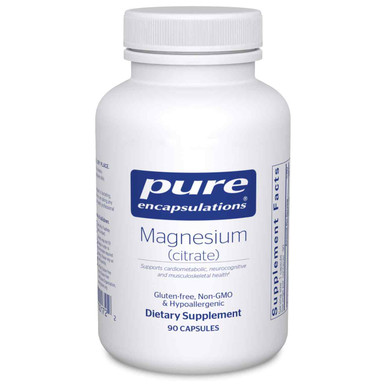
Pure Encapsulations Magnesium (citrate) is the least expensive way to get a clean, well-absorbed magnesium. It carries 150 mg of magnesium per capsule, the most of the four, with the same short ingredient list as its glycinate sibling. It fits Wendell: someone who wants daily magnesium and welcomes a little help with regularity. Start with one capsule in the morning and add a second at lunch only if your gut is fine with it. Our Pure Encapsulations Magnesium Citrate guide covers it in more detail.
Magnesium (citrate) 150mg
$20.50
Magnesium Citrate 150mg by Pure Encapsulations Pure Encapsulations Magnesium Citrate offers a highly bioavailable form of magnesium designed to support critical bodily functions. This premium… Click here to read more
Who does Thorne Magnesium CitraMate fit?
Thorne® Magnesium CitraMate sits between the two camps. According to Thorne's current label, each capsule's 135 mg of magnesium comes mostly from dimagnesium malate (80 mg), with the rest from magnesium citrate (55 mg). With less citrate per capsule than a straight citrate, many people find it gentler on the bowel, though Thorne's label still notes that gas, bloating, or loose stools can occur at higher amounts. Thorne suggests 1 capsule one to three times daily. It fits someone who found straight citrate a little too active but does not need a dedicated evening glycinate.
Magnesium Citramate (135mg) 90c
$22.00
Magnesium Citramate (135 mg) – Highly Absorbable Magnesium Supplement Magnesium Citramate (135 mg) 90c by Thorne is a premium magnesium supplement formulated with a blend… Click here to read more

If you're not sure which form fits your situation, Holistic Health Partners offers a free product consultation. We don't want you to buy more supplements. We want you to buy the right one.
What won't magnesium glycinate or citrate do?
Neither form makes up for a diet that is short on magnesium-rich foods like leafy greens, nuts, seeds, beans, and whole grains. A capsule fills a gap; it does not replace the plate.
Neither is a sleep aid in the way people often hope. The 2025 trial found a small effect, mostly in people who ate little magnesium to begin with. If you already eat well and still sleep badly, a different magnesium form is unlikely to be the missing piece, and the reason is worth discussing with your clinician.
And citrate is not a long-term answer for ongoing constipation. A persistent change in bowel habits deserves a conversation with a doctor, not a bigger dose.
Who should skip magnesium supplements or check with a clinician first?
Most healthy adults tolerate either form well at label doses. Talk with your doctor or pharmacist before starting if any of these apply:
- You have reduced kidney function. The NIH notes that the risk of magnesium toxicity rises when the kidneys cannot clear the excess. This is the most important caution on the list.
- You take an oral bisphosphonate such as alendronate (Fosamax). Magnesium can reduce its absorption, so take the two at least 2 hours apart.
- You take a tetracycline or quinolone antibiotic. Take the antibiotic at least 2 hours before or 4 to 6 hours after a magnesium supplement.
- You take diuretics or proton pump inhibitors. These can affect your magnesium status, which is worth a conversation with whoever prescribes them.
- You are pregnant or nursing. The Pure glycinate, Douglas, and Thorne labels all ask you to check with your healthcare professional first.
- You already get loose stools easily. Skip citrate and start with glycinate at one capsule.
Stop and call your provider if you develop persistent diarrhea, nausea, or unusual weakness after starting magnesium. As with any supplement, consult your healthcare provider before use, especially if you are pregnant, nursing, or taking medications.
Can you take magnesium glycinate and citrate together?
Yes, and many people do: a citrate capsule in the morning for regularity and a glycinate capsule with dinner. The rule is to add the elemental magnesium from both and keep the daily total from supplements at or under 350 mg unless your clinician advises more. One citrate capsule from Pure (150 mg) plus one glycinate capsule (120 mg) comes to 270 mg, which leaves room for the small amount in a typical multivitamin.
What about other magnesium forms?
Magnesium glycinate vs citrate is the comparison people search most, but those two are not the only options. Magnesium L-threonate is mainly marketed for brain support, malate appears in blends like the Thorne CitraMate, and oxide shows up in low-cost multis but absorbs poorly in the study above. The Keep reading links at the bottom of this page cover the individual products in more depth.
The bottom line on magnesium glycinate vs citrate
Pick by what you want the supplement to do besides supplying magnesium. If you want a quiet stomach and an evening routine, choose glycinate. If you want the lowest cost and do not mind, or actively want, some help with regularity, choose citrate. If straight citrate is a bit too much, the Thorne citrate-malate blend is a middle path. Whatever you choose, start with one capsule a day with food, count every source toward the 350 mg limit, and give it about four weeks before you judge it.
Constance's sticky note, for the record, is still on her monitor. She has added a third line: "Count the multi."
FAQs
Which is better, magnesium glycinate or citrate?
Does magnesium citrate make you poop?
Is magnesium glycinate or citrate better for sleep?
How much magnesium glycinate or citrate should I take a day?
Can I take magnesium glycinate and citrate at the same time?
Who should not take magnesium supplements?
Keep reading
- Pure Encapsulations Magnesium Glycinate 360: Benefits, Dosage & More
- Pure Encapsulations Magnesium Citrate: Gentle, Effective Digestive Support
- Magnesium Citramate by Thorne: Energy, Sleep and Muscle Function
Not sure if this is the right product for you?
The licensed wellness professionals at Holistic Health Partners, led by Carolyn Mulally BS, RN, HN-BC, offer free product consultations — no appointment required. They can help you find the right supplement for your specific health goals.
Get a Free Consultation
These statements have not been evaluated by the Food and Drug Administration. This product is not intended to diagnose, treat, cure, or prevent any disease.