
Best Probiotic for Women: What Our Clinical Team Looks For (and Who Each Fits)
Table of Contents
- What should you look for in the best probiotic for women?
- Which probiotics does our clinical team compare here?
- What do the strains in each option do?
- How do you take a women's probiotic?
- What does the research on these strains show?
- Who should skip a probiotic, or check first?
- Do you need a women's-specific probiotic?
- What is the best probiotic for women?
- FAQs
Quick answer: The best probiotic for women is the one whose strains match your goal. For vaginal and urinary microbiome support, look for the studied strain pair Lactobacillus rhamnosus GR-1 and Lactobacillus reuteri RC-14, taken orally once a day. For everyday digestive support, a multi-strain blend of named lactobacilli and bifidobacteria is the better fit, and a "women's" label is not required. Read the CFU count guaranteed through expiration, not at manufacture, and check storage before you buy.
Clinical review pending — Holistic Health Partners
Marisol Quintero, a fictional 52-year-old ferry ticket agent, and her younger sister Dana were standing at the pharmacy counter with the same question for opposite reasons. Dana wanted something for the gas and irregularity that followed every work trip; Marisol wanted to support her vaginal comfort after menopause. The pharmacist turned both bottles over and pointed at the fine print: two strain names on one, five on the other. "Same word on the front," she said, "different jobs on the back." Neither sister had ever read past the billions.
That is the whole idea of this guide to the best probiotic for women: read the back of the bottle first.
What should you look for in the best probiotic for women?
Look for four things on the label: named strains (letters and numbers after the species), a CFU count guaranteed through the expiration date, a daily serving you can keep up with, and storage that fits your life. The NIH Office of Dietary Supplements notes that probiotic effects can be specific to individual strains and that products with higher CFU counts are not necessarily more effective (NIH ODS probiotics fact sheet). The same fact sheet advises choosing products labeled with the CFU count at the end of shelf life, because organisms can die off before you take them.
The strain code matters more than the species. L. rhamnosus GR-1 and L. rhamnosus Lr-32 share a species name, but research on one does not transfer automatically to the other. A study measuring vaginal lactobacilli says nothing about digestion, and a stool study says nothing about vaginal flora. So when you shop for the best probiotic for women, the first question is not "which brand?" but "which goal?"
- Vaginal and urinary microbiome support: the GR-1 and RC-14 pair is the most studied oral option for this purpose.
- Everyday digestive support: a broad blend of named Lactobacillus and Bifidobacterium strains.
- Both: it is reasonable to pick one goal first, give it a fair trial, and reassess, rather than stacking two bottles on day one.
Which probiotics does our clinical team compare here?
We compared four probiotics we carry from professional brands: two built on the GR-1 and RC-14 pair, and two digestive blends. There is no single best probiotic for women, so these are four different fits, not a ranking, and most women need one of them at most.
| Product | Strains | CFU per capsule | Daily serving | Storage | Approx. price (Nov 2026) | Best for |
|---|---|---|---|---|---|---|
| Pro-Flora Women's Probiotic (Integrative Therapeutics®) | L. rhamnosus GR-1, L. reuteri RC-14 | 1 billion guaranteed through expiration | 1 capsule, once or twice daily (manufacturer) | Cool, dry place; refrigeration optional | About $34 for 30 | The lowest-cost way to try the GR-1/RC-14 pair |
| UltraFlora Women's (Metagenics®) | L. rhamnosus GR-1, L. reuteri RC-14 (50:50) | 2 billion | 1 capsule once daily | Dry place or refrigerate | About $38 for 30 | The same pair at twice the per-capsule count, in one daily capsule |
| Probiotic-5 (Pure Encapsulations®) | L. acidophilus La-14, L. rhamnosus Lr-32, B. longum Bl-05, B. bifidum Bb-06, B. lactis Bl-04 | 10 billion | 1 capsule, 1–2 times daily | Keep refrigerated | About $43.50 for 60 | Dairy-free, soy-free digestive support at the lowest cost per day |
| FloraMend Prime Probiotic (Thorne®) | L. gasseri KS-13, B. bifidum G9-1, B. longum MM-2 | 5 billion | 1 capsule daily with a meal | No refrigeration needed | About $56 for 30 | Shelf-stable, once-daily digestive support for travel and busy schedules |
Prices change; the product links show current pricing. Label details come from each manufacturer's current product page or product information sheet, checked November 2026.
What do the strains in each option do?
The two women's formulas use the same two lactobacilli, chosen and studied for the vaginal and urinary microbiome; the two digestive blends combine lactobacilli and bifidobacteria that live mainly in the gut. Here is what each bottle actually contains.
Pro-Flora Women's Probiotic: the studied pair at the lowest entry cost
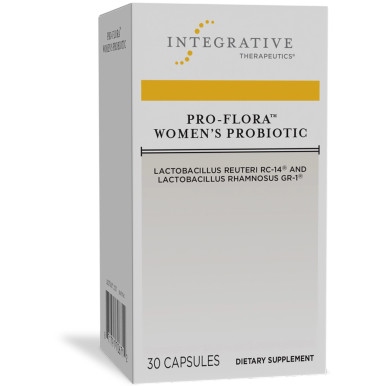
Pro-Flora Women's Probiotic by Integrative Therapeutics supplies L. rhamnosus GR-1® and L. reuteri RC-14® with at least 1 billion viable CFU per capsule through the expiration date, a guarantee stated on the manufacturer's product page. That 1 billion is the total for both strains combined. The manufacturer lists it as gluten-free and soy-free, and it can be taken with or without food.
One label detail to settle before you order: our product listing says the formula contains milk protein and lists one capsule daily, while the manufacturer's current page does not mention milk and lists one capsule once or twice daily. That likely reflects an older label. If you have a milk allergy, check the bottle you receive, or ask us to check it for you.
Pro-Flora Women's Probiotic 30c
$33.75
Pro-Flora Women's Probiotic 30c by Integrative Therapeutics – Vaginal Health Support ProbioticPro-Flora Women's Probiotic capsules by Integrative Therapeutics are an oral supplement for vaginal and… Click here to read more
UltraFlora Women's: the same pair, 2 billion per capsule
UltraFlora Women's by Metagenics uses the same two strains in a 50:50 blend at 2 billion CFU per capsule, taken once daily. The Metagenics product page lists it as gluten-free and dairy-free and says it can be kept in a dry place or refrigerated. Other ingredients are maltodextrin, a hypromellose capsule, microcrystalline cellulose and vegetable magnesium stearate.
If you are choosing between Pro-Flora and UltraFlora, you are choosing between the same studied pair at two serving sizes and two prices. UltraFlora gives you 2 billion in one capsule; Pro-Flora costs a little less and lets you take a second capsule on the manufacturer's directions if your practitioner suggests it.
UltraFlora Women’s 30 Capsules (f)
$37.95
UltraFlora Women’s 30 Capsules by Metagenics UltraFlora Women's by Metagenics contains a scientifically formulated blend of probiotics that provide support for urogential health and promote… Click here to read more

Probiotic-5: five strains for everyday digestion
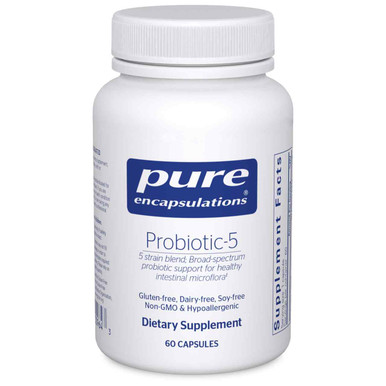
Probiotic-5 by Pure Encapsulations provides 10 billion CFU per capsule from five named strains: L. acidophilus La-14, L. rhamnosus Lr-32, B. longum Bl-05, B. bifidum Bb-06 and B. lactis Bl-04. The Pure Encapsulations product information sheet describes it as dairy-free and soy-free, for adults 18 and older, and to be kept refrigerated. The "5" in the name means five strains, not 5 billion.
It is the dairy-free probiotic pick for a woman who wants a broad lactobacilli-plus-bifidobacteria blend, avoids dairy and soy, and has a refrigerator handy. At one capsule a day, a 60-capsule bottle lasts two months.
Probiotic-5/Dairy Free 60c (F)
$43.50
Probiotic-5 60's by Pure Encapsulations – Gut Health Support Probiotic Supplement Probiotic-5 60's by Pure Encapsulations is a probiotic supplement designed to support GI tract… Click here to read more
FloraMend Prime Probiotic: three strains, no refrigerator
FloraMend Prime Probiotic by Thorne supplies 5 billion CFU of L. gasseri KS-13, B. bifidum G9-1 and B. longum MM-2 in one capsule taken daily with a meal. Thorne's product page lists it as dairy-free, gluten-free and soy-free and stable at room temperature. Thorne advises against opening the capsule, because the capsule is part of how the strains are delivered, so skip it if you usually empty capsules into food.
This is the shelf-stable probiotic for the travel bag and desk drawer: once a day, no ice pack. It is a general gut formula, not a women's formula, and that is fine if digestion is your goal.
FloraMend Prime Probiotic 30c (F)
$56.00
Thorne FloraMend Prime Probiotic – Comprehensive Gut Support for Digestive and Immune Health Support your digestive system and immune response naturally with Thorne FloraMend Prime… Click here to read more

How do you take a women's probiotic?
Take one capsule a day as the label directs, at a time you will remember. No label here asks you to time the dose to a cycle or take it on an empty stomach. Here are the label directions side by side.
| Product | Dose on the label | With food? | Storage | Label upper limit |
|---|---|---|---|---|
| Pro-Flora Women's Probiotic | 1 capsule once or twice daily (manufacturer); our listing says 1 daily | With or without food | Cool, dry place; may refrigerate | 2 capsules a day |
| UltraFlora Women's | 1 capsule once daily | Not specified | Dry place or refrigerate | 1 capsule a day unless your practitioner directs otherwise |
| Probiotic-5 | 1 capsule, 1–2 times daily | With or between meals | Keep refrigerated | 2 capsules a day |
| FloraMend Prime Probiotic | 1 capsule daily | With a meal; do not open the capsule | Room temperature | 1 capsule a day |
None of these labels gives a time to results, so agree on a check-in point with your practitioner before you start. Pick one product, take it daily, and note what changes, such as bowel regularity, gas, or comfort. That short log makes a follow-up conversation far more useful than "I think it helped."
More is not better. Doubling a dose to chase a study number, or combining two bottles to reach a bigger CFU total, adds cost without a clear reason. If a refrigerated bottle arrives warm or sits out, ask before you assume it is fine; shelf-stable products still need protection from heat, so the glove compartment is not a storage plan.
What does the research on these strains show?
Human trials support the GR-1 and RC-14 pair for shifting vaginal lactobacilli in healthy, non-pregnant women, and the KS-13, G9-1 and MM-2 blend for shifting gut bifidobacteria in older adults. None of the studies tested these exact retail bottles, and none compared the four products here.
GR-1 and RC-14 in healthy women
In a randomized, placebo-controlled trial of 64 healthy women, daily oral capsules of GR-1 and RC-14 for 60 days produced a significant increase in cultured vaginal lactobacilli at days 28 and 60 compared with placebo, with no adverse effects reported. The paper calls RC-14 L. fermentum; the strain has since been reclassified as L. reuteri, the name on today's labels.
What about pregnancy?
Results in pregnancy have been different. In a UK randomized, double-blind trial of women taking oral GR-1 and RC-14 from early pregnancy, the probiotic did not change the vaginal microbiota compared with placebo at 18–20 weeks. That is a good reason to treat pregnancy as its own conversation with your obstetric provider rather than assume the non-pregnant results apply.
The FloraMend strains in older adults
In a randomized, double-blind crossover study of 32 adults with an average age of 70, the KS-13, G9-1 and MM-2 combination taken twice daily for three weeks led more participants to show an increase in fecal bifidobacteria than placebo (48% versus 30%). That figure is the share of people with a lab change, not a 48% improvement in digestion, and the study was not specific to women.
Probiotic-5 earns its place here on its verified label: five named strains, a guaranteed count and clear allergen information. We are not claiming these trials tested its formula.
Who should skip a probiotic, or check first?
Even the best probiotic for women is not for everyone. Women who are immunocompromised, seriously ill, pregnant or breastfeeding, or taking prescription medication should check with their clinician before starting any of these. The NIH fact sheet notes that probiotics have been linked to bloodstream and other serious infections, most of them in people who were severely ill or immunocompromised.
- Immune-suppressing medication or a serious illness: talk with your prescriber first. Pure Encapsulations' information sheet states probiotics may be contraindicated for immunocompromised individuals.
- Pregnancy or breastfeeding: each manufacturer here asks you to consult your healthcare practitioner first. A women's label is not pregnancy clearance.
- Prescription medicines, including antibiotics: ask your pharmacist whether and how to space a probiotic around your prescription.
- Milk allergy: confirm the Pro-Flora bottle you receive, given the label difference noted above.
- New urinary or vaginal symptoms: burning, unusual discharge, pelvic pain or fever needs a clinician's assessment, not a supplement trial.
- Persistent digestive changes: blood in the stool, unexplained weight loss, severe pain or a lasting change in bowel habits should be checked by a doctor.
Mild gas can happen when you start a probiotic. Significant or worsening discomfort is a reason to stop and ask, not to push through.
Do you need a women's-specific probiotic?
Only if your goal is vaginal or urinary microbiome support. For digestion, energy around meals or regularity, the best probiotic for women is often a well-labeled general blend such as Probiotic-5 or FloraMend Prime, and "women's" on the label adds nothing. That is why two of the four products in this guide carry no gender on the label at all.
What changes after menopause?
Women in their 50s and 60s often ask us whether the GR-1 and RC-14 pair is the best probiotic for women after menopause. Menopause by itself does not tell you which product to pick: start with what you are trying to support, and bring new symptoms to your clinician before you reach for a bottle.
Can yogurt or kefir replace a capsule?
Fermented foods are a good habit if you tolerate them, but they do not usually tell you which strains you are getting or how many survive to the spoon. A capsule with named strains is the way to get a specific, studied combination. You do not need a capsule just because you skip yogurt.
What is the best probiotic for women?
The best probiotic for women is the one matched to a single, clear goal. For vaginal and urinary microbiome support, choose the GR-1 and RC-14 pair: Pro-Flora Women's Probiotic for the lowest entry cost, or UltraFlora Women's for 2 billion in one daily capsule. For everyday digestion, choose Probiotic-5 if you want five strains and dairy-free, soy-free at the best cost per day and can refrigerate it, or FloraMend Prime if you want a shelf-stable, once-daily capsule. Pick one, take it consistently, and reassess with your practitioner. The right supplements, not more supplements.
FAQs
Do women need a women's-specific probiotic?
What is the difference between Pro-Flora Women's Probiotic and UltraFlora Women's?
How many CFUs should a women's probiotic have?
Should I take my probiotic in the morning or at night?
Do probiotics need to be refrigerated?
Can I take a probiotic while pregnant or breastfeeding?
Keep reading
- Best probiotics: supplements to support gut health
- The connection between GI health and overall wellness
- Pure Encapsulations Women's Nutrients review
Not sure if this is the right product for you?
The licensed wellness professionals at Holistic Health Partners, led by Carolyn Mulally BS, RN, HN-BC, offer free product consultations — no appointment required. They can help you find the right supplement for your specific health goals.
Get a Free Consultation
These statements have not been evaluated by the Food and Drug Administration. This product is not intended to diagnose, treat, cure, or prevent any disease.