Betaine & Pepsin Ortho Molecular: Ingredients & Dosage
Table of Contents
- What is Betaine & Pepsin Ortho Molecular?
- What do betaine HCl and pepsin do in the stomach?
- Who may benefit from Betaine & Pepsin?
- How does Betaine & Pepsin Ortho Molecular compare to other betaine HCl products?
- How much Betaine & Pepsin should I take, and when?
- What won't Betaine & Pepsin do?
- Is Betaine & Pepsin safe, and what are the side effects?
- Is Betaine & Pepsin Ortho Molecular worth it?
- FAQs
Analise Petrakis has run the deli counter at her family's grocery in Canton for twenty-six years, and she can hand you a quarter pound of capicola without glancing at the scale. Last month her niece, who works the front desk at a naturopath's office, wrote Betaine & Pepsin Ortho Molecular on the back of a receipt and tucked it under the register drawer.
The trouble is Sunday. Analise is 57, and the roast lamb she has made every Sunday since her mother stopped making it now stays with her until the counter opens at six on Monday, high and heavy, like a stone sitting just under her ribs. Pork chops do the same thing. A tuna salad doesn't. The receipt is still under the drawer.
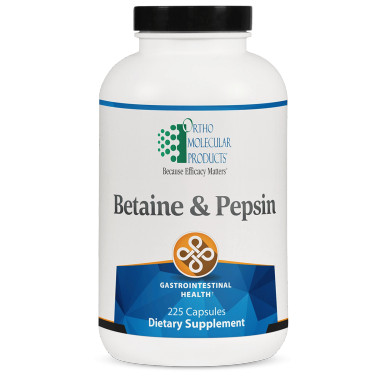
Betaine & Pepsin by Ortho Molecular Products is a two-ingredient digestive supplement that supplies hydrochloric acid and pepsin, the enzyme the stomach uses to start breaking down protein. A two-capsule serving contains 1,040 mg of betaine hydrochloride USP and 208 mg of pepsin (1:3,000). Ortho Molecular says it helps maintain gastric pH, promotes healthy digestion, especially of dietary protein, and supports overall nutrient absorption. The label dose is 1 to 2 capsules before each meal, or as recommended by your health care professional. It is aimed at adults whose protein-heavy meals sit too long, and the label tells anyone who is pregnant or nursing to consult their physician before taking it.
What is Betaine & Pepsin Ortho Molecular?
It is a replacement for two things a healthy stomach makes on its own. Ortho Molecular's product sheet describes the normal sequence: the hormone gastrin tells the parietal cells in the stomach lining to release hydrochloric acid (HCl) and tells the chief cells to release pepsin. When stomach pH falls to around 2.0, the signal backs off and acid production slows. It is a feedback loop, and pepsin only works inside it. Pepsin is most active at low pH, so if the stomach isn't acidic enough, the enzyme sits idle.
Betaine & Pepsin Ortho Molecular supplies both halves. Betaine hydrochloride is the acid source. Pepsin is the enzyme. Ortho states that studies have shown HCl production decreases with age, and that ongoing use of acid-reducing medication can also deplete stomach acid and lead to malabsorption of certain vitamins and minerals. Those are the two situations the formula is built around.
Two details on the label are worth reading closely, because most product pages skip them.
The per-capsule amount. The Supplement Facts panel lists a two-capsule serving, so one capsule delivers 520 mg of betaine HCl and 104 mg of pepsin. That matters because the directions say 1 to 2 capsules, and a single capsule is half of the listed serving.
What "1:3,000" means. It is a standard potency grade for pepsin, not a ratio of ingredients. Under the standard test, one part of the pepsin powder digests 3,000 parts of coagulated egg white. Two products can both list "208 mg pepsin" and differ in strength if their grades differ, so the grade is the number to compare.
Ortho Molecular sells only through licensed health care practitioners, and Covenant Health Products carries Betaine & Pepsin in its 225-capsule size. Our overview of Ortho Molecular Products covers how the company formulates and who it sells to.
Betaine & Pepsin 225c
$44.30
Betaine & Pepsin by Ortho Molecular Products – Stomach Acid and Protein Digestion Support Betaine & Pepsin by Ortho Molecular Products is a targeted digestive… Click here to read more
What do betaine HCl and pepsin do in the stomach?
The two ingredients have separate jobs, and one of them depends on the other to do anything at all.
Betaine hydrochloride: 1,040 mg per serving
Betaine is trimethylglycine, a compound found naturally in beets and spinach. Bound to hydrochloric acid, it becomes a dry, stable powder that can be put in a capsule. Once the capsule dissolves in the stomach, the acid is released and gastric pH drops. Ortho notes that betaine HCl has been used for years to support digestion because of exactly this ability to lower gastric pH.
The best human measurement of that effect comes from pharmacology research, not digestion research. In a 2013 pilot study at UC San Francisco, six healthy volunteers took a proton pump inhibitor until their stomach pH rose above 4. A single 1,500 mg dose of betaine HCl then brought the average pH from 5.2 down to 0.6, with pH dropping below 3 in about six minutes. The effect lasted a little over an hour before pH drifted back up.
Three things follow from that. The effect is fast, which is why the label says to take it before a meal rather than after. It is temporary, which is why the dose is per meal and not once a day. And the study was small, used a slightly larger dose than one serving of this product, and measured pH rather than how anyone felt after dinner. It shows that betaine HCl does what it is supposed to do chemically. It doesn't show what it will do for your Sunday roast.
Pepsin 1:3,000: 208 mg per serving
The stomach doesn't secrete pepsin in working form. It secretes pepsinogen, an inactive precursor, and acid switches it on. Ortho describes what happens next as a chain reaction: once some pepsin is active, it activates more pepsinogen, so protein digestion speeds up. Pepsin then cuts long protein chains into shorter peptides that the small intestine can finish.
This is why the pairing is the point of the formula. Pepsin added without an acid source has nothing to switch it on in a stomach that isn't acidic enough. Betaine HCl added without pepsin lowers the pH but leaves the stomach to supply its own enzyme. Together they cover both steps.
Why stomach acid reaches past the stomach
Ortho makes three claims for HCl that go beyond protein, and each has a physical explanation.
- Minerals and vitamin B12. Ortho says HCl is vital for absorbing vitamins and minerals, especially vitamin B12, calcium, magnesium, copper and zinc. B12 is the clearest case: in food it is bound to protein, and the NIH Office of Dietary Supplements explains that stomach acid and pepsin release it so it can be absorbed further down. Acid also keeps minerals in a form the gut can take up.
- The pancreas. Ortho says HCl helps signal the pancreas to release its own digestive enzymes. Acidic, partly digested food leaving the stomach triggers the hormone secretin, and the peptides pepsin produces help trigger cholecystokinin, the hormone that tells the pancreas to release enzymes for fat, starch and the rest of the protein.
- Gut flora and immune function. Ortho says keeping the stomach acidic supports normal gastric and intestinal flora and healthy immune function. One of the studies it cites, a 1972 study published in Gut, found that at pH below 4.0, 99.9% of test bacteria were killed within 30 minutes. In stomachs without acid, the bacteria survived for at least an hour.
Who may benefit from Betaine & Pepsin?
Betaine & Pepsin Ortho Molecular is a narrow product. The people it fits share a pattern: their trouble follows protein specifically, and someone has looked at the bigger picture first.
- Adults in their fifties and sixties, like Analise, who can name the year meat started sitting heavier and notice it after a roast but not after a salad.
- People who stopped an acid-reducing medication with their prescriber's approval, or whose prescriber has reviewed it, and who are now working with a practitioner on digestion.
- Lifters, post-surgical patients and anyone else eating to a protein target who notices the big meals more than the small ones.
- Someone who tried a broad plant-enzyme blend for a few weeks and felt no difference.
- Practitioners who want an acid-and-pepsin product with no extra enzymes, so the response to each ingredient is easier to read.
If you're not sure whether this fits your situation, Holistic Health Partners offers a free product consultation.
Who should not take this without checking first
- Anyone pregnant or nursing. Ortho's label caution reads: If you are pregnant or nursing, consult your physician before taking this product.
- Anyone who currently has heartburn, gastritis or a stomach ulcer. Ortho's label doesn't list this, but adding acid to an irritated stomach lining is the wrong direction. Integrative Therapeutics' label for the same two ingredients says outright that it is not recommended when peptic ulcer, gastritis or heartburn is present. We'd apply the same rule here.
- Anyone taking a proton pump inhibitor or H2 blocker. Those drugs are prescribed to lower stomach acid, and this product raises it. Talk to the prescriber before combining them, and don't stop a prescribed medication on your own.
- Anyone on thyroid hormone, regular NSAIDs such as ibuprofen or aspirin, or corticosteroids such as prednisone. Stomach acid affects how some drugs are absorbed, and NSAIDs and steroids can already be hard on the stomach lining. Your prescriber should see the label first.
How does Betaine & Pepsin Ortho Molecular compare to other betaine HCl products?
Covenant carries several betaine products. The closest comparison is Integrative Therapeutics' Betaine HCl with Pepsin, which uses the same two ingredients. Ortho's own Digestzyme is the comparison if you want acid plus a full enzyme spread.
| Betaine & Pepsin (Ortho Molecular) | Betaine HCl with Pepsin (Integrative Therapeutics) | Ortho Digestzyme (Ortho Molecular) | |
|---|---|---|---|
| Per 2-capsule serving | 1,040 mg betaine HCl, 208 mg pepsin 1:3,000 | 1.3 g betaine HCl, 260 mg pepsin | 300 mg betaine HCl, 150 mg pepsin, plus pancreatin, ox bile, bromelain and papain |
| Betaine HCl per capsule | 520 mg | 650 mg | 150 mg |
| Label dose | 1–2 capsules before each meal | 1–2 capsules at the beginning of each meal, do not chew | 1–2 capsules before each meal |
| Capsule | Natural gelatin | Vegetable (modified cellulose) | Natural gelatin |
| Bottle and cost per serving | 225 capsules, about $0.40 per 2-capsule serving ($44.30 at time of writing) | 250 capsules, about $0.37 per 2-capsule serving ($46.00 at time of writing) | Sold in two sizes; see product page |
| Label cautions | Pregnant or nursing: consult your physician | Not recommended with peptic ulcer, gastritis or heartburn; consult if pregnant, nursing or on prescription drugs | Contains plant and animal enzymes; pregnant or nursing: consult your physician |
| Where it wins | Smaller per-capsule step for a gentler start; Ortho's published mechanism and references | More betaine HCl per dollar; the only vegetarian capsule of the three; clearer label warnings | Covers fats and starches as well as protein |
The honest reading of that table: if you are vegetarian, or if price per milligram is what you're shopping on, Integrative Therapeutics' version is the better buy. Our guide to Betaine HCl with Pepsin by Integrative Therapeutics covers it in detail. If your heaviness follows mixed meals, fatty meals or everything, Digestzyme or a combination product like the one in our Digestive Enzymes Ultra + Betaine HCl write-up is a better match than acid alone.
Where Betaine & Pepsin Ortho Molecular earns its place is the smaller dose per capsule. At 520 mg, one capsule is a gentler starting point than 650 mg, and moving from one capsule to two is a smaller jump.
How much Betaine & Pepsin should I take, and when?
The label dose for Betaine & Pepsin Ortho Molecular is 1 to 2 capsules before each meal, or as recommended by your health care professional. Two capsules is the full listed serving.
Timing. Before the meal, not after. The acid needs to be in place when the food arrives, because a large meal raises stomach pH as it comes in, and pepsin needs the low pH already there. Taken at the end of a meal, the acid lands in a stomach full of food that has already pushed pH up.
Starting. Within the label range, the conservative way to begin is one capsule before the meal that bothers you most, which for Analise would be Sunday dinner. Whether to move to two capsules, or to take it with every meal, is a decision for you and your practitioner. Swallow the capsules whole. Opening them puts acid on your teeth and the lining of your mouth and throat.
How long a bottle lasts. The 225-capsule bottle holds 112 two-capsule servings. At two capsules with three meals a day, that is about 37 days. At one capsule with one meal a day, it is 225 days.
When to judge it. This is a per-meal product, not one that builds up over weeks. Two to three weeks of use with the meals that actually bother you is a fair trial. If nothing has changed by then, it probably isn't your answer.
What won't Betaine & Pepsin do?
It won't help heartburn. Some sources online argue that heartburn comes from too little acid rather than too much and that acid supplements are the fix. Ortho doesn't claim this product helps heartburn, and we won't either. If you're burning now, this is the wrong bottle.
It won't tell you whether your stomach acid is low. Almost nobody asking that question has had their gastric pH measured. The home "HCl challenge," taking more capsules until you feel warmth, is not a validated test, and Ortho doesn't describe it anywhere. Don't use this product that way.
It isn't a TMG supplement. Betaine (TMG) is sold separately for methylation support. Ortho positions Betaine & Pepsin for digestion, and the HCl form is chosen for its acid, not its methyl groups. If methylation is what you're after, ask about a product made for it.
It won't fix a deficiency. Ortho says HCl supports absorption of B12 and minerals. That is different from correcting low B12 or low iron, which needs a blood test and a plan from your clinician.
It won't do much for fat or fiber. Pepsin digests protein. If the trouble follows a cream sauce or a bowl of beans, a broader enzyme product fits better.
It won't replace an exam. New, persistent or worsening upper-stomach symptoms after age 50 deserve a doctor's visit. A capsule that makes dinner easier can also make it easier to put off finding out why dinner got harder.
Betaine & Pepsin 225c
$44.30
Betaine & Pepsin by Ortho Molecular Products – Stomach Acid and Protein Digestion Support Betaine & Pepsin by Ortho Molecular Products is a targeted digestive… Click here to read more
Is Betaine & Pepsin safe, and what are the side effects?
The manufacturer's caution is printed on the label in full: If you are pregnant or nursing, consult your physician before taking this product.
Ortho doesn't publish a side-effect list. The likely problem with any acid supplement is the obvious one. If it is a poor match for you or for the meal, you may feel warmth, burning or more upper-stomach discomfort. Stop taking it if that happens, and talk to your practitioner before trying again. Don't push through it with more capsules.
Medications are the other consideration. Acid-reducing drugs work in the opposite direction, and stomach acid can change how some drugs are absorbed, including thyroid hormone. People who take NSAIDs or corticosteroids regularly, or who have had a stomach ulcer, should not add acid without their prescriber's input.
The other ingredients are natural gelatin capsules, microcrystalline cellulose, silicon dioxide, magnesium stearate and stearic acid. Betaine & Pepsin Ortho Molecular contains no gluten, corn, yeast, or artificial colors or flavors. Because the capsules are gelatin, it isn't suitable for vegetarians or vegans.
As with any supplement, consult your healthcare provider before use, especially if you are pregnant, nursing, or taking medications.
Is Betaine & Pepsin Ortho Molecular worth it?
For an adult whose difficulty is specifically with protein-heavy meals, who has no active heartburn, gastritis or ulcer, and whose medications have been reviewed, Betaine & Pepsin is a clean, two-ingredient formula with both amounts disclosed to the milligram and a manufacturer explanation that matches the physiology. The 520 mg capsule makes it easy to start low.
It is the wrong pick for vegetarians, for anyone currently dealing with heartburn, and for anyone whose discomfort follows every kind of meal rather than protein. The honest trade-off is cost: Integrative Therapeutics sells more betaine HCl per dollar in a vegetarian capsule, and a 225-capsule bottle is a big commitment for something you could rule out in two weeks. We don't want you to buy more supplements, we want you to buy the right ones.
For Analise, the receipt under the register drawer is a reasonable thing to bring to her doctor, along with the question of why Sunday dinner started sitting differently in the first place.
Not sure if this is the right product for you?
The licensed wellness professionals at Holistic Health Partners, led by Carolyn Mulally BS, RN, HN-BC, offer free product consultations — no appointment required. They can help you find the right supplement for your specific health goals.
Get a Free Consultation
These statements have not been evaluated by the Food and Drug Administration. This product is not intended to diagnose, treat, cure, or prevent any disease.