Reacted Multimin Ortho Molecular: Ingredients & Dosage
Table of Contents
- What is Reacted Multimin Ortho Molecular?
- What minerals are in Reacted Multimin, and how do they work?
- Who should take Reacted Multimin?
- How does Reacted Multimin Ortho Molecular compare to drugstore calcium and a multivitamin?
- How do I take Reacted Multimin Ortho Molecular?
- What won't Reacted Multimin do?
- Is Reacted Multimin Ortho Molecular safe?
- Is Reacted Multimin Ortho Molecular worth it?
- FAQs
Oliver Brandt is fifty-six and has carried mail in Duluth for twenty-two years, about twelve miles a day on foot. Oliver knows which porch on the route has the loose third step and which golden retriever will follow the truck for a block and a half. In February an icy stoop won, and the broken wrist that followed led to a bone density scan that came back lower than the doctor liked. The nurse practitioner wrote Reacted Multimin Ortho Molecular on a sticky note and stuck it to the back of the appointment card.
The card now rides in the front pocket of the mail satchel. Since the scan, Oliver has been chewing two chalky calcium tablets a day from the grocery store, and they leave things uncomfortably backed up for most of the week, which is no small problem on a walking route with three public restrooms. There is also a magnesium bottle in the kitchen cupboard that keeps getting forgotten, and Oliver can't work out whether the note means "take this as well" or "take this instead."
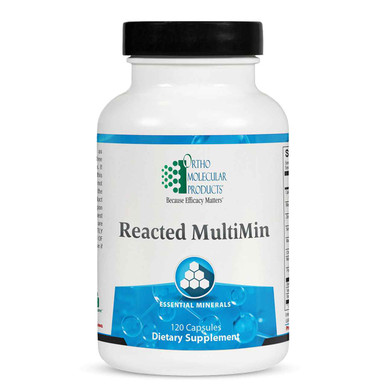
Reacted Multimin Ortho Molecular is a multimineral capsule with no vitamins in it. A 4-capsule serving provides 300 mg of calcium, 150 mg of magnesium, 25 mg of zinc, 190 mcg of selenium and seven other minerals, most of them as Albion® amino acid chelates, plus 45 mg of betaine hydrochloride. Ortho Molecular describes it as broad-spectrum mineral support that fits any bone-building protocol. The label dose is 4 capsules a day in divided doses, or as recommended by your health care professional, and one 120-capsule bottle lasts 30 days. It suits adults who want their minerals in one well-absorbed formula and who are getting their vitamins, including vitamin D, from somewhere else.
What is Reacted Multimin Ortho Molecular?
It is a mineral formula, and only a mineral formula. That is the first thing to understand about Reacted Multimin Ortho Molecular, and the thing most people get wrong when they see "multi" on the label. There is no vitamin D, no vitamin K, no B vitamins and no vitamin C. There is also no iron, copper or iodine on the panel.
"Reacted" is Ortho Molecular's word for minerals that have been bonded to amino acids, a form usually called a chelate. Most of the minerals here come from Albion®, a mineral manufacturer known for its chelates. The company sells Reacted Calcium, Reacted Magnesium and others as single minerals. Reacted Multimin puts eleven of them in one bottle, in ratios the manufacturer chose so that the minerals don't crowd each other out at the point of absorption.
Here is the full panel, per 4-capsule serving:
| Ingredient | Form | Amount |
|---|---|---|
| Calcium | Albion® calcium bisglycinate chelate | 300 mg |
| Magnesium | DiMagnesium malate; Albion® magnesium lysinate glycinate chelate | 150 mg |
| Potassium | Potassium glycinate complex | 90 mg |
| Zinc | Albion® zinc bisglycinate chelate | 25 mg |
| Manganese | Albion® manganese bisglycinate chelate | 5 mg |
| Selenium | Selenium glycinate complex | 190 mcg |
| Chromium | O-polynicotinate | 190 mcg |
| Molybdenum | Albion® molybdenum glycinate chelate | 45 mcg |
| Boron | Bororganic™ glycine | 45 mcg |
| Vanadyl sulfate | 3 mg | |
| Betaine hydrochloride USP | 45 mg |
Other ingredients are a vegetable capsule, microcrystalline cellulose, magnesium stearate, stearic acid and silicon dioxide.
Ortho Molecular is a practitioner-channel brand. Its formulas are sold through licensed health care professionals rather than on drugstore shelves, and at Covenant this is a clinic-access product, so you register (free) before you can order. The practical difference from a retail multimineral shows up in the forms on that panel. A drugstore calcium-magnesium tablet usually uses calcium carbonate and magnesium oxide, which are cheap and dense. Chelates cost more and take up more room, which is the reason this serving is four capsules instead of one tablet.
Reacted Multimin 120c
$36.90
Reacted Multimin by Ortho Molecular Products – Broad-Spectrum Mineral Support Reacted Multimin by Ortho Molecular Products provides a synergistic blend of highly-absorbable mineral chelates designed… Click here to read more
What minerals are in Reacted Multimin, and how do they work?
Why chelated minerals at all
A chelate is a mineral bound to one or two amino acids, most often glycine. Ortho Molecular states that Albion® chelates are taken up through active absorption mechanisms in the gut, which is a different route from the one a loose mineral salt depends on. The company also says chelates are gentler on the digestive tract and don't cause the constipation associated with calcium carbonate. For Oliver, that one sentence is most of the reason the note was written.
Ortho Molecular cites a human study in which Albion's calcium chelate averaged 44% absorption without meal enhancement, against under 10% for calcium carbonate. That is the manufacturer's citation and its figure, and it is worth reading as such. What it tells you is that the form matters at least as much as the milligram number printed on the front of a bottle.
Calcium: 300 mg
Calcium is the main structural mineral in bone, and Ortho Molecular describes calcium and magnesium as contributors to bone structure, muscle function and nerve transmission. Three hundred milligrams is a modest amount on purpose. The NIH Office of Dietary Supplements puts the adult recommendation at 1,000 to 1,200 mg a day from all sources, so this formula is designed to fill part of the gap that food leaves, not to supply the whole amount.
Magnesium: 150 mg
The magnesium arrives in two forms, dimagnesium malate and an Albion® lysinate glycinate chelate. Magnesium works alongside calcium in muscle contraction and relaxation and in nerve signaling. Ortho Molecular lists it among the minerals that support cardiovascular health. At 150 mg it sits well under the 350 mg ceiling the NIH sets for magnesium from supplements.
Zinc and selenium: 25 mg and 190 mcg
Ortho Molecular describes both as supporting healthy immune function. Zinc is used by hundreds of enzymes. Selenium is built into proteins called selenoproteins, several of which work as antioxidant enzymes. Both amounts are generous. The selenium is more than three times the 55 mcg adult RDA, and the zinc is more than double the 8 to 11 mg RDA. Neither is a problem alone, but both matter if you also take a multivitamin, which we cover below.
Potassium: 90 mg
Potassium takes part in muscle contraction, including the heart muscle. Ninety milligrams is a small amount, though. A medium banana has roughly four to five times as much. Supplements are limited in how much potassium they can carry, so treat this as a top-up and not a reason to eat fewer vegetables.
Manganese, molybdenum, boron, chromium and vanadyl sulfate
These are the trace minerals, needed in milligram or microgram amounts. Manganese and molybdenum act as cofactors, meaning specific enzymes cannot do their work without them. Boron appears here as Bororganic™ glycine at 45 mcg, a small amount. Chromium comes as O-polynicotinate at 190 mcg. Vanadyl sulfate, at 3 mg, is a form of vanadium. The panel notes that no Daily Value has been established for chromium, boron, vanadyl sulfate or betaine hydrochloride.
Betaine hydrochloride: 45 mg
This is the ingredient that sets the formula apart from most multiminerals. Betaine HCl is a source of hydrochloric acid, and minerals generally need an acidic stomach to be released and absorbed. Ortho Molecular says it is included to prime digestion and improve the absorption of vitamins and minerals.
Here is the part no product page will tell you. In a 2013 study of healthy volunteers whose stomach acid had been lowered with medication, betaine HCl temporarily brought stomach pH back down, but the dose was 1,500 mg. This formula has 45 mg spread across four capsules. It is a supporting player that may help the minerals around it, not a substitute for a dedicated digestive acid supplement.
Who should take Reacted Multimin?
Ortho Molecular's own description is broad, mineral support for a variety of protocols. In practice it tends to fit people like these:
- Adults on a bone-building plan from their practitioner who want calcium and magnesium in a form that's easier on the gut than carbonate
- Someone who already takes a separate vitamin D and K2 and doesn't want to double up on vitamins
- People whose multivitamin is light on minerals, or who left their multi behind because of iron and want minerals without it
- Anyone who has had trouble with chalky calcium tablets and the sluggish digestion that can follow them
- A person with a practitioner-designed protocol who prefers one mineral bottle over five
Who should not take this
The label caution, word for word: If you are pregnant or nursing, consult your physician before taking this product.
It is also the wrong product if you are counting on it for all of your calcium, because 300 mg won't get you there. It isn't for anyone whose practitioner has asked them to avoid zinc, selenium or chromium, and it isn't the place to start if your goal is iron, iodine or copper, because none of the three is in it.
If you're not sure whether this fits your situation, Holistic Health Partners offers a free product consultation. We don't want you to buy more supplements. We want you to buy the right ones, and for some people the right one turns out to be a multivitamin they already own.
How does Reacted Multimin Ortho Molecular compare to drugstore calcium and a multivitamin?
Reacted Multimin Ortho Molecular usually gets weighed against two other options, a grocery-store calcium-magnesium tablet and a full multivitamin with minerals. They are built for different jobs.
| Reacted Multimin (Ortho Molecular) | Typical drugstore calcium-magnesium | Full multivitamin with minerals | |
|---|---|---|---|
| Mineral forms | Mostly Albion® amino acid chelates | Usually calcium carbonate and magnesium oxide | Varies widely by brand |
| Number of minerals | 11, plus betaine HCl | 2 or 3 | Often 8 to 12, at smaller amounts |
| Vitamin D and K | None | Often includes vitamin D | Yes |
| Serving | 4 capsules, divided doses | 1 to 2 tablets | 1 to 6, depending on brand |
| Digestive comfort | Manufacturer says chelates avoid carbonate-type constipation | Carbonate is a common cause of constipation | Depends on the forms used |
| Cost | About $1.23 a day at $36.90 for 30 days | Usually a few cents a day, the clear winner on price | Wide range |
The honest read. If calcium carbonate agrees with you and your only goal is more calcium, the drugstore tablet is far cheaper and often brings vitamin D along with it. Reacted Multimin earns its price when carbonate doesn't agree with you, when you want trace minerals as well as calcium and magnesium, or when your practitioner has you on a bone protocol and wants the minerals in a separate bottle from the vitamins.
If you already take a good multivitamin with minerals, adding this on top is probably more than you need. Compare the zinc and selenium totals before you stack the two.
How do I take Reacted Multimin Ortho Molecular?
The label says 4 capsules per day in divided doses, or as recommended by your health care professional. A 120-capsule bottle is a 30-day supply.
Divided doses means splitting the four capsules across the day, such as two in the morning and two in the evening. There are two good reasons for that. Minerals compete with each other for absorption, and calcium in particular is absorbed best in smaller amounts at a time. The NIH notes that absorption is highest at 500 mg or less per dose. Splitting the serving also keeps the betaine HCl working alongside more than one meal.
The label does not say whether to take the capsules with food. Because betaine HCl is a source of stomach acid, many people take it with meals, and that is a reasonable question to put to your practitioner.
Separate it from medications that minerals can bind to. Calcium, magnesium and zinc can interfere with the absorption of certain drugs, so if you take any prescription medication, ask your pharmacist how many hours apart to space them.
As for timeframe, minerals are slow, steady work. Bone in particular is rebuilt over months. Give a mineral routine a full season of consistent use before you and your practitioner judge it, and use labs or a follow-up scan rather than how you feel to measure progress.
What won't Reacted Multimin do?
Most product pages leave this section out.
It won't give you vitamin D. Calcium and vitamin D work as a pair, and this formula has no vitamin D or vitamin K. If bone is the reason you're buying it, ask your practitioner about something like K-Force, Ortho Molecular's vitamin K2 and D3 formula, alongside it.
It won't cover all of your calcium. Three hundred milligrams is roughly a quarter to a third of the adult recommendation. Food still has to do most of the work.
It isn't a multivitamin. The word "multi" in the name refers to minerals only. No B vitamins, no vitamin C, no vitamin A.
It won't correct an iron, iodine or copper shortfall. None of the three is on the panel.
It isn't a complete bone formula. Ortho Molecular positions it to support any bone-building protocol, which is different from being the whole protocol. If you want a single bone-focused product instead, our guide to Pro Bono by Ortho Molecular covers the brand's dedicated bone formula.
It isn't a digestive aid. At 45 mg, the betaine HCl is there to help mineral absorption, not to stand in for a full-strength betaine product.
Reacted Multimin 120c
$36.90
Reacted Multimin by Ortho Molecular Products – Broad-Spectrum Mineral Support Reacted Multimin by Ortho Molecular Products provides a synergistic blend of highly-absorbable mineral chelates designed… Click here to read more
Is Reacted Multimin Ortho Molecular safe?
The label caution, word for word: If you are pregnant or nursing, consult your physician before taking this product.
Watch your totals if you take other supplements. The adult upper limit for zinc is 40 mg a day, and this formula supplies 25 mg. The upper limit for selenium is 400 mcg, and this formula supplies 190 mcg. Add a multivitamin, a separate zinc or a handful of Brazil nuts, which are unusually rich in selenium, and you can get closer to those limits than you'd expect. The NIH selenium fact sheet lists the signs of getting too much, including a garlic odor on the breath and brittle hair and nails.
Minerals can also interact with medications. According to the NIH, calcium supplements can reduce the absorption of certain antibiotics (tetracyclines and fluoroquinolones), the thyroid medication levothyroxine and bone-density medications called bisphosphonates, and zinc can interact with some of the same antibiotics. Because the formula also contains chromium and vanadyl sulfate, tell your practitioner if you take medication for blood sugar. If you have a history of stomach ulcers, ask before taking any product with betaine HCl.
As with any supplement, consult your healthcare provider before use, especially if you are pregnant, nursing, or taking medications.
Is Reacted Multimin Ortho Molecular worth it?
For the right person, yes. Reacted Multimin Ortho Molecular puts eleven minerals, most of them as Albion® chelates, into one 30-day bottle, with a small amount of betaine HCl to help them absorb. It suits adults on a practitioner-guided bone or mineral plan, people who can't tolerate calcium carbonate, and anyone who keeps their vitamins and minerals in separate bottles on purpose.
It doesn't suit someone looking for a one-bottle multivitamin, someone who needs all of their calcium from a supplement, or someone who is already well covered by a mineral-rich multi. The honest trade-off is cost and convenience. You are paying more, and swallowing four capsules a day instead of one tablet, for a form that is gentler and better absorbed, according to the manufacturer.
Oliver took the sticky note, the grocery-store calcium and the forgotten magnesium bottle to the next appointment, so the nurse practitioner could decide which of them stay.
Not sure if this is the right product for you?
The licensed wellness professionals at Holistic Health Partners, led by Carolyn Mulally BS, RN, HN-BC, offer free product consultations — no appointment required. They can help you find the right supplement for your specific health goals.
Get a Free Consultation
These statements have not been evaluated by the Food and Drug Administration. This product is not intended to diagnose, treat, cure, or prevent any disease.