Liposomal Urolithin A by Codeage: What the Research Says About Mitochondrial Renewal
Table of Contents
Liposomal Urolithin A by Codeage: Renew Your Energy
Phil Ashworth had coached high school football for twenty-six years, and for most of them he could out-run his own linebackers at practice. That changed around age 54. It wasn't any one injury—it was the accumulation. Stairs at the stadium left his knees aching for two days instead of two hours. He'd sleep eight hours and still wake up feeling like he'd been hit by a truck. Looking for answers, Phil came across Liposomal Urolithin A by Codeage while researching supplements that support healthy aging and cellular energy. His wife started calling it "Old Man Tuesday," because Tuesdays after Friday night games had become the unofficial day Phil couldn't get off the couch.
His doctor's bloodwork came back clean -- no diabetes, no thyroid problem, cholesterol fine. "You're just getting older," she told him, which is the kind of answer that helps nobody. Phil started reading about mitochondria and urolithin A almost by accident, after an assistant coach mentioned a supplement he'd started taking. What he found surprised him: the fatigue, the slow recovery, the general sense of running on a weaker battery -- there's real biology behind that, and it has a name. Mitochondrial decline. And there's a compound your gut can make from foods like pomegranates and walnuts that's been shown to help clean out the damaged mitochondria dragging your energy down.
Phil started taking Liposomal Urolithin A by Codeage two months ago. He's not coaching from the couch on Tuesdays anymore. You don't have to accept "you're just getting older" as the final word on your own energy, either -- there's a specific, well-studied compound worth understanding first.
What Is Liposomal Urolithin A?
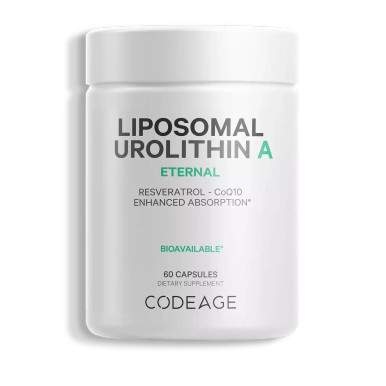
Liposomal Urolithin A by Codeage is a mitochondrial-support formula built around urolithin A -- a compound your gut bacteria produce when you eat ellagitannin-rich foods like pomegranates, walnuts, and certain berries. Not everyone's gut microbiome converts those foods into meaningful amounts of urolithin A, which is part of why direct supplementation has become a serious area of clinical research over the last several years.
This isn't a single-ingredient capsule. Codeage combines urolithin A with trans-resveratrol, betaine anhydrous, and CoQ10, delivered through what the company calls its Helix Liposomal Delivery system -- a phospholipid-based carrier made from non-GMO sunflower lecithin, designed to help a notoriously poorly-absorbed compound actually reach circulation. The product is manufactured in a cGMP-certified U.S. facility, and the brand references NSF-aligned quality and labeling practices as part of its production standards.
Each serving (2 capsules) delivers 500mg of trans-resveratrol, 162.5mg of betaine anhydrous, and 60mg of CoQ10 alongside the urolithin A, in a phospholipid (liposomal) matrix. A bottle contains 60 capsules -- a 30-day supply at the recommended serving size, which lines up with the month-plus timeframes used in the clinical research behind the core ingredients. If you're looking for urolithin A in complete isolation with nothing else in the capsule, this isn't that product -- but every ingredient here is chosen to support the same mitochondrial pathway, not to pad the label.
Key Ingredients and How They Work
Urolithin A: The Mitophagy Trigger
Mitophagy is your body's cellular recycling program for mitochondria -- the process that identifies damaged, worn-out mitochondria and clears them out so healthier ones can take their place. As we age, this process slows down measurably, and old, dysfunctional mitochondria start accumulating in muscle and other energy-hungry tissue. That's a meaningful part of why energy, recovery, and muscle performance decline with age even when bloodwork looks normal.
Urolithin A works through several overlapping pathways. It activates the PINK1/Parkin pathway, which is the cellular tagging system that marks damaged mitochondria for removal. It also engages AMPK (a cellular energy sensor) while inhibiting mTOR, a growth-signaling pathway that becomes overactive with age and actively suppresses the body's natural cleanup process. Relieving that suppression allows ULK1 to kick off autophagosome formation around the damaged mitochondria that need to go. On the biogenesis side, urolithin A also stimulates SIRT1 and PGC-1α, the master regulators that drive the creation of new, functional mitochondria.
The net effect studied in both animal and early human research: better mitochondrial quality control, not just quantity -- old ones cleared out, new ones built, with knock-on effects for muscle performance, endurance, and cellular energy production.
Trans-Resveratrol: Working the Same Cellular Pathway
Resveratrol, best known from red wine and grape skins, is included here because of its own well-documented activation of SIRT1 -- the same longevity-associated pathway urolithin A engages from a different angle. Research on resveratrol's antioxidant and cellular-stress-response properties has been building for over two decades, and pairing it with urolithin A is a deliberate attempt to reinforce the same mitochondrial biogenesis signal rather than introduce an unrelated ingredient.
CoQ10: Fueling the Mitochondria You Just Cleaned Up
Coenzyme Q10 is a compound your own mitochondria use directly in the electron transport chain -- the actual machinery that produces ATP, your cellular energy currency. CoQ10 levels decline naturally with age and are also depleted by some common cholesterol medications. Including it here means that as urolithin A helps clear out damaged mitochondria and stimulate new ones, CoQ10 is on hand to help fuel the ones that remain -- a logical pairing rather than an unrelated add-on.
Betaine Anhydrous: Supporting Methylation and Cellular Stress Response
Betaine (also called trimethylglycine) supports methylation processes throughout the body and has research behind it for exercise performance and liver methylation support. In this formula, it rounds out the cellular-stress and energy-metabolism angle the other three ingredients are already working on.
Liposomal Urolithin A 60c
$99.99
Liposomal Urolithin A™ by Codeage – Healthy Aging and Cellular Energy Support Liposomal Urolithin A™ by Codeage is a practitioner-friendly liposomal urolithin A supplement designed… Click here to read more
Liposomal Delivery: Why It Matters Here Specifically
Liposomal Urolithin A by Codeage is lipophilic but poorly water-soluble, and it undergoes extensive first-pass metabolism in the gut and liver (primarily glucuronidation and sulfation) before much of it reaches your bloodstream in usable form. That's a real absorption problem for a compound that has to reach muscle and other tissue to do its job. Liposomal delivery wraps the active compounds in phospholipid vesicles -- similar in structure to your own cell membranes -- which can help protect them through digestion and improve how efficiently they're taken up. It's the same rationale used for liposomal vitamin C, glutathione, and other compounds where standard capsules underperform on actual absorption.
What the Clinical Trials Actually Found
Urolithin A didn't arrive at these mechanisms through animal studies alone -- it's been through a real human clinical pipeline, which is more than can be said for most trending supplement ingredients. The foundational safety and pharmacokinetics work, published by Andreux and colleagues in 2019, gave healthy older adults single and repeated oral doses of Liposomal Urolithin A by Codeage and tracked plasma levels, standard clinical labs, and adverse events. The result: a clean safety profile with no serious adverse events across the tested dose range, and pharmacokinetic data confirming the compound and its metabolites reach meaningful systemic circulation on a once-daily dosing schedule. That safety foundation is what allowed later trials to move forward with confidence.
A follow-up randomized, placebo-controlled trial (Singh et al., 2022) built directly on that foundation, testing whether Liposomal Urolithin A by Codeage supplementation actually translates into measurable muscle benefits in older adults -- not just favorable biomarkers. Using oral doses in the same 500-1000mg/day range over several months, the trial measured muscle strength, endurance, and physical performance against placebo. Muscle endurance and performance measures improved in the urolithin A group, and the mechanistic correlates researchers found in participants' blood and muscle tissue lined up with the mitophagy and mitochondrial-function signals seen in the earlier animal and cell research -- meaning the human results weren't just correlational, they tracked with the biological mechanism the ingredient is supposed to trigger.
A separate industry-sponsored study (often referred to as the "Ryse" study after the branded formulation tested) looked at physical performance and mitochondrial biomarkers over a shorter multi-week window. Reviewers describe the results as modest but directionally positive -- consistent with the pattern across urolithin A research generally: strong, well-characterized mechanism, promising but still-accumulating human outcome data, and a safety profile that has held up well across every published human trial to date. Independent reviewers, including the Alzheimer's Drug Discovery Foundation's supplement analysis, characterize the overall clinical picture as encouraging but early-stage -- worth taking seriously, not worth treating as settled science.
What does that mean practically? The mechanism (mitophagy activation via PINK1/Parkin, AMPK, and SIRT1/PGC-1α) is well-established at the cellular level. The human outcome data, while still building, consistently points the same direction: better muscle endurance and performance markers in older adults after months of consistent use, with a safety profile that has never raised a serious red flag across multiple independent trials.
Who May Benefit From Liposomal Urolithin A by Codeage?
- Adults over 40 noticing slower recovery from exercise or physical activity
- Active people and former athletes managing the natural decline in muscle endurance that comes with age
- Anyone specifically interested in mitochondrial health and cellular energy production as part of a longevity-focused routine
- People already taking CoQ10 or resveratrol separately who want a combined, liposomal-delivery option
- Those who eat pomegranates, walnuts, or berries regularly but want more consistent urolithin A exposure than diet alone reliably provides
Who Should Use Caution
Because this formula includes CoQ10, anyone on blood thinners (like warfarin) should talk to their provider first, since CoQ10 can interact with anticoagulant medication. Betaine anhydrous can, in some people, affect blood cholesterol markers, so it's worth a conversation if you're already managing lipid levels closely. As always, pregnant or nursing individuals should check with a healthcare provider before starting any new supplement, and anyone on prescription medication should confirm there's no interaction specific to their situation.
It's also worth being realistic about who this product is not built for. If your primary goal is isolating and tracking Urolithin A's individual effect -- for instance, if you're already taking resveratrol or CoQ10 separately and don't want overlapping intake -- a single-ingredient Urolithin A product will give you a cleaner picture. This combination formula is designed for people who want a broader mitochondrial-support stack in one product, not for precise self-experimentation with one variable at a time.
How It Compares to Standard Alternatives
| Feature | Liposomal Urolithin A (Codeage) | Standard Urolithin A Capsule |
|---|---|---|
| Delivery Form | Liposomal (phospholipid-encapsulated) | Standard capsule, no enhanced-absorption system |
| Formula Type | Combination (urolithin A + resveratrol + CoQ10 + betaine) | Usually single-ingredient |
| Manufacturing | cGMP-certified U.S. facility | Varies by brand |
| Best For | Those wanting a broader mitochondrial-support stack in one product | Those wanting to isolate and track urolithin A alone |
How to Use Liposomal Urolithin A by Codeage
The label recommends 2 capsules daily with food. Clinical research on urolithin A alone has generally used doses in the 500mg-1000mg per day range, taken once daily, over periods of one to four months before meaningful outcomes were measured in trials. Consistency matters more than timing -- take it with a meal that contains some fat, since the liposomal and CoQ10 components are better utilized alongside dietary fat.
Realistically, most of the human research behind urolithin A's muscle-performance benefits measured outcomes after 4 months of consistent daily use, not days or weeks. This is a slow-build supplement, not a same-day-energy product -- set expectations accordingly.
A common question is whether to cycle this supplement (take breaks) or use it continuously. The published human trials to date used continuous daily dosing for the full study period without cycling, and there's no published evidence suggesting a cycling protocol produces better results. Unless your healthcare provider recommends otherwise for a specific reason, continuous daily use matches how the ingredient has actually been studied.
Safety Considerations
Human trials on Liposomal Urolithin A by Codeage, including foundational safety and pharmacokinetic research, have reported a generally favorable safety profile with no serious adverse events at doses up to 1000mg/day. CoQ10 has decades of safety data behind it as well. That said, this is a multi-ingredient formula, and each component carries its own considerations -- particularly the CoQ10/blood-thinner interaction and betaine's potential effect on lipid panels noted above.
As with any supplement, consult your healthcare provider before use, especially if you are pregnant, nursing, or taking medications.
The Bottom Line
Mitochondrial decline is one of the quieter drivers of feeling older before you think you should -- slower recovery, flatter energy, workouts that used to feel routine suddenly costing you two extra recovery days. Liposomal Urolithin A by Codeage targets that decline directly, pairing a compound your body may not be producing enough of on its own with resveratrol and CoQ10 in a delivery system built to actually get absorbed.
This is best suited for people looking for consistent, months-long mitochondrial support as part of a broader healthy-aging routine -- not a quick fix, and not a product for someone who specifically wants urolithin A alone with nothing else in the capsule. For Phil, two months in, Tuesdays don't feel like a recovery day anymore. They just feel like a normal day.
Not sure if this is the right product for you?
The licensed wellness professionals at Holistic Health Partners, led by Carolyn Mulally BS, RN, HN-BC, offer free product consultations -- no appointment required. They can help you find the right supplement for your specific health goals.
Get a Free ConsultationFAQs
Is Liposomal Urolithin A the same as pure Urolithin A supplements?
No. This is a combination formula that pairs urolithin A with trans-resveratrol, betaine anhydrous, and CoQ10 in a liposomal delivery system. If you specifically want urolithin A in isolation with no other active ingredients, look for a single-ingredient product instead.
How long does it take to notice benefits from Urolithin A?
Most published human research measured outcomes after 4 months of consistent daily use. This is a supplement for sustained mitochondrial support over months, not a short-term energy boost.
What does "liposomal" actually mean, and does it matter?
Liposomal means the active ingredients are encapsulated in phospholipid vesicles, similar in structure to your own cell membranes. For a compound like urolithin A that's poorly water-soluble and heavily metabolized before absorption, this delivery method is designed to improve how much of the active compound actually reaches your bloodstream compared to a standard capsule.
Can I take this with my daily multivitamin or other supplements?
Generally, yes, but because this formula includes CoQ10 and betaine, it's worth a quick review with your healthcare provider or pharmacist if you're on blood thinners or managing cholesterol, to rule out any interaction specific to your regimen.
Is Urolithin A only useful for athletes?
No. While much of the clinical research has focused on muscle endurance and performance, the underlying mechanism -- clearing damaged mitochondria and supporting the creation of new ones -- is relevant to anyone interested in general energy metabolism and healthy aging, not just competitive athletes.
Where does Urolithin A come from naturally, and why supplement it?
Your gut bacteria produce urolithin A when you eat ellagitannin-containing foods like pomegranates, walnuts, and certain berries. However, not everyone's gut microbiome converts these foods into meaningful urolithin A -- research suggests a significant portion of people are "low producers" naturally, which is a major reason direct supplementation has become an active area of research.
These statements have not been evaluated by the Food and Drug Administration. This product is not intended to diagnose, treat, cure, or prevent any disease.