Pure Encapsulations Magnesium Glycinate: Dose & Who It Suits
Table of Contents
- What is Pure Encapsulations Magnesium Glycinate?
- What does the magnesium in each capsule do?
- How do you take Pure Encapsulations Magnesium Glycinate?
- Who is it for, and who should skip it?
- How does it compare to other magnesium we carry?
- What are the side effects of magnesium glycinate?
- Is Pure Encapsulations Magnesium Glycinate worth it?
- FAQs
Quick answer: Pure Encapsulations Magnesium (glycinate) is a vegan capsule that supplies 120 mg of magnesium per capsule as magnesium glycinate, a form bound to the amino acid glycine that tends to be gentler on digestion than oxide or chloride. The label suggests 1 to 4 capsules a day with meals, and it comes in 90, 180 and 360-capsule bottles. It suits adults who want a dose they can adjust one capsule at a time; if you want a liquid, Pure's liquid magnesium on our shelf uses magnesium citrate, not glycinate.
Clinical review pending — Holistic Health Partners
| Key fact | Pure Encapsulations Magnesium (glycinate) |
|---|---|
| Form | Magnesium glycinate (chelate) in a vegetarian cellulose capsule |
| Dose per capsule | 120 mg magnesium (elemental) |
| Bottle sizes | 90, 180 or 360 capsules |
| Who it suits | Adults who want a gentle, adjustable magnesium; people who got loose stools from oxide or citrate |
| Take it | 1–4 capsules daily with food, per the label |
| Price and details | See current price and sizes |
Renata Okafor, a 47-year-old hospital billing supervisor, had sworn off magnesium after a drugstore bottle of magnesium oxide sent her running for the restroom two mornings in a row. So when her pharmacist suggested magnesium glycinate at the refill counter, she crossed her arms and said she'd tried magnesium, thanks. He turned the bottle around and pointed at two lines: the form, and the 120 mg per capsule, which meant she could start with one and stop there if her stomach complained. She left with the smallest bottle, mostly to prove him wrong.
Whether she does or not, the label is the right place to start.
What is Pure Encapsulations Magnesium Glycinate?
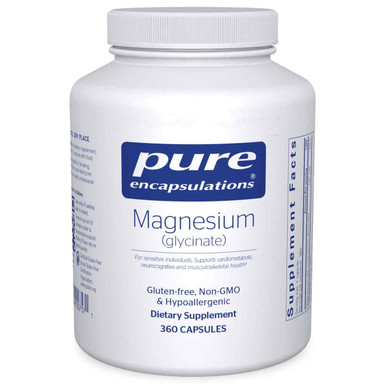
It's a single-ingredient magnesium supplement: each capsule of Pure Encapsulations® Magnesium (glycinate) holds 120 mg of magnesium as magnesium glycinate, and nothing else of substance. The only other ingredients are the vegetarian capsule (cellulose and water) and ascorbyl palmitate, a small amount of vitamin C ester used to protect freshness. There's no magnesium stearate, gluten, soy, dairy or artificial color, and the manufacturer lists it as vegan.
The 120 mg figure is elemental magnesium, the amount your body counts toward its daily needs, not the weight of the whole magnesium-plus-glycine compound. Pure Encapsulations states it is the highest dose of pure magnesium glycinate per capsule among leading professional brands, with no other forms of magnesium mixed in. That last part matters: some "glycinate" products blend in cheaper magnesium oxide to raise the number on the front of the bottle.
You'll see it sold as "Magnesium Glycinate 360" because the 360-capsule bottle is the size most people search for. It's the same capsule in all three sizes; only the count changes.
Magnesium (glycinate)
$27.00
Magnesium (Glycinate) by Pure Encapsulations – Highly Bioavailable Magnesium for Heart Health, Sleep, and Stress Relief Pure Encapsulations Magnesium (Glycinate) is a highly bioavailable form… Click here to read more
What does the magnesium in each capsule do?
Magnesium is a cofactor for enzymes involved in energy production, muscle contraction and relaxation, nerve signaling and bone mineralization, so each 120 mg capsule tops up a mineral your body uses all day. The NIH Office of Dietary Supplements sets the adult Recommended Dietary Allowance at 400–420 mg a day for men and 310–320 mg for women, and many adults fall short of that from food alone.
Why glycinate instead of oxide or citrate?
The glycinate form is chosen mainly for comfort. According to the NIH fact sheet, the magnesium forms most commonly reported to cause diarrhea are carbonate, chloride, gluconate and oxide; glycinate isn't on that list, and Pure Encapsulations describes its glycinate as less likely to cause loose stools than other forms. That's why it's the usual pick for people who, like Renata, have had a bad week with a cheaper magnesium. Citrate is well absorbed too, but it pulls more water into the bowel, which some people want and others don't.
What does the research say about magnesium and sleep?
The evidence is real but modest, and it's worth knowing exactly how modest. In a 2025 randomized, placebo-controlled trial of 155 adults reporting poor sleep, participants took 250 mg of magnesium as magnesium bisglycinate 30–60 minutes before bed for four weeks. Scores on the Insomnia Severity Index improved by 3.9 points in the magnesium group against 2.3 points on placebo, a small but statistically significant difference, and the authors describe the effect as modest. Sleep was self-reported, and the trial ran only 28 days.
Earlier work is less clear. A 2022 systematic review of nine studies with 7,582 participants found that observational studies link magnesium status with sleep quality, while the randomized trials showed an uncertain effect, and the authors called for larger, longer trials. The honest read: magnesium supports relaxation and normal sleep for some people, especially those whose intake runs low, and it isn't a sedative.
Does magnesium help muscle cramps?
For the common night-time leg cramps of older adults, probably not much. A 2020 Cochrane review concluded it is unlikely that magnesium provides clinically meaningful cramp prophylaxis to older adults, and found the pregnancy research conflicting. Magnesium still matters for normal muscle relaxation, and low intake is worth correcting, but if frequent cramps are your main reason for buying it, talk with your provider first. Our earlier version of this article overstated this point, and we've corrected it.
How do you take Pure Encapsulations Magnesium Glycinate?
Take 1 to 4 capsules daily with food, as the label directs, and start at the low end. Most adults begin with one or two capsules and adjust from there. Here's what each step up gives you.
| Capsules a day | Magnesium | When and how | A 360-count bottle lasts |
|---|---|---|---|
| 1 | 120 mg | With dinner. A good starting dose if other forms upset your stomach. | About 12 months |
| 2 | 240 mg | One with lunch and one with dinner, or both with dinner if you're using it for evening relaxation. | About 6 months |
| 3 | 360 mg | Split across meals. Above the 350 mg adult upper limit for supplemental magnesium, so use this amount with a practitioner's guidance. | About 4 months |
| 4 | 480 mg | The label maximum. Split across meals, practitioner-guided only. | About 3 months |
- Take it with food. The manufacturer's directions say to consume it with food, which also helps your stomach.
- Evening works well for many people. The sleep trial above dosed 30–60 minutes before bed. With Pure Encapsulations Magnesium Glycinate, taking your capsules with dinner gets you close to that window and keeps the "with food" direction.
- Know the upper limit. The NIH sets a Tolerable Upper Intake Level of 350 mg a day for magnesium from supplements and medications in adults (food doesn't count toward it). Three or four capsules go past that, which is fine under a practitioner's eye but not something to drift into on your own.
- Count every source. Add up the magnesium in your multivitamin, any sleep or electrolyte blend, and antacids or laxatives that contain magnesium.
- Give it about four weeks. That's how long the sleep trial ran before measuring. If nothing has changed after a month at a steady dose, that's useful information for your next conversation with a practitioner.
Who is it for, and who should skip it?
Pure Encapsulations Magnesium (glycinate) is a good fit for adults who want a gentle, single-ingredient magnesium and the freedom to adjust the dose in 120 mg steps. That usually includes:
- People whose diet runs light on leafy greens, legumes, nuts, seeds and whole grains
- Anyone who got loose stools or cramping from magnesium oxide or citrate
- Adults who want magnesium as part of an evening wind-down routine
- Vegans and people avoiding common allergens, since the capsule is free of gluten, soy, dairy and magnesium stearate
Talk with your provider first, or skip it, if you:
- Have reduced kidney function. The NIH notes that the risk of magnesium toxicity rises when the kidneys can't clear excess magnesium.
- Take a tetracycline or quinolone antibiotic (such as doxycycline or ciprofloxacin). Magnesium binds them; the NIH advises taking these antibiotics at least 2 hours before or 4–6 hours after a magnesium supplement.
- Take an oral bisphosphonate such as alendronate. Separate it from magnesium by at least 2 hours.
- Take a potassium-sparing diuretic such as spironolactone or amiloride, which reduces magnesium loss. (Loop and thiazide diuretics and long-term proton pump inhibitors do the opposite and can lower magnesium, which is worth raising with your prescriber.)
- Are pregnant or nursing, have any health condition, or take any medication. That's the manufacturer's own warning, and it's a sensible one.
Not sure which list you're on? Holistic Health Partners offers a free product consultation, and bringing your medication list makes that conversation quick.
How does it compare to other magnesium we carry?
Choose by format and dose: Pure Encapsulations Magnesium Glycinate capsules win on adjustability, and each alternative wins on something else.
| Pure Encapsulations Magnesium (glycinate) | Douglas Laboratories Magnesium Glycinate | Thorne Magnesium Bisglycinate powder | Pure Encapsulations Magnesium liquid | |
|---|---|---|---|---|
| Form | Glycinate capsule | Glycinate capsule | Bisglycinate powder, mixed in water | Citrate liquid, pomegranate flavor |
| Magnesium per serving | 120 mg per capsule | 120 mg per capsule | 200 mg per scoop | 215 mg per teaspoon, plus 20 mg vitamin B6 |
| Label directions | 1–4 capsules daily with food | 1 capsule, 1–2 times daily | 1 scoop in at least 8 oz water daily | 1 teaspoon daily with a meal (adults) |
| Servings per container | 90, 180 or 360 | 120 or 240 | 60 | 48 |
| CHP price range | $27–$87 | $27–$51 | $52 | $39 |
| Best for | Fine-tuning your dose; sensitive stomachs; vegan | The same 120 mg glycinate dose at a lower cost per capsule | People who don't want to swallow capsules; athletes who need NSF Certified for Sport | People who want a liquid and don't mind the citrate form |
Douglas Laboratories® Magnesium Glycinate is the closest match: the same 120 mg per capsule and the same form. At current prices its 120-count bottle works out a little cheaper per capsule than the 90 or 180-count Pure bottles, while the Pure 360-count closes most of that gap. Pick Douglas if you take one or two capsules a day and want the lower price; pick Pure if you prefer its larger bottle or its vegan, magnesium-stearate-free capsule.
Thorne® Magnesium Bisglycinate is a lightly sweetened powder with 200 mg of magnesium per scoop. It's the pick for anyone who struggles with capsules or likes a warm mug of something before bed, and it carries NSF Certified for Sport, which matters to tested athletes.
Is there a Pure Encapsulations magnesium glycinate liquid?
Pure Encapsulations lists a magnesium glycinate liquid among its delivery forms (directions: 2 teaspoons daily with a meal), but the liquid we carry today is Pure Encapsulations Magnesium liquid, which uses magnesium citrate. Each teaspoon gives 215 mg of magnesium plus 20 mg of vitamin B6 in a pomegranate-flavored base sweetened with xylitol and stevia. If you search "magnesium liquid" because you can't swallow pills, it's a good option. If you specifically want glycinate because citrate loosens your stools, stay with the capsules or Thorne's powder, or ask us about the glycinate liquid.
What are the side effects of magnesium glycinate?
Most people notice nothing at 1 or 2 capsules a day. The most common effect at higher doses is the same one every magnesium can cause: loose stools, sometimes with nausea or cramping, which the NIH links to high supplemental doses. It usually settles when you drop back a capsule or split the dose across meals. In the 2025 sleep trial, the magnesium group logged two adverse events against seven on placebo, and none were serious.
Some people feel pleasantly relaxed after an evening dose. If that happens in the daytime and you'd rather it didn't, move your capsules to dinner.
As with any supplement, talk with your healthcare provider before starting if you take prescription medication or have a health condition.
Is Pure Encapsulations Magnesium Glycinate worth it?
Yes, if you want a clean, single-form magnesium you can tune in 120 mg steps. Pure Encapsulations Magnesium (glycinate) gives you glycinate only, no oxide filler, in a vegan capsule with almost nothing else in it, and the 360-count bottle keeps the cost per capsule reasonable. It's the right choice for sensitive stomachs and for anyone building a steady evening routine.
It's the wrong choice if you have reduced kidney function without medical supervision, if you need a liquid in glycinate form specifically, or if you'd rather spend less for the same dose, in which case Douglas Laboratories' version does the same job. And it won't do the work of a sleep routine on its own; the research supports a modest nudge, not a knockout.
Renata, for the record, is on her second bottle. One capsule with dinner, no restroom sprints. She told the pharmacist he was right about the label, and only about the label.
FAQs
How many Pure Encapsulations magnesium glycinate capsules should I take a day?
The label says 1 to 4 capsules daily with food. Each capsule has 120 mg of magnesium, so that range is 120 to 480 mg. Most adults start with 1 or 2 capsules (120 to 240 mg). Three or four capsules go above the 350 mg adult upper limit the NIH sets for supplemental magnesium, so use that amount only with a practitioner's guidance.
Does Pure Encapsulations make a magnesium glycinate liquid?
Is it better to take magnesium glycinate at night or in the morning?
What is the difference between the 90, 180 and 360-capsule bottles?
Can I take magnesium glycinate with my medications?
Will magnesium glycinate upset my stomach like magnesium oxide did?
Keep reading
- Pure Encapsulations Magnesium Citrate: how the citrate form differs
- Douglas Labs Magnesium Glycinate: a closer look
- Magnesium Citramate by Thorne: citrate and malate together
Not sure if this is the right product for you?
The licensed wellness professionals at Holistic Health Partners, led by Carolyn Mulally BS, RN, HN-BC, offer free product consultations — no appointment required. They can help you find the right supplement for your specific health goals.
Get a Free Consultation

These statements have not been evaluated by the Food and Drug Administration. This product is not intended to diagnose, treat, cure, or prevent any disease.