Balance Ortho Molecular: Ingredients, Dosage & Safety
Table of Contents
- What is Balance Ortho Molecular?
- What's in Balance, and how does each ingredient work?
- Who is Balance a good fit for?
- How does Balance Ortho Molecular compare to standalone vitex or EstroDIM?
- How much Balance Ortho Molecular should I take, and when?
- What won't Balance do?
- Is Balance safe, and what are the side effects?
- Is Balance Ortho Molecular worth it?
- FAQs
Diana Mercado is 39 and has been a court stenographer in Hamilton County for fourteen years. She writes 225 words a minute on a machine with twenty-two keys, and she can still read her own shorthand from her first murder trial. Last Tuesday her older sister texted her a photo of a white bottle with four words underneath it: Balance Ortho Molecular. Ask someone.
The red pen in Diana's desk drawer is how she knows something changed. For most of her adult life her period came every 28 days, give or take one. Over the past year she has circled day 24, then day 37, then day 31, then day 41 on the paper calendar she keeps beside the courtroom schedule. A three-week trial starts next month, and she has no idea where in it her cycle will land.
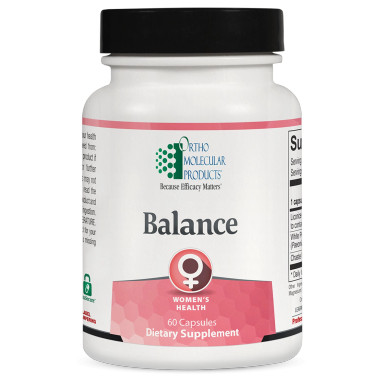
Balance is a practitioner-grade capsule from Ortho Molecular Products built on three botanicals: 20 mg of chaste berry extract (vitex), 200 mg of licorice root extract standardized to 12% glycyrrhizin complex, and 200 mg of white peony root extract (Paeonia lactiflora). Ortho says the formula supports a regular menstrual cycle, promotes healthy progesterone-to-estrogen balance, supports normal prolactin levels and promotes healthy testosterone levels. It is meant for adult women in their childbearing years. The dose is one capsule a day, or as recommended by your health care professional, so a 60-capsule bottle lasts two months. The label is direct about one group: do not consume this product if you are pregnant or nursing. And because this is whole licorice, not the deglycyrrhizinated kind, anyone with high blood pressure should talk to a clinician before starting.
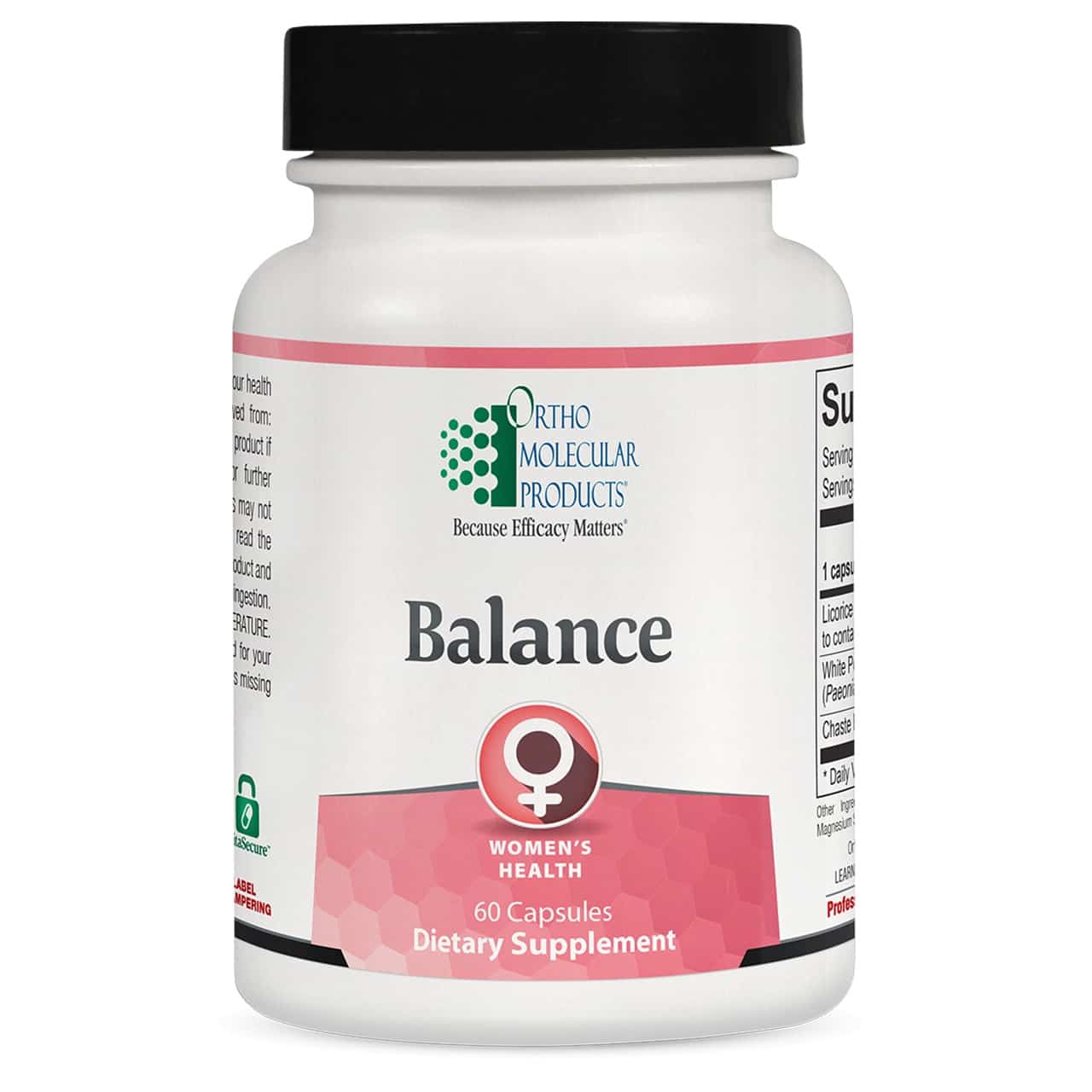
What is Balance Ortho Molecular?
It's a three-herb formula that works on the same hormonal system from three different directions. Chaste berry acts at the pituitary gland, where it influences prolactin signaling. Licorice changes how the body processes cortisol and androgens such as testosterone. White peony is paired with licorice, a combination Ortho says has been used in clinical trials to help maintain normal DHEA-S, prolactin and prostaglandin levels. Ortho's stated reason for the product is that up to three in four women experience hormonal changes during their childbearing years.
What makes it practitioner-grade rather than retail is mostly the dosing logic. Ortho calls the 20 mg of chaste berry a clinical dose, and that number matches the best-performing dose in a published dose-comparison trial (covered below). Many single-herb vitex capsules list several hundred milligrams, and that figure means little unless you know how concentrated the extract is. Balance also names the glycyrrhizin standardization of its licorice, which is the number that matters for safety.
Ortho Molecular sells through licensed health care practitioners, and Covenant Health Products carries Balance for clinic members. For background on the company itself, our Ortho Molecular Products overview explains how it formulates and who it sells to.
Balance - 60 CT
$34.40
Balance by Ortho Molecular Products – Menstrual Cycle Support Balance by Ortho Molecular Products is a capsule-based female hormone balance supplement containing chaste berry, licorice,… Click here to read more
What's in Balance, and how does each ingredient work?
Chaste berry extract (Vitex agnus-castus): 20 mg
Chaste berry contains compounds with dopamine-like activity. Dopamine is the brain's main brake on prolactin: when dopamine binds its receptors in the pituitary, prolactin release slows. That is the link Ortho draws between chaste berry and normal prolactin levels, and prolactin shares pituitary signaling with the hormones that time ovulation. It is the reason vitex has a long history of use for menstrual cycle support.
The dose is where this formula is careful. A 2012 multicenter, placebo-controlled trial randomized 162 women aged 18 to 45 to placebo or to 8, 20 or 30 mg of a vitex extract for three menstrual cycles. The women rated cycle-related symptoms such as irritability, bloating and breast fullness. The 20 mg group improved significantly more than placebo and more than the 8 mg group. The 30 mg group did no better than 20 mg. Every dose was well tolerated.
One caveat most write-ups leave out: that trial tested a specific proprietary extract called Ze 440. Balance's label doesn't say its chaste berry extract is Ze 440, and it doesn't list a standardization. So the trial supports the reasoning behind 20 mg. It doesn't prove this exact capsule will produce the same result.
Licorice root extract: 200 mg, standardized to 12% glycyrrhizin complex
Do the math on the label and each capsule delivers about 24 mg of glycyrrhizin complex. Glycyrrhizin is the compound that makes licorice useful here, and it is also the one that needs respect.
Ortho explains that glycyrrhizin and its metabolites slow the enzyme that converts active cortisol into inactive cortisone. Cortisol stays active longer, which is the basis for Ortho's adrenal support rationale. The same mechanism explains licorice's best-known side effect. In the kidney, that enzyme normally keeps cortisol from acting like aldosterone, the hormone that tells the body to hold sodium and release potassium. Slow it down and cortisol starts sending that signal. Sodium stays, potassium goes, and blood pressure can climb. One mechanism, two outcomes.
On testosterone, Ortho states that licorice blocks two enzymes in the androgen pathway, 17-hydroxysteroid dehydrogenase and 17-20 lyase. The research behind that is a 2004 study of nine healthy women aged 22 to 26, who took 3.5 g a day of a licorice preparation containing 7.6% glycyrrhizic acid for two cycles. Their average total testosterone fell from 27.8 to 17.5 ng/dL by the second month and went back to baseline after they stopped. Renin and aldosterone dropped too, though blood pressure didn't change in that young, healthy group.
Now compare the doses. That study works out to roughly 266 mg of glycyrrhizic acid a day. One capsule of Balance provides about 24 mg, around one-eleventh as much. The study shows the mechanism is real. It doesn't tell you what one capsule a day will do to your lab values, and nobody should promise you that number.
This is also why Balance can't use DGL, the deglycyrrhizinated licorice found in many digestive products. DGL is licorice with the glycyrrhizin removed, which makes it gentler on blood pressure and useless for this purpose.
White peony root extract (Paeonia lactiflora): 200 mg
White peony and licorice are an old pairing. Together they form a classic two-herb formula in Japanese Kampo and traditional Chinese medicine. Ortho says the combination has been used in clinical trials to help maintain normal DHEA-S, prolactin and prostaglandin levels, and to support healthy progesterone secretion and estrogen balance.
Be clear about what that means. Ortho's materials describe peony as half of a team, not on its own, and they don't cite peony-only human data. The best-studied compound in peony root is paeoniflorin, but the label doesn't say how much of it each capsule contains. If you're judging the formula by its evidence, chaste berry carries the most weight, licorice the clearest mechanism, and peony the least independent data.
Who is Balance a good fit for?
- A woman in her 30s or early 40s whose cycle length has started to wander, like Diana's, after her clinician has ruled out pregnancy, a thyroid problem and other medical causes.
- Women whose practitioner wants to combine chaste berry with licorice and peony instead of using vitex on its own.
- Someone who prefers one capsule a day to a multi-capsule routine.
- Patients whose labs show prolactin or testosterone toward the edges of normal and whose practitioner wants botanical support while monitoring them.
- Label readers who want the glycyrrhizin standardization printed, not guessed at.
Who should not take Balance Ortho Molecular without checking first
- Anyone pregnant or nursing. The label states: Do not consume this product if you are pregnant or nursing. Consult your physician for further information. That is a "do not," not an "ask first."
- People with high blood pressure, heart disease, kidney disease or low potassium. The NIH's National Center for Complementary and Integrative Health warns that even small amounts of glycyrrhizin have caused severe effects in people with high blood pressure or heart or kidney conditions, and in people who eat a lot of salt.
- Anyone taking corticosteroids such as prednisone, blood pressure medication, or a diuretic that lowers potassium. NCCIH notes that interactions between licorice and corticosteroids have been reported.
- Women on hormonal birth control, fertility treatment or hormone therapy. Every herb in this formula is working on hormone signaling. Your prescriber should see the label.
- Anyone taking a medication that affects dopamine. Chaste berry's action runs through dopamine receptors, so mention it to the prescriber who manages that drug.
- Women with a history of a hormone-sensitive condition, such as breast, uterine or ovarian cancer. NCCIH says chaste berry may not be safe for them.
- Men and children. Balance is formulated for adult women, and the label gives no children's dose.
If you're not sure whether this fits your situation, Holistic Health Partners offers a free product consultation.
How does Balance Ortho Molecular compare to standalone vitex or EstroDIM?
| Balance (Ortho Molecular) | Vitex Extract (Integrative Therapeutics) | EstroDIM (Ortho Molecular) | |
|---|---|---|---|
| Built around | Chaste berry, licorice and white peony | Chaste tree berry only | Indole-3-carbinol, DIM and vitamin E |
| What the maker says it's for | Cycle regularity, progesterone-to-estrogen balance, prolactin, testosterone | Single-herb chaste tree support | Estrogen balance and detoxification |
| Label dose | 1 capsule daily | 1 capsule twice daily | 1 capsule daily |
| Chaste berry per day | 20 mg extract (standardization not listed) | 450 mg extract, standardized to 0.5% agnusides | None |
| Glycyrrhizin per day | About 24 mg | None | None |
| Approximate cost per day | About $0.57 ($34.40 per 60 at time of writing) | About $0.92 ($27.50 per 60, a 30-day supply, at time of writing) | About $0.51 ($30.40 per 60 at time of writing) |
| Pregnancy and nursing | Do not consume | Consult a professional first | Consult your physician |
| Where it wins | Three herbs, one capsule, trial-matched vitex dose | No licorice, so no blood pressure concern from glycyrrhizin; standardization disclosed | Works on estrogen metabolism, a different job entirely |
Two honest points from that table. First, if you have high blood pressure or take a medication that lowers potassium, a chaste-berry-only product such as Integrative Therapeutics' Vitex Extract removes the licorice question altogether. You lose the licorice and peony, but for some women that is the right trade. Second, EstroDIM isn't a substitute. It supports estrogen metabolism through compounds from cruciferous vegetables and doesn't touch prolactin. Our guide to CDG EstroDIM covers that side of the picture.
Where Balance earns its place is the combination at a low daily cost. At about 57 cents a day it costs less than the standalone vitex at its label dose, and it adds the licorice-and-peony pairing that a single-herb product can't. If you're comparing other women's formulas, our write-up on Designs for Health FemGuard Balance is a useful reference point.
How much Balance Ortho Molecular should I take, and when?
The label dose is one capsule per day, or as recommended by your health care professional. That's it. There's no loading phase and no cycle-day schedule on the label, so a 60-capsule bottle covers about two cycles.
The label doesn't say whether to take it with food. Taking it at the same time every day, with breakfast for example, makes it easier to stay consistent, and food can help if you notice the mild nausea or stomach upset that NCCIH lists among chaste berry's possible side effects.
The more useful question is how long to wait before judging it. Cycles are the unit of measurement here, not weeks. The dose trial above ran for three full cycles, and NCCIH notes that studies of chaste berry fruit extract have lasted up to three months. A fair trial is three cycles of daily use while you write down the first day of each period, the same way Diana does with her red pen. If you own a home blood pressure cuff, take a reading before you start and again after a few weeks. With 24 mg of glycyrrhizin a day the risk for most healthy women is low, but a number on a cuff is better than a guess.
What won't Balance do?
It won't explain why your cycle changed. A cycle that starts wandering in your late 30s or 40s can come from thyroid changes, perimenopause, pregnancy, a large weight change, stress, a medication, or a pituitary issue that needs medical attention. Balance supports a system. It can't tell you which part of that system has changed. Get the labs first.
It isn't birth control and it isn't a fertility treatment. Ortho makes no claim for either, and you shouldn't rely on it for either.
It isn't built for menopause. Ortho aims Balance at women in their childbearing years and at keeping a menstrual cycle regular. If your periods have stopped, you're asking a different question.
It won't reproduce the numbers from the licorice study. That study used roughly eleven times the glycyrrhizin in one capsule. Treat Ortho's testosterone claim as support for healthy levels, not a guaranteed drop on your next blood test.
It probably isn't for you if blood pressure is already a concern. A vitex-only product is the simpler choice. We don't want you to buy more supplements. We want you to buy the right ones.
Balance - 60 CT
$34.40
Balance by Ortho Molecular Products – Menstrual Cycle Support Balance by Ortho Molecular Products is a capsule-based female hormone balance supplement containing chaste berry, licorice,… Click here to read more
Is Balance safe, and what are the side effects?
The manufacturer's caution on the Balance Ortho Molecular label reads: Do not consume this product if you are pregnant or nursing. Consult your physician for further information.
Ortho doesn't publish a side-effect list, so the safety questions come down to the two best-understood herbs. Chaste berry is generally well tolerated in the short term, according to the NCCIH chasteberry fact sheet. The side effects reported in studies (nausea, stomach pain, diarrhea, headache and itching) are generally mild. NCCIH also says it may not be safe for women with hormone-sensitive conditions, and that use during pregnancy or breastfeeding may be unsafe.
Licorice is the ingredient to watch. Glycyrrhizin can make the body hold sodium and lose potassium, and the risk rises with larger amounts, longer use, a salty diet, and existing heart, kidney or blood pressure problems. Stop taking Balance and call your clinician if you notice swelling in your ankles or hands, rising home blood pressure readings, a pounding or irregular heartbeat, or unusual muscle weakness or cramping. Those are the signs of the sodium and potassium shift described above. Licorice interactions with corticosteroids have been reported, and anything else that lowers potassium adds to the effect.
Hormone-related changes are possible with any formula aimed at the menstrual cycle. Ortho's guidance is to pause and get advice if you notice unexpected changes, and to have a health professional review your medications, blood pressure, potassium status and any hormone-related care before you start.
Balance contains no gluten, yeast, or artificial colors or flavors. The other ingredients are natural vegetable capsules, microcrystalline cellulose, magnesium stearate, silicon dioxide and calcium silicate.
As with any supplement, consult your healthcare provider before use, especially if you are pregnant, nursing, or taking medications.
Is Balance Ortho Molecular worth it?
For an adult woman whose cycle has become less predictable, whose clinician has checked for medical causes, and whose blood pressure is normal, Balance Ortho Molecular is a sensible, inexpensive formula to raise with a practitioner. The trial-matched 20 mg vitex dose, the disclosed glycyrrhizin standardization, and the one-capsule routine are its real strengths.
It's the wrong pick if you're pregnant or nursing, if you have high blood pressure or a heart or kidney condition, or if you want a product with independent human data behind every ingredient. Peony is the weakest link on evidence. The honest trade-off: you get three herbs for about 57 cents a day, and the licorice that makes the formula distinctive is also the reason some women should skip it.
For Diana, the photo on her phone is a starting point. The first step is still a blood draw and a conversation with her doctor about why the circles on her calendar stopped lining up.
Not sure if this is the right product for you?
The licensed wellness professionals at Holistic Health Partners, led by Carolyn Mulally BS, RN, HN-BC, offer free product consultations — no appointment required. They can help you find the right supplement for your specific health goals.
Get a Free Consultation
These statements have not been evaluated by the Food and Drug Administration. This product is not intended to diagnose, treat, cure, or prevent any disease.