Liposomal Glutathione Dosage: How Much Should I Take?
Table of Contents
- Which liposomal glutathione do we reach for first?
- What is liposomal glutathione, and why does the form change the dose?
- How much liposomal glutathione should I take?
- How do you take liposomal glutathione?
- How many pumps or softgels equal 500 mg?
- How does Quicksilver compare with the other glutathione supplements we carry?
- Who should skip liposomal glutathione, or check first?
- Bottom line: what liposomal glutathione dosage should you start with?
- FAQs
Quick answer: The typical liposomal glutathione dosage for most adults is 250 to 500 mg a day, the range the softgel labels we carry direct; human studies have used 250 to 1,000 mg daily. Count milligrams, not pumps or softgels, because strength per serving varies from 100 mg to 250 mg between products. Start at the label serving, split larger amounts across the day, and get a professional's input before going above the label.
Clinical review pending — Holistic Health Partners
| Typical daily amount | 250 to 500 mg (label directions); studies used 250 to 1,000 mg |
|---|---|
| Forms we carry | Liposomal liquid (100 mg per 2 pumps), liposomal softgel (250 mg each), sustained-release capsule (175 mg each) |
| When to take it | Liquid: hold in the mouth 30 seconds. Softgels: with meals, in divided doses |
| Check first if you | Are pregnant or nursing, take prescription medication, are under medical care, or avoid soy |
| Price and details | Quicksilver Scientific Liposomal Glutathione and the alternatives in the comparison table below |
Ray Delgado, 54, schedules freight for a trucking company and keeps everything in spreadsheets. When his practitioner suggested about 500 mg of glutathione a day, he made a column titled "How much liposomal glutathione should I take?" and stalled: one bottle said 100 mg per two pumps, another said 250 mg per softgel. His pharmacist looked at both labels and said, "The number on the front isn't your dose. The serving size is." That one sentence is most of this guide.
Here is how to turn a liposomal glutathione dosage in milligrams into pumps or softgels, and when to ask before you go higher.
Which liposomal glutathione do we reach for first?
For most people starting out, we point to Quicksilver Scientific® Liposomal Glutathione. Each 1 mL serving (2 pumps) gives 100 mg of Opitac™ reduced glutathione and 75 mg of phosphatidylcholine from sunflower lecithin, in a 50 mL bottle with 50 servings. The small serving size is the reason we like it for dosing: you can adjust your liposomal glutathione dosage in 100 mg steps instead of 250 mg jumps. It comes in cacao mint or lemon mint, and the label lists it as gluten-, soy- and dairy-free, sugar-free and vegan.
Liposomal Glutathione 1.7 oz (f)
$45.00
Glutathione + Liquid Glutathione – High-Absorption Antioxidant and Detox Support Glutathione + by Quicksilver Scientific is a premium liposomal glutathione supplement designed to support cellular… Click here to read more

What is liposomal glutathione, and why does the form change the dose?
Glutathione is a three-amino-acid molecule (glutamate, cysteine and glycine) that your cells make on their own. It is one of the main antioxidants inside cells, it helps recycle other antioxidants such as vitamins C and E, and it takes part in the liver's normal processing of compounds for elimination.
A liposomal product wraps glutathione in tiny spheres of phospholipids, the same kind of fat that makes up cell membranes. The idea is to protect it from digestion so more of it reaches the bloodstream. In Quicksilver's liquid, phosphatidylcholine from sunflower lecithin forms the liposomes. In the softgels we carry, a soy-derived phospholipid complex does the same job.
What each ingredient contributes:
- Reduced glutathione (100 to 250 mg per serving): the active, "reduced" form your cells use. Brand names you will see on labels include Opitac™ and Setria®; both are reduced glutathione made by fermentation.
- Phospholipids (75 to 125 mg per serving): phosphatidylcholine or a phospholipid complex that forms the liposome. They carry the glutathione; they are not the reason you take the product.
- Everything else: water, glycerin and flavor in liquids; gelatin, olive oil and beeswax in softgels. Read this line if you avoid gelatin, soy or alcohol (the Quicksilver liquid lists ethanol).
That is why a liposomal glutathione dosage can look small next to a 500 mg plain capsule. You are paying for the delivery system as well as the milligrams.
How much liposomal glutathione should I take?
For general antioxidant support, the usual liposomal glutathione dosage is 250 to 500 mg a day. That is what the softgel labels we carry direct (1 to 2 softgels of 250 mg), and it is above what the Quicksilver label directs (100 to 200 mg). Research has used more, but the studies are small, so treat higher amounts as something to discuss with a professional rather than a default.
What the human studies actually tested:
- Liposomal glutathione, 500 or 1,000 mg a day for one month. In a Penn State pilot study of 12 healthy adults, glutathione levels in blood rose within one week and peaked around two weeks. The researchers saw no clear difference between the two doses, though they noted the group was too small to tell (Sinha et al., 2017).
- Standard oral glutathione, 250 or 1,000 mg a day for six months. In a randomized, placebo-controlled trial of 54 non-smoking adults, body stores of glutathione rose at both doses, with larger and steadier increases at 1,000 mg. Levels returned to baseline after a one-month break (Richie et al., 2015).
- Standard oral glutathione, 500 mg twice a day for four weeks. A randomized trial of 40 healthy adults found no significant change in red blood cell glutathione or oxidative stress markers (Allen and Bradley, 2011).
Read together, these studies say two things. Daily glutathione can raise body stores, and consistency over weeks matters more than a big single dose. The studies also do not tell you that 1,000 mg beats 500 mg for you, and they measured blood levels, not how anyone felt. Your own liposomal glutathione dosage depends on why you are taking it, what else you take (NAC or alpha-lipoic acid, for example), and your medications.
How do you take liposomal glutathione?
Follow the label on your bottle; directions differ by form. Here is what each label we carry says, in one place.
| Product | Label serving | How often | With food? | Label daily range |
|---|---|---|---|---|
| Quicksilver Liposomal Glutathione (liquid) | 2 pumps (1 mL) = 100 mg | Once or twice daily; hold in mouth 30 seconds, then swallow | Not specified; may be taken straight or in water or juice | 100 to 200 mg |
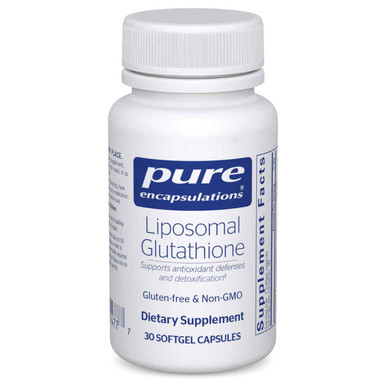
| Pure Encapsulations® Liposomal Glutathione (softgel) | 1 softgel = 250 mg | 1 to 2 daily, in divided doses | With meals | 250 to 500 mg |
| Douglas Laboratories® Liposomal Glutathione (softgel) | 1 softgel = 250 mg | 1 to 2 times daily | With meals | 250 to 500 mg |
| Thorne® Glutathione-SR (sustained-release capsule, not liposomal) | 1 capsule = 175 mg | 2 to 3 times daily | Not specified on label | 350 to 525 mg |
A few practical habits help:
- Split anything above one serving. Morning and early afternoon is an easy rhythm, and the softgel labels call for divided doses.
- Use the liquid within 30 days of opening. That is Quicksilver's label direction, so a bottle used at 2 pumps twice a day (25 days) fits comfortably.
- Give it a few weeks before judging. In the studies above, blood levels moved over one to several weeks, and they fell back after people stopped. A steady daily habit matters more than the exact hour.
How many pumps or softgels equal 500 mg?
Once you know your liposomal glutathione dosage in milligrams, divide it by the milligrams per serving on the label. For 500 mg a day:
- Quicksilver liquid: 10 pumps (5 mL), which is above the label's 2 to 4 pumps a day. Go there only on a practitioner's advice, and know that a 50 mL bottle then lasts about 10 days.
- Pure Encapsulations or Douglas Laboratories softgels: 2 softgels, the top of their label range.
- Thorne Glutathione-SR: 3 capsules gives 525 mg, the top of its label range.
For 250 mg, it is 5 pumps of the liquid, 1 softgel, or roughly 1 to 2 Thorne capsules. If your target sits at 100 to 200 mg, the Quicksilver liquid is the only option here that gets you there without cutting a softgel.
How does Quicksilver compare with the other glutathione supplements we carry?
The product you pick changes how your liposomal glutathione dosage translates into pumps, softgels or capsules, because strength per serving differs. All four are good products; they suit different people. Prices are our listed prices when this guide was updated and can change, so check each product page.
| Product | Form | Glutathione per serving | Servings | Approx. price (per 100 mg) | Best for |
|---|---|---|---|---|---|
| Quicksilver Liposomal Glutathione | Liposomal liquid, sunflower lecithin | 100 mg (Opitac™) | 50 | $45 (about $0.90) | Fine-tuning in small steps; soy-free and vegan; people who dislike swallowing pills |
| Pure Encapsulations Liposomal Glutathione | Liposomal softgel | 250 mg (Setria®) | 30 or 60 | $67.50 / $117 (about $0.78 to $0.90) | A no-measuring softgel with meals |
| Douglas Laboratories Liposomal Glutathione | Liposomal softgel | 250 mg (Setria®) | 45 | $87.50 (about $0.78) | Softgel users who want a 45-count bottle |
| Thorne Glutathione-SR | Sustained-release capsule (not liposomal) | 175 mg | 60 | $54 (about $0.51) | The lowest cost per milligram; athletes who want NSF Certified for Sport® |
How to choose: if you want control over the dose or need a soy-free option, the Quicksilver liquid fits. If you would rather swallow a softgel and not measure anything, Pure Encapsulations and Douglas Laboratories carry the same 250 mg Setria® amount per softgel. Both contain soy and gelatin. If cost matters most and a liposome is not a must for you, Thorne's sustained-release capsule gives the most glutathione per dollar.
Liposomal Glutathione(F)
$67.50
Liposomal Glutathione by Pure Encapsulations – Advanced Antioxidant and Detoxification Support Liposomal Glutathione by Pure Encapsulations is a premium antioxidant supplement designed to support liver… Click here to read more
Who should skip liposomal glutathione, or check first?
Oral glutathione is generally well tolerated at label amounts. The complaints people report are mild and digestive: bloating, gas or loose stools. Taking softgels with food, or lowering the amount, usually settles them.
Talk with your practitioner before starting if you:
- Are pregnant or nursing. Every label we carry asks you to check first.
- Are in cancer treatment, including chemotherapy or radiation. Antioxidant supplements can interact with some treatments, so your oncology team should decide.
- Take prescription medications or are under medical supervision for any condition.
- Avoid soy or gelatin. The softgels contain soy and gelatin (Douglas lists bovine gelatin). The Quicksilver liquid uses sunflower lecithin instead.
- Avoid alcohol completely. The Quicksilver liquid lists ethanol among its other ingredients.
- Already take NAC or a glutathione-support formula. NAC supplies cysteine, a building block your body uses to make glutathione, so stacking products can double up on the same goal.
If any of these apply, ask your practitioner to set your liposomal glutathione dosage before you start, rather than going by the label alone. More is not automatically better. If something feels off, drop back to one serving and ask.
Bottom line: what liposomal glutathione dosage should you start with?
Start at one label serving, which is 100 mg of the Quicksilver liquid or 250 mg in a softgel. Stay consistent for a few weeks, and treat 500 mg a day as the usual ceiling unless a professional suggests otherwise. Research ranges run up to 1,000 mg, but the studies are small, and the right amount depends on your goals, your other supplements and your medications. That last part is where a short conversation pays off.
FAQs
Can I take liposomal glutathione every day?
Yes. Daily use is how both the product labels and the human studies are set up, and in a six-month trial glutathione stores rose with daily intake and fell back to baseline about a month after people stopped. Stay within the label range unless a practitioner suggests otherwise.
Should I take liposomal glutathione on an empty stomach or with food?
Follow your product's label. The Pure Encapsulations and Douglas Laboratories softgel labels say to take them with meals, in divided doses. The Quicksilver liquid label doesn't specify food; it says to hold 2 pumps in your mouth for 30 seconds before swallowing, straight or mixed with water or juice.
Is 1,000 mg of glutathione a day too much?
Studies have used up to 1,000 mg a day in healthy adults, but they were small, and one pilot study saw no clear difference between 500 and 1,000 mg of liposomal glutathione. The labels we carry top out at 200 to 525 mg a day, so go above that only with guidance from a professional who knows your medications.
Can I take liposomal glutathione with NAC?
Many people do, but check with a practitioner first. NAC supplies cysteine, a building block your body uses to make its own glutathione, so taking both aims at the same goal and you may need less of one. A free product consultation can help you sort out the combination.
How long does a bottle of Quicksilver Liposomal Glutathione last?
The 50 mL bottle holds 50 servings of 2 pumps (100 mg). At the label's maximum of 2 pumps twice a day it lasts 25 days, which fits Quicksilver's direction to use the bottle within 30 days of opening. At 1 serving a day, you'd reach that 30-day limit with some left over.
Is liposomal glutathione soy-free?
It depends on the product. The Quicksilver Scientific liquid uses phosphatidylcholine from sunflower lecithin, and its label lists it as soy-free and vegan. The Pure Encapsulations and Douglas Laboratories softgels both contain soy and gelatin. Thorne Glutathione-SR is not liposomal and uses a plant-based capsule; check its label for your specific allergens.
Keep reading
- Glutathione by Quicksilver Scientific: Advanced Detox Support
- Glutathione Cell Defense by Integrative Therapeutics: Dosage
Not sure if this is the right product for you?
The licensed wellness professionals at Holistic Health Partners, led by Carolyn Mulally BS, RN, HN-BC, offer free product consultations — no appointment required. They can help you find the right supplement for your specific health goals.
Get a Free Consultation
These statements have not been evaluated by the Food and Drug Administration. This product is not intended to diagnose, treat, cure, or prevent any disease.